All species › Parrots › African and New World parrots › Saffron-headed Parrot
Saffron-headed Parrot | Pyrilia pyrilia
Saffraankoppapegaai | Loro cabeciamarillo | Papagaio-de-cabeça-açafrão
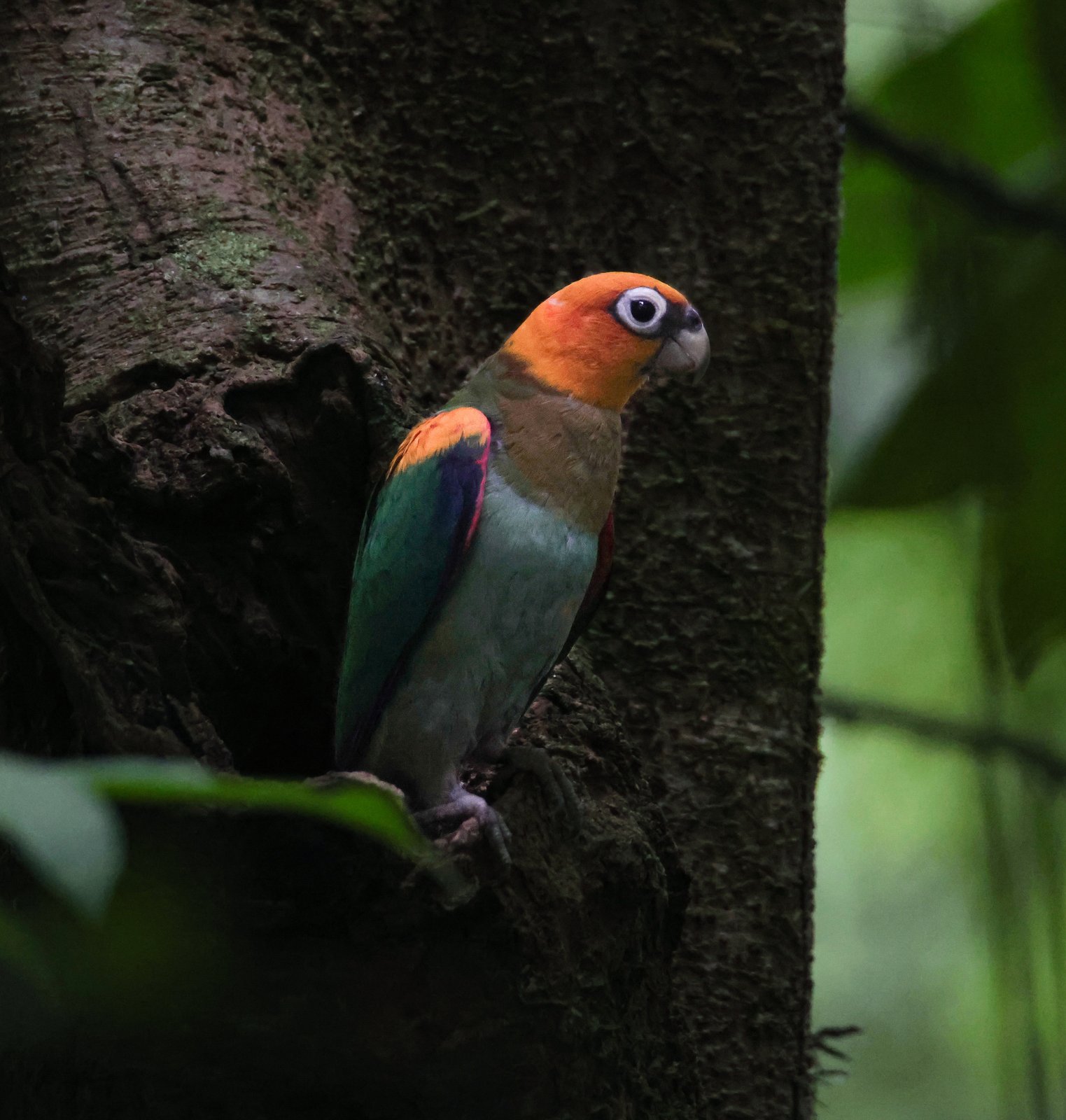
The Saffron-headed Parrot is a stocky parrot with an entirely yellow head. It lives in humid forest in northern Colombia, western Venezuela and eastern Panama, in pairs or small groups high in the canopy. Because of deforestation in northern Colombia it has declined sharply in places.
Voice
A high, nasal call, often repeated in flight, and soft chatter while feeding.
Recording: Ross Gallardy — CC BY-NC-SA 4.0 · xeno-canto
Identification
24 cm, stocky, with a short tail and a pale bill. The whole head and throat are saffron yellow, with a bare, whitish eye-ring. The body is green, olive on the breast. The shoulder and leading edge of the wing are yellow, the underwing coverts red and the flight feathers bluish. The sexes are alike; juveniles have a greenish head with little yellow.
Confusion species
Yellow-crowned Amazon Amazona ochrocephala is larger, with only the forehead and crown yellow and red in the wing. Brown-hooded Parrot Pyrilia haematotis has a dark brown head with a red ear spot. Rose-faced Parrot Pyrilia pulchra has a pink face and lives on the Pacific side.
Habitat
Humid lowland, foothill and lower montane forest, forest edges and older secondary forest, from sea level to about 1700 m. It eats fruit, seeds and flowers in the canopy. The nest is in a tree cavity.
Where the bird is most at home, classified by the vegetation units of the Andes and the west coast.


Range and movements
In Colombia in the north, from the Gulf of Urabá and northern Chocó through the Caribbean lowlands and the Magdalena valley to the foot of the Eastern Andes and the Serranía de Perijá. Absent from Ecuador, Peru, Bolivia and the Galápagos. Outside the guide area in eastern Panama and western Venezuela.
- Resident
- dark = core range, pale = thinly spread
How and when to look
Look in forest remnants in the Magdalena valley and the foothills of northern Colombia, from clearings, for pairs flying over the canopy. In fruiting trees they often sit still and give themselves away by their calls.
Conservation status
Near Threatened. Much of the forest within its range has been cleared for farming and ranching, and the species is trapped locally for the cage-bird trade.
Scientific name
Pyrilia pyrilia | (Bonaparte, 1853) (GBIF: Pionopsitta pyrilia)
Bonaparte described the species in 1853 as Psittacula pyrilia; because it was later moved to another genus, the author and year stand in brackets. The genus Pyrilia was introduced in 1856 by Bonaparte. The genus name combines Greek pur, 'fire', with Latin ilia, 'flanks'. A tautonym: the species name equals the genus name, Greek pur, 'fire', and Latin ilia, 'flanks'. The specimen the first description was based on came from Sierra Nevada de Santa Marta, Colombia.