All species › Parrots › African and New World parrots › Orange-cheeked Parrot
Orange-cheeked Parrot | Pyrilia barrabandi
Barrabands papegaai | Loro cachetinaranja | Curica-de-bochecha-laranja
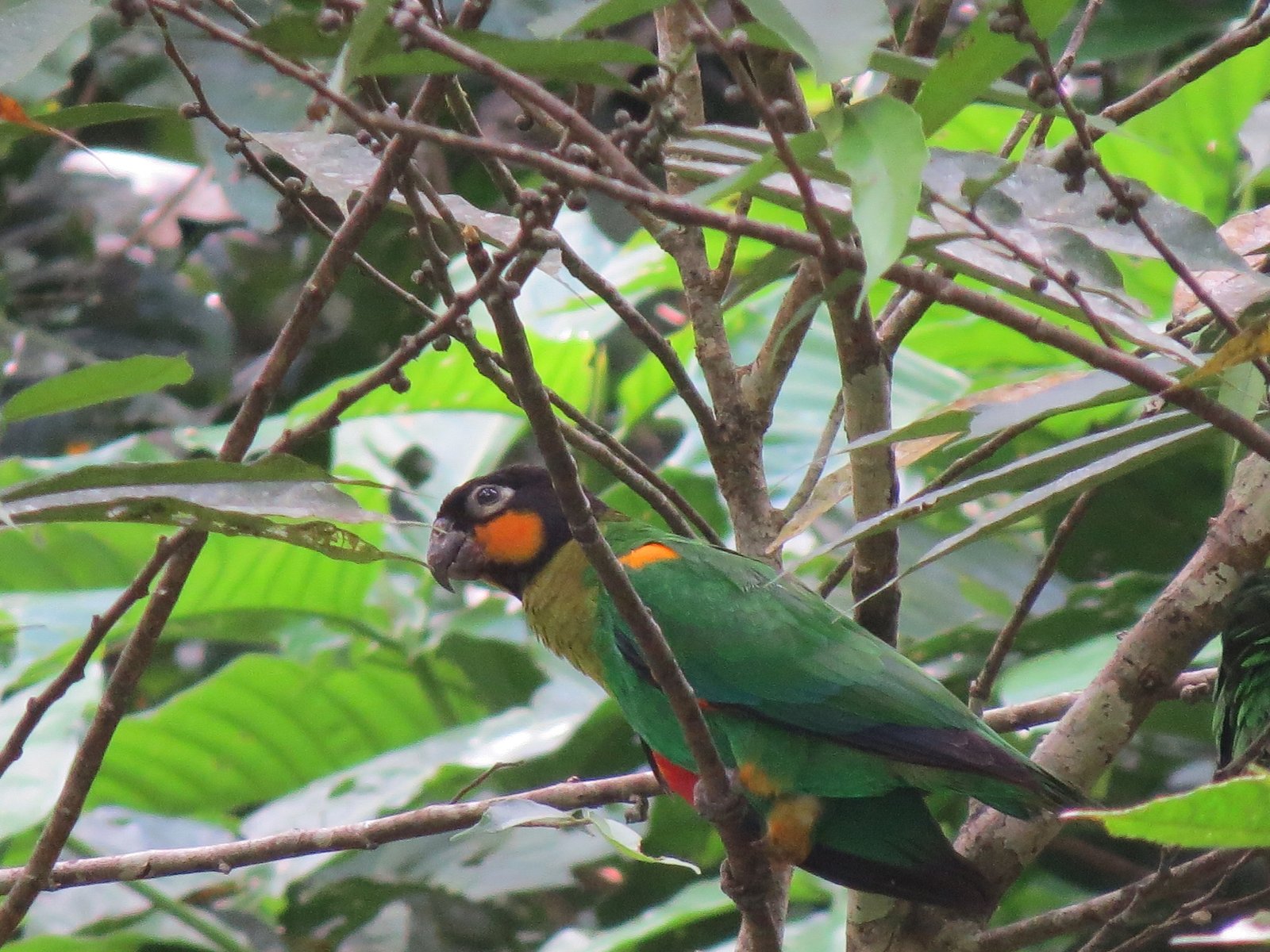
The Orange-cheeked Parrot is a medium-sized, stocky, short-tailed parrot of the genus Pyrilia, found in the Amazonian lowlands east of the Andes. The black head with an orange cheek patch and the orange and red markings on the shoulder and underwing make it recognisable. Pairs and small groups live high in the canopy and in south-eastern Peru regularly visit clay licks along the rivers.
Voice
A hoarse, disyllabic call such as chuweet, mainly in flight, and softer chattering from perched birds. Groups often call in the early morning as they fly over the forest.
Recording: Guilherme Melo — CC BY-NC-SA 4.0 · xeno-canto
Identification
25 cm, stocky, with a short, square tail and a pale, horn-coloured bill. The head is black, with a large orange patch on the cheek; in birds from the north of the guide area this patch is more yellowish orange. The body is green, with an olive-golden wash across the breast. The shoulder and leading edge of the wing are orange to red, the underwing coverts red, and the flight feathers partly blue. The sexes are alike. Juveniles have a duller, brownish green head and a smaller cheek patch.
Confusion species
Black-headed Parrot Pionites melanocephalus also has a black crown, but has a white breast and belly and an orange-yellow throat and nape, and lives in the same forests. Blue-headed Parrot Pionus menstruus is slightly larger, with a blue head, a black ear patch and red undertail coverts. Short-tailed Parrot Graydidascalus brachyurus is all green, without a black head. The related Brown-hooded Parrot Pyrilia haematotis and Rose-faced Parrot Pyrilia pulchra live only west of the Andes.
Habitat
Humid terra firme rainforest, flooded forest (várzea) and their edges, also foothill forest, from the lowlands to roughly 500 m, locally higher. It eats fruit, seeds and flowers in the canopy and visits clay licks along rivers. It nests in a tree cavity.
Where the bird is most at home, classified by the vegetation units of the Andes and the west coast.


Range and movements
In Colombia in the Amazonian lowlands of the south-east. In Ecuador and Peru in the Amazonian lowlands east of the Andes. In Bolivia in the lowlands of the north. Absent from the Galápagos. Outside the guide area in southern Venezuela and western Amazonian Brazil.
- Resident
- dark = core range, pale = thinly spread
How and when to look
Clay licks along the rivers of south-eastern Peru, as in Madre de Dios, attract groups in the morning. Elsewhere pairs and small groups are seen mainly from canopy towers or as they fly fast and straight over the forest.
Conservation status
Least Concern. The species has a large range in largely intact lowland forest; locally forest is lost to clearance and birds are trapped for the trade.
Scientific name
Pyrilia barrabandi | (Kuhl, 1820) (GBIF: Pionopsitta barrabandi)
Kuhl described the species in 1820 as Psittacus Barrabandi; because it was later moved to another genus, the author and year stand in brackets. The genus Pyrilia was introduced in 1856 by Bonaparte. The genus name combines Greek pur, 'fire', with Latin ilia, 'flanks'. Named after Jacques Barraband (1767–1809), French designer and painter of birds. The name goes back to Levaillant's Caïca Barraband (1805). The specimen the first description was based on came from Brazil.