All species › Swifts › Hummingbirds › Blue-tailed Emerald
Blue-tailed Emerald | Chlorostilbon mellisugus
Blauwstaartsmaragdkolibrie | Esmeralda coliazul | Esmeralda-de-cauda-azul
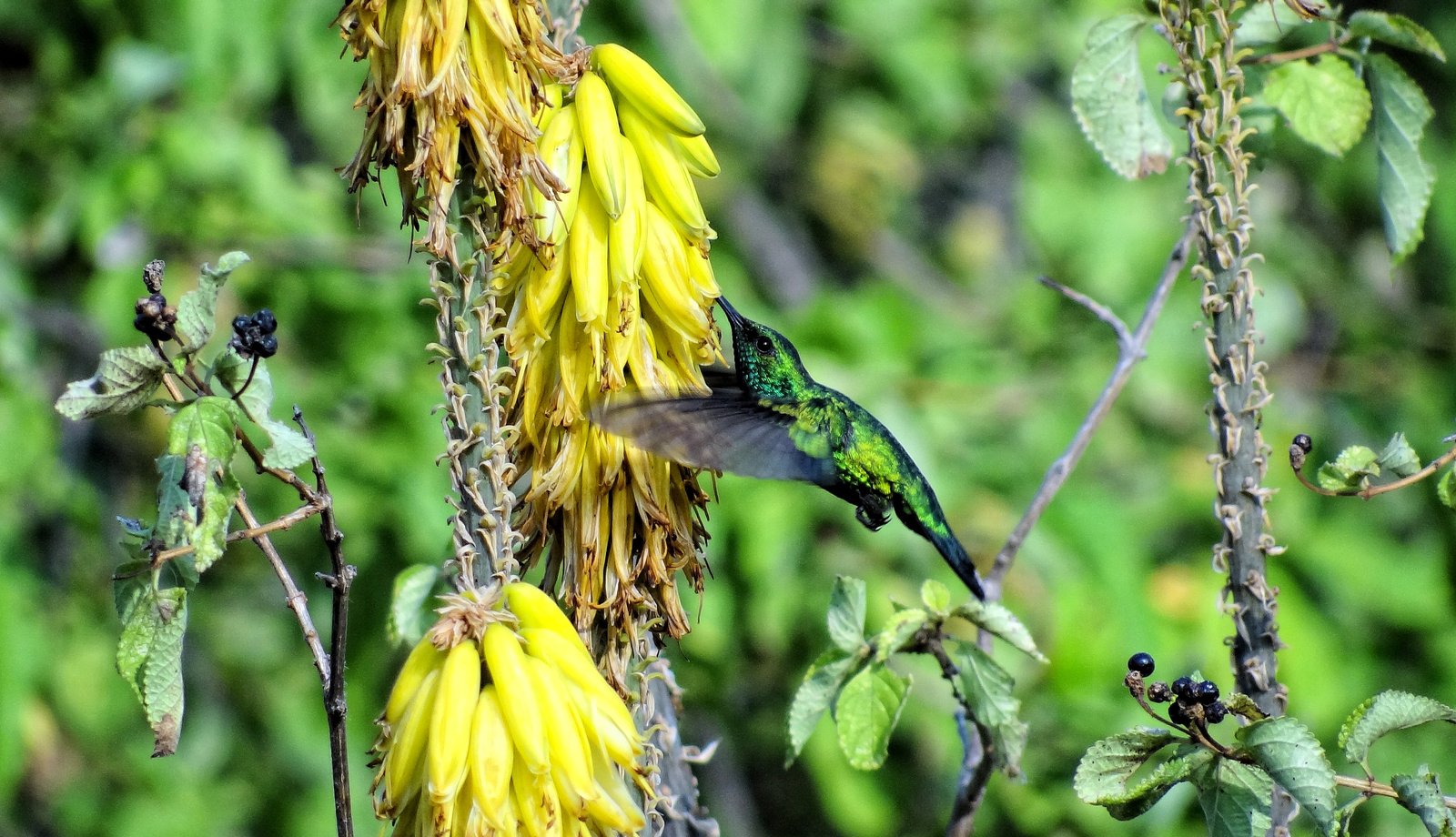
The Blue-tailed Emerald is a very small, all-green hummingbird of open and semi-open, shrubby country east of the Andes. The male is glittering green with a blue-black tail, the female grey below with a white stripe behind the eye. The species has a large range in northern South America and is treated by some authors as one species together with Western Emerald.
Voice
A dry, short tsik or tchip, often repeated in series; the male also gives a soft, high twittering.
Recording: Wim Jacobs — CC BY-NC-SA 4.0 · xeno-canto
Identification
7–8 cm, with a short, straight, black bill and a blue-black, slightly forked tail. The male is entirely glittering green; depending on the light the throat and breast look bluer or more golden green. The female is bronzy green above and pale grey below, with a white stripe behind the eye and a dark ear patch; the outer tail feathers have grey to white tips. Young birds resemble the female.
Confusion species
Western Emerald Chlorostilbon melanorhynchus is almost identical and is separated mainly by range: it lives west of the Andes and in the inter-Andean valleys. Glittering-bellied Emerald Chlorostilbon lucidus in Bolivia is slightly larger and has a red bill with a black tip. Glittering-throated Emerald Chionomesa fimbriata is larger, with a longer bill with a red lower mandible, a white central stripe down the belly and a bronzy green tail. The female Fork-tailed Woodnymph Thalurania furcata is larger, with darker grey underparts, and lives inside the forest.
Habitat
Open and semi-open country with shrubs, forest edges, savanna, riverbanks, gardens and plantations, from the lowlands to about 1500 m, locally higher in dry valleys. It takes nectar from small flowers at low to middle heights and catches small insects in flight and from leaves. The small cup nest, of plant fibres and spider silk with lichens on the outside, is placed low in a shrub; the female alone incubates two white eggs.
Where the bird is most at home, classified by the vegetation units of the Andes and the west coast.


Range and movements
In Colombia east of the Andes, in the llanos and locally in Amazonia, and locally also in the north. In Ecuador locally in the eastern lowlands. In Peru on the eastern slope and in the eastern lowlands, also in dry valleys such as those of the Marañón and the Huallaga. In Bolivia scarcer, in the lowlands of the north and east. Absent from the Galápagos. Outside the guide area in Venezuela, the Guianas, northern Brazil, Trinidad and the ABC islands.
- Resident
- dark = core range, pale = thinly spread
How and when to look
Look at flowering shrubs and hedges along open country, riverbanks and village edges. The male often perches low on a bare twig near its flowers.
Conservation status
Not Evaluated under the current species limits. The species lives in open and man-made habitats and is common over much of its range; no significant threats are known.
Scientific name
Chlorostilbon mellisugus | (Linnaeus, 1758)
Linnaeus described the species in 1758 as Trochilus mellisugus; because it was later moved to another genus, the author and year stand in brackets. The genus Chlorostilbon was introduced in 1853 by Gould. The genus name combines Greek khlōros, 'green', with stilbōn, 'glittering'. The species name combines Latin mel, 'honey', with sugere, 'to suck', so 'honey-sucker'. The specimen the first description was based on came from West Indies (according to the description).