All species › Swifts › Hummingbirds › Rufous-shafted Woodstar
Rufous-shafted Woodstar | Chaetocercus jourdanii
Jourdans boself | Estrellita de Jourdan | Estrelinha-de-haste-ruiva
The Rufous-shafted Woodstar is a small hummingbird of northern South America that occurs in the guide area only in north-eastern Colombia. The name refers to the rufous shafts of the male's tail feathers. Like other woodstars it hovers at small flowers with a buzzing, bee-like flight.
Voice
Usually silent. Short, dry tsip notes; the wings make a soft buzzing sound.
No recording with a suitable Creative Commons licence is available for this species yet.
Identification
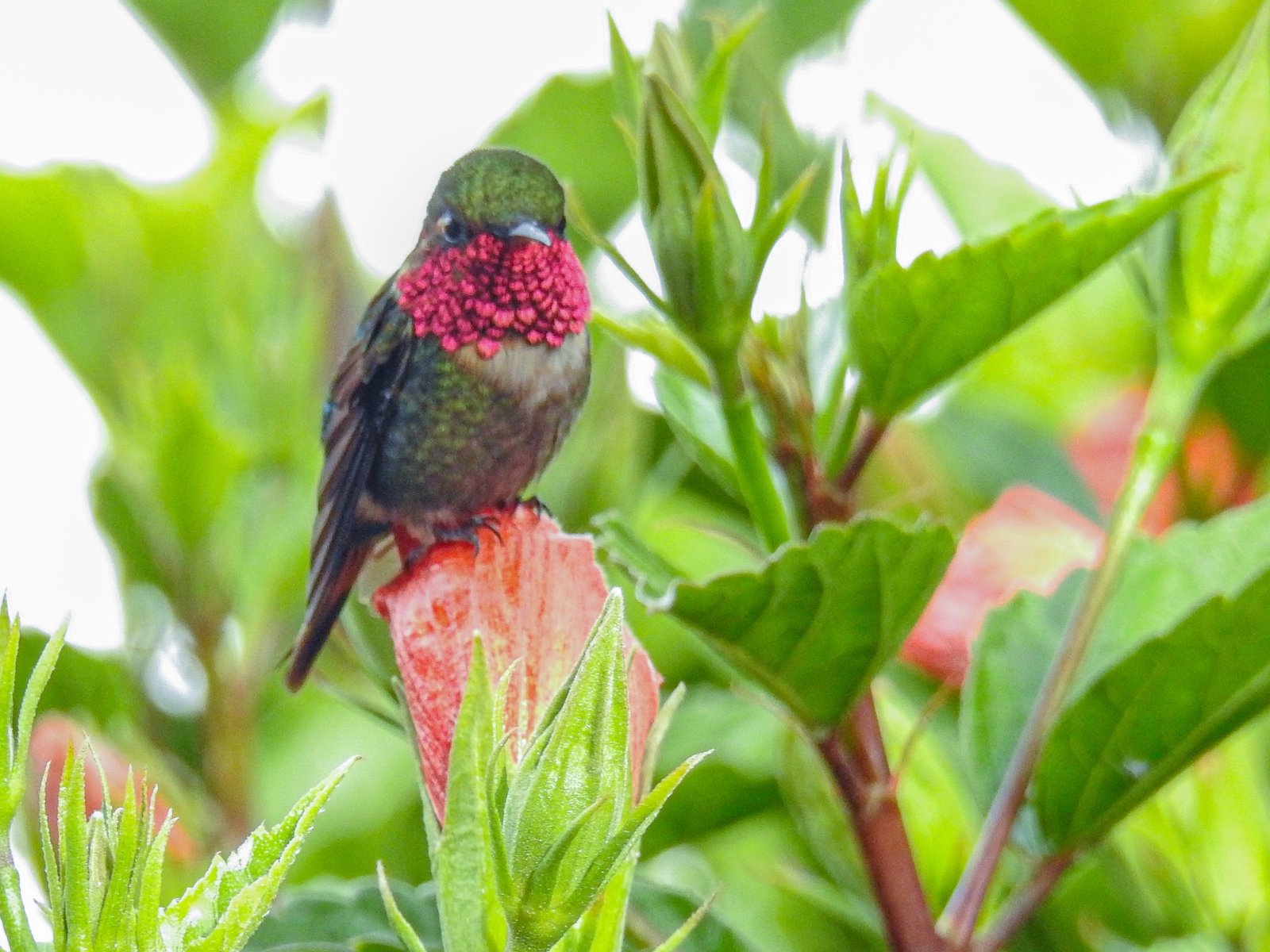
7 cm, with a short, straight black bill. The male is green above, with a glittering rose-purple throat, a white spot behind the eye and a white band across the breast. The rest of the underparts are green, with a white patch on the side of the rump. The short, forked tail is dark, with rufous shafts and inner webs. The female is green above and cinnamon to buff below, with a dark ear patch and a rufous tail with a black band.
Confusion species
Gorgeted Woodstar Chaetocercus heliodor is smaller, the male without a white breast band and with elongated side points to the throat. The male White-bellied Woodstar Chaetocercus mulsant has a white belly and a tail without rufous. Santa Marta Woodstar Chaetocercus astreans occurs only in the Santa Marta mountains. The female closely resembles those of the other woodstars.
Habitat
Edges of humid montane forest, clearings, shrubby slopes, coffee plantations and gardens, roughly between 1000 and 3000 m, lower outside the guide area. It takes nectar at small flowers in shrubs and trees and catches small insects. The nest is a small cup of plant down on a branch.
Where the bird is most at home, classified by the vegetation units of the Andes and the west coast.


Range and movements
In Colombia only in the north-east: in the Serranía del Perijá and in the Eastern Andes in Norte de Santander, Santander, Boyacá and Cundinamarca. Absent from Ecuador, Peru, Bolivia and the Galápagos. Outside the guide area in the mountains of northern Venezuela and on Trinidad.
- Resident
- dark = core range, pale = thinly spread
How and when to look
At flowering shrubs and trees along forest edges and in gardens in the Serranía del Perijá and on the slopes of the Eastern Andes in Norte de Santander and Santander. Watch the male when it spreads its tail: the rufous shafts then become visible.
Conservation status
Least Concern. The species tolerates forest edges, plantations and gardens.
Scientific name
Chaetocercus jourdanii | (Bourcier, 1839)
Bourcier described the species in 1839 as Ornismya Jourdanii; because it was later moved to another genus, the author and year stand in brackets. The genus Chaetocercus was introduced in 1855 by Gray. The genus name combines Greek khaitē, 'hair', with kerkos, 'tail'. The species name honours Claude Jourdan (1803–1873), a French zoologist and palaeontologist and director of the natural history museum in Lyon. The specimen the first description was based on came from Trinidad.