All species › Swifts › Hummingbirds › Blue-throated Starfrontlet
Blue-throated Starfrontlet | Coeligena helianthea
Blauwe incakolibrie | Inca ventrivioleta | Inca-de-garganta-azul
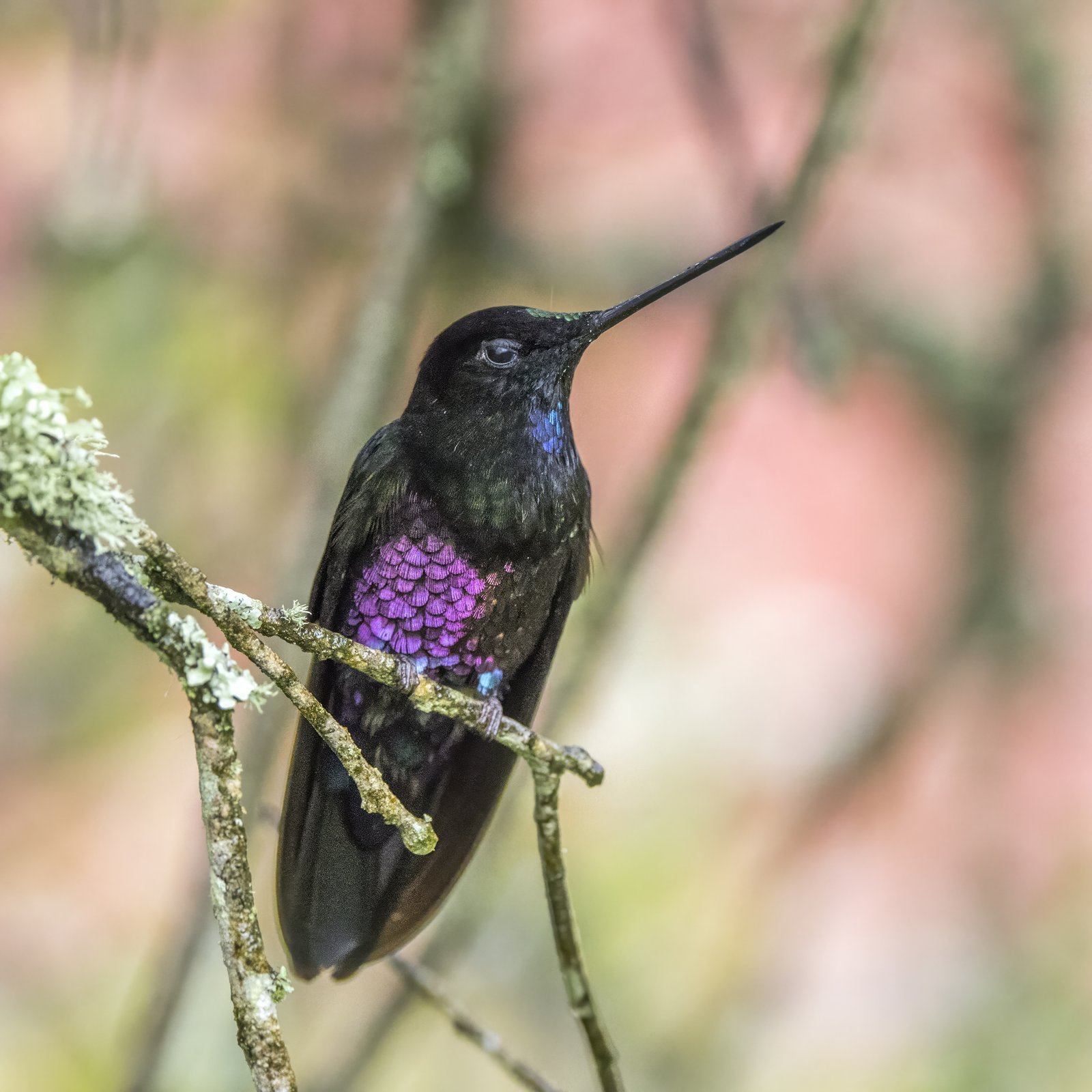
The Blue-throated Starfrontlet is a dark starfrontlet with a long, straight bill of high cloud forest and the páramo edge in the Eastern Andes of Colombia and adjacent western Venezuela. The male has a violet belly and a glittering blue-green rump. The species also occurs in gardens and parks on the high plateau around Bogotá.
Voice
A sharp, dry chik, often repeated while feeding, and a rapid twitter in chases.
No recording with a suitable Creative Commons licence is available for this species yet.
Identification
13–14 cm, with a long, straight black bill of just over 3 cm. The male is very dark green, almost black at a distance, with a glittering green forehead, a small blue-violet throat patch, a glossy rosy-violet belly and a glittering blue-green rump. The tail is bronzy green and slightly forked. The female has a cinnamon throat and is spotted green on a buff ground below, with a violet wash on the belly and also a blue-green rump. Both sexes have a small white spot behind the eye.
Confusion species
Golden-bellied Starfrontlet Coeligena bonapartei occurs in the same area but has a golden-yellow to orange belly and a golden-green rump. Collared Inca Coeligena torquata has a white breast band and white sides to the tail. Bronzy Inca Coeligena coeligena is plain bronzy brown and lives lower. Mountain Velvetbreast Lafresnaya lafresnayi has a shorter, decurved bill and a tail with much white.
Habitat
High cloud forest, elfin forest, forest edges and scrub in the transition to páramo, roughly between 2500 and 3300 m, locally lower. It also enters gardens, parks and hedges with flowering shrubs. It visits long-tubed flowers and catches small insects. The nest is a cup of moss and plant down on a branch or among roots on a steep bank.
Where the bird is most at home, classified by the vegetation units of the Andes and the west coast.


Range and movements
In Colombia in the Eastern Andes, from Norte de Santander and Santander south to Cundinamarca. Absent from Ecuador, Peru, Bolivia and the Galápagos. Outside the guide area only in adjacent western Venezuela.
- Resident
- dark = core range, pale = thinly spread
How and when to look
In parks, gardens and thickets with flowering shrubs around Bogotá and in the cloud forest of the Eastern Andes, for example at feeders. The male shows the violet belly mainly in side light.
Conservation status
Least Concern. Its high-elevation forest is heavily fragmented, but the species tolerates scrub, thickets and gardens.
Scientific name
Coeligena helianthea | (Lesson, 1839)
Lesson described the species in 1839 as Ornismya helianthea; because it was later moved to another genus, the author and year stand in brackets. The genus Coeligena was introduced in 1833 by Lesson. The genus name comes from Latin coeligenus, 'heaven-born' or 'celestial'. The species name comes from Greek hēlios, 'sun', and antheion, 'blossom, flower'. The specimen the first description was based on came from Bogotá, Colombia.