All species › Swifts › Hummingbirds › Sword-billed Hummingbird
Sword-billed Hummingbird | Ensifera ensifera
Zwaardkolibrie | Colibrí picoespada | Beija-flor-bico-de-espada
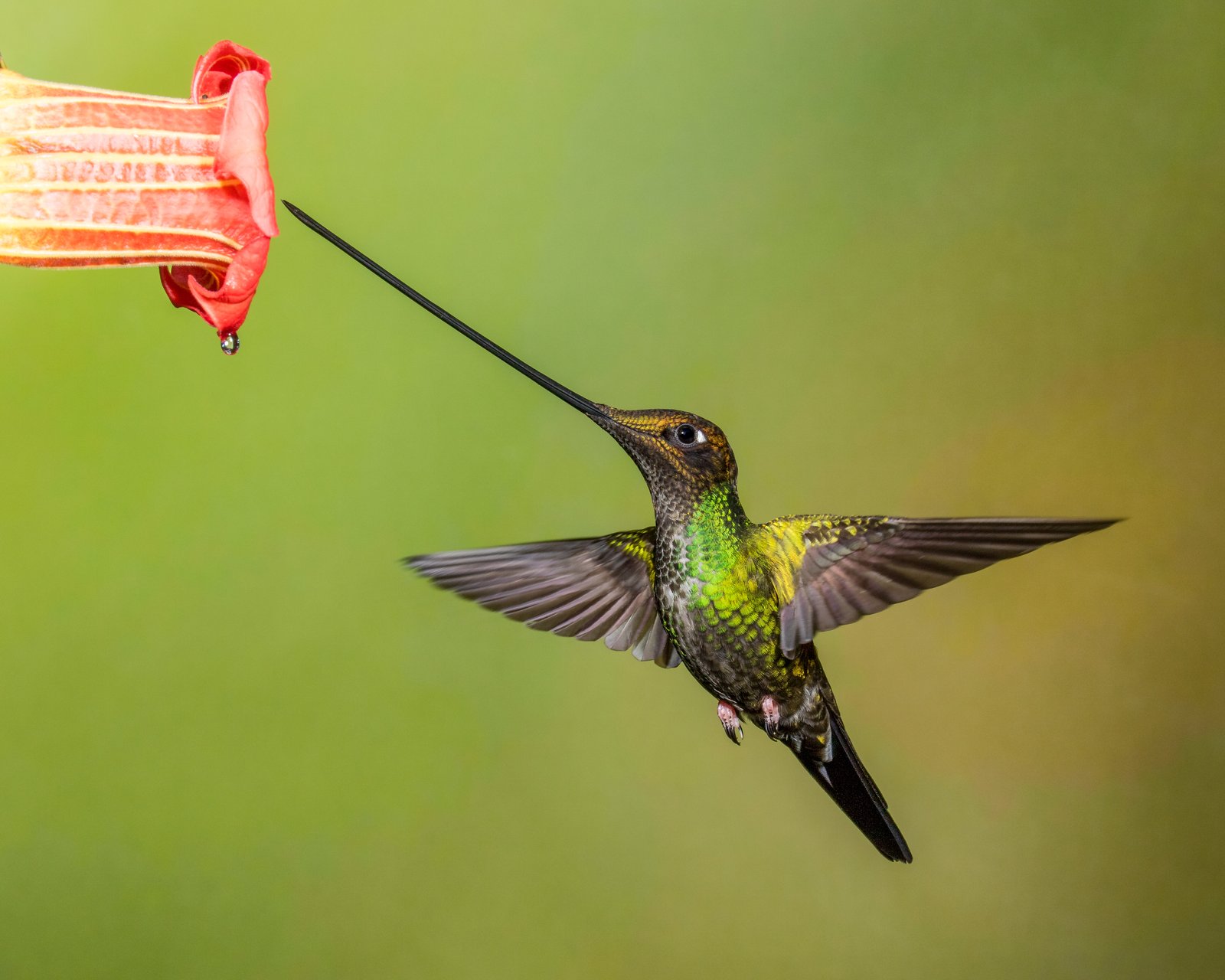
The Sword-billed Hummingbird is the only bird in the world whose bill is longer than the rest of its body excluding the tail. With that bill it reaches the nectar in the long flower tubes of passionflowers and angel's trumpets, beyond the reach of other hummingbirds. It lives in the high cloud forest of the Andes and is one of the most sought-after hummingbirds of the region.
Voice
Usually silent. The call is a low, rattling or trilling trrr, mainly in flight.
Recording: Mitch Lysinger — CC BY-NC-SA 4.0 · xeno-canto
Identification
20–23 cm, of which about half is bill; the straight, slightly upturned bill is 9–11 cm long. The body is fairly large for a hummingbird. The male is bronzy green, with a dark, coppery head and a dark throat; the tail is slightly forked and bronzy green. The female is green above and whitish below, densely spotted green. Both have a small white spot behind the eye. When perched it holds the bill angled upwards.
Confusion species
Unmistakable because of its bill. Incas such as Collared Inca Coeligena torquata also have a long, straight bill, but it is much shorter than the body. Great Sapphirewing Pterophanes cyanopterus is as large or larger, but has a much shorter bill and blue wings.
Habitat
High cloud forest, elfin forest and their edges, scrub and thickets above the closed treeline, and gardens with flowering plants, mostly at roughly 2500 to 3500 m, locally lower. It visits mainly flowers with long, pendent corollas, such as passionflowers, Passiflora, and angel's trumpets, Brugmansia; it also catches insects in flight. It comes to feeders.
Where the bird is most at home, classified by the vegetation units of the Andes and the west coast.


Range and movements
In Colombia in all three cordilleras. In Ecuador on both slopes of the Andes. In Peru along the Andes, mainly on the eastern slope. In Bolivia on the eastern slope of the Andes. Absent from the Galápagos. Outside the guide area in the Andes of western Venezuela.
- Resident
- dark = core range, pale = thinly spread
How and when to look
At feeders and flowering passionflowers at lodges and reserves in high cloud forest, such as the Yanacocha reserve above Quito in Ecuador. A bird often visits the same flowers along a fixed route; waiting at a flowering shrub pays off.
Conservation status
Least Concern. Deforestation of high montane forest affects its habitat locally, but it also uses forest edges and gardens.
Scientific name
Ensifera ensifera | (Boissonneau, 1840)
Boissonneau described the species in 1840 as Ornismya ensifera; because it was later moved to another genus, the author and year stand in brackets. The genus Ensifera was introduced in 1843 by Lesson. The genus name comes from Latin ensis, 'sword', and -fer, 'bearing': 'sword-bearer', after the very long bill. The species name repeats the genus name: Latin ensis, 'sword', and -fer, 'bearing', after the bill, which is longer than the body. The specimen the first description was based on came from Bogotá, Colombia.