All species › Swifts › Hummingbirds › Great Sapphirewing
Great Sapphirewing | Pterophanes cyanopterus
Saffiervleugelkolibrie | Alazafiro grande | Asa-de-safira-grande
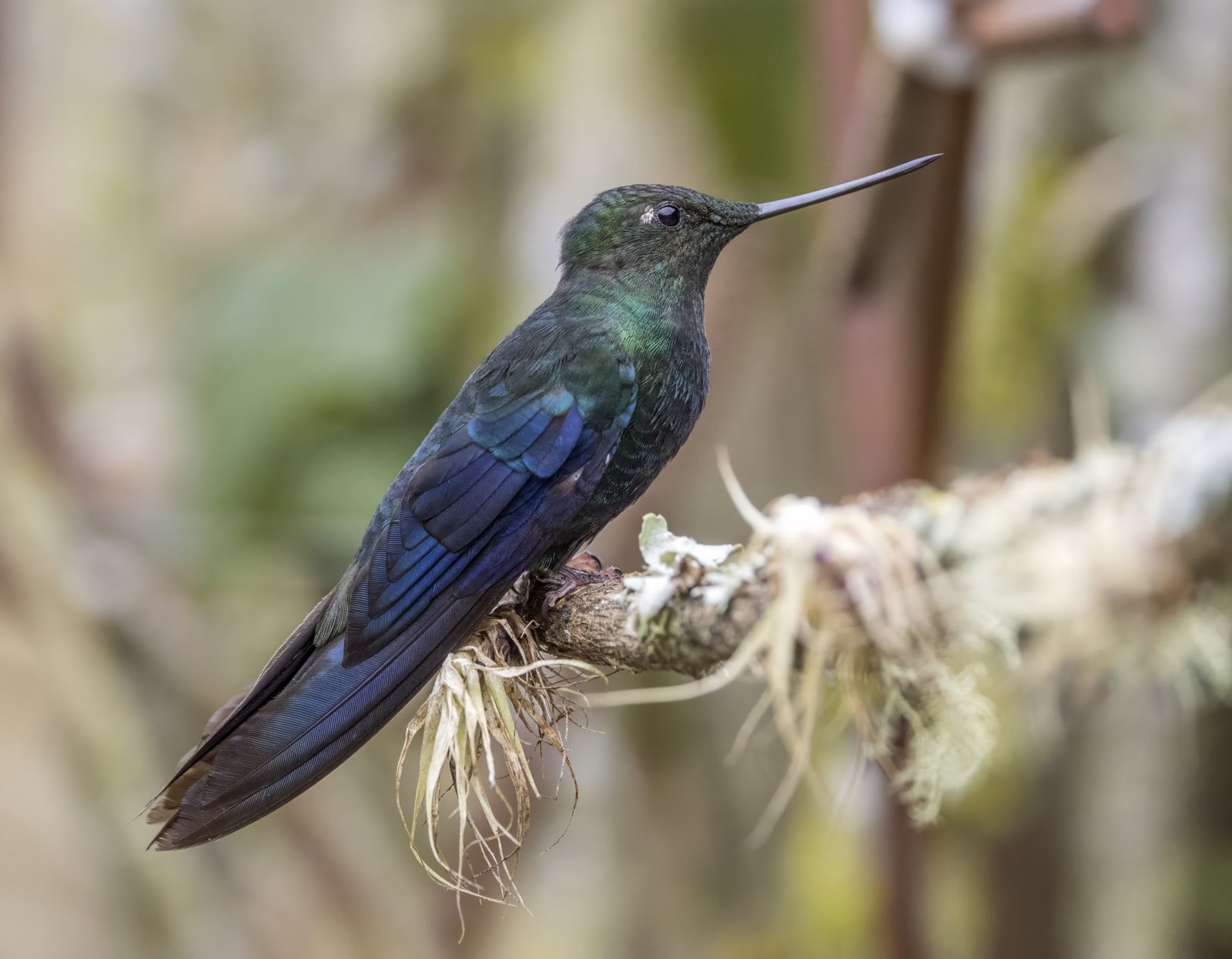
The Great Sapphirewing is, after the Giant Hummingbird, the largest hummingbird of the Andes. It lives at the treeline from Colombia to Bolivia and flies with slow, deep wingbeats, sometimes with short glides. The male's wings are deep sapphire blue.
Voice
A loud, sharp tseet or chit, often in flight, and a rapid twitter in chases. The slow wingbeats make a low hum.
Recording: Dan Lane — CC BY-NC-SA 3.0 · xeno-canto
Identification
19 cm, with a straight black bill of about 3 cm and a long, slightly forked tail. The male is dark glossy green with a blue sheen on the head and underparts; the wings are largely sapphire blue. The female is green above and cinnamon below, with less blue in the wings and pale edges to the outer tail feathers. After landing the bird often holds its wings raised for a moment.
Confusion species
Giant Hummingbird Patagona gigas is larger and dull brownish grey, with no blue in the wing and a white rump, and lives mainly in drier, open valleys. Sword-billed Hummingbird Ensifera ensifera has a very long bill. Shining Sunbeam Aglaeactis cupripennis is smaller and rufous, with a short bill and a glittering rump. The female resembles females of the large starfrontlets and incas Coeligena, but these are smaller and have no blue in the wing.
Habitat
Elfin forest and high cloud forest at the treeline, scrub at the edge of páramo and puna, Polylepis groves and flowering hedges, roughly between 2600 and 3700 m. It feeds at large flowers, often on the outside of shrubs, and sometimes clings to the flower instead of hovering. The nest is a large cup of moss and plant down.
Where the bird is most at home, classified by the vegetation units of the Andes and the west coast.


Range and movements
In Colombia in the high Andes, mainly in the Central Andes and in the south of the country. In Ecuador in the high Andes along their whole length. In Peru along the Andes, mainly on the humid eastern slope. In Bolivia in the humid Andes of La Paz and Cochabamba. Absent from the Galápagos. Does not occur outside the guide area.
- Resident
- dark = core range, pale = thinly spread
How and when to look
At flowering shrubs along roads that climb through elfin forest to the páramo or puna, and at feeders in high-elevation reserves. Look for the slow, swallow-like flight and the blue wings in sunlight.
Conservation status
Least Concern. Logging and fires at the treeline affect its habitat locally, but the species has a large range.
Scientific name
Pterophanes cyanopterus | (Fraser, 1840)
Fraser described the species in 1840 as Trochilus cyanopterus; because it was later moved to another genus, the author and year stand in brackets. The genus Pterophanes was introduced in 1849 by Gould. The genus name comes from Greek pteron, 'wing', and phanēs, 'visible, shining'. The specific name comes from Greek kuanos, 'dark blue', and -pteros, 'winged': blue-winged. The specimen the first description was based on came from Bogotá, Colombia.