All species › Swifts › Hummingbirds › Buff-tailed Coronet
Buff-tailed Coronet | Boissonneaua flavescens
Bruinstaarthoornkolibrie | Coronita colianteada | Coroinha-de-cauda-camurça
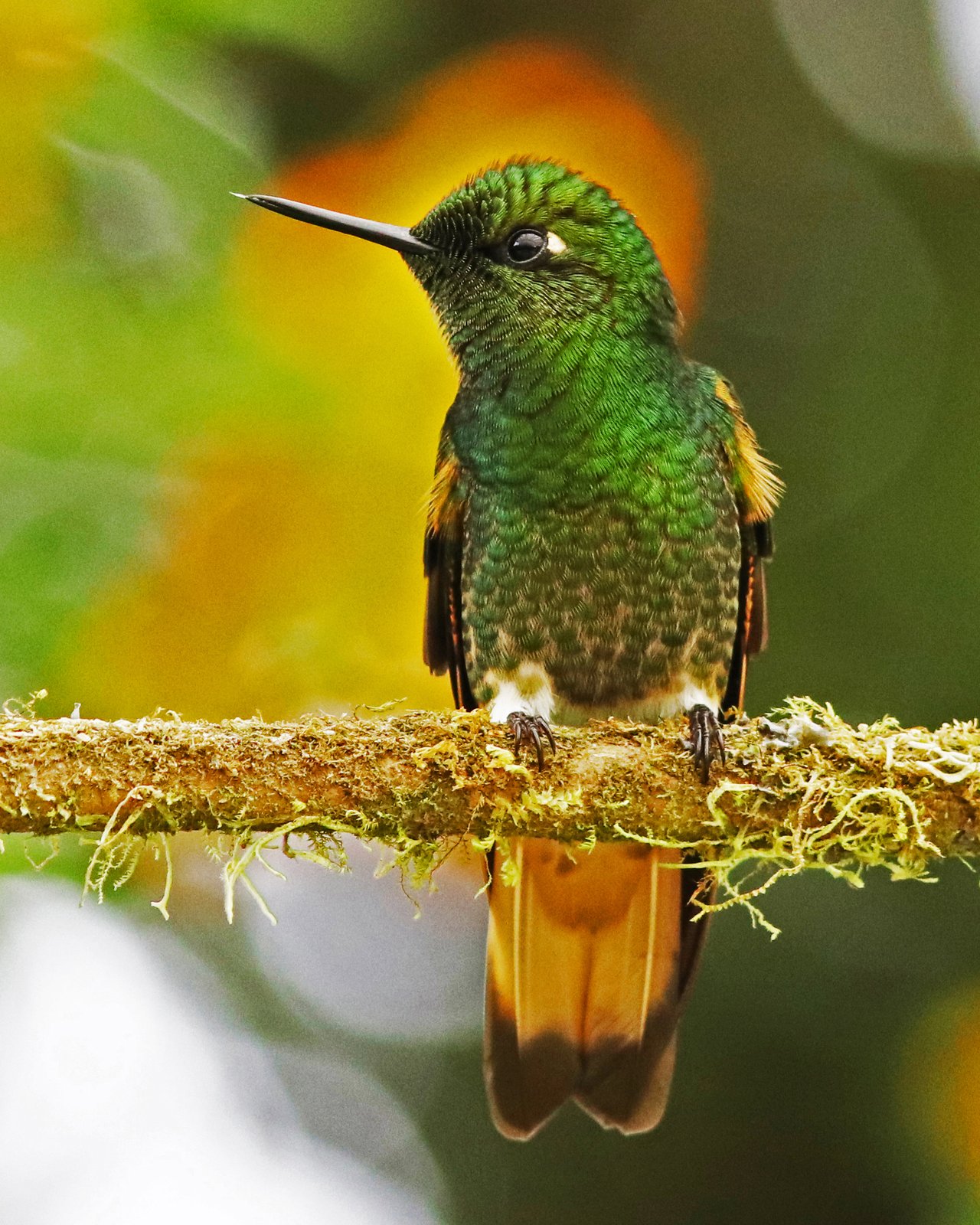
The Buff-tailed Coronet is a sturdy green hummingbird of cloud forest in the northern Andes, with a short bill and a largely buff tail. Like all coronets it briefly holds its wings raised after landing, showing the cinnamon underwing. At feeders it vigorously defends its place against other hummingbirds.
Voice
A sharp, repeated tseet and rapid series of high, squeaky notes, especially in chases.
Recording: Jonas Nilsson — CC BY-NC-SA 4.0 · xeno-canto
Identification
11–12 cm, with a short, straight black bill. Glossy green above and scaled green on a pale buff ground below. The underwing coverts are cinnamon. The tail is pale buff, with bronzy green central feathers and dark tips. The sexes are almost alike; the female is slightly paler below.
Confusion species
Chestnut-breasted Coronet Boissonneaua matthewsii has a plain chestnut breast and belly and a rufous tail. Velvet-purple Coronet Boissonneaua jardini is dark purple below, with a white tail, and lives lower. Fawn-breasted Brilliant Heliodoxa rubinoides has a longer bill and a green tail without buff.
Habitat
Humid cloud forest, forest edges, clearings with flowering shrubs and gardens near forest, roughly between 1800 and 3000 m, locally lower or higher. It feeds at all levels of the forest and defends flowering trees and feeders. The nest is a cup of moss on a branch.
Where the bird is most at home, classified by the vegetation units of the Andes and the west coast.


Range and movements
In Colombia in all three ranges of the Andes. In Ecuador on both slopes of the Andes in the north and centre of the country. Absent from Peru, Bolivia and the Galápagos. Outside the guide area in the Andes of western Venezuela.
- Resident
- dark = core range, pale = thinly spread
How and when to look
At feeders in cloud forest, for example north-west of Quito, where it often holds a fixed perch. Look for the briefly raised wings after each landing.
Conservation status
Least Concern. The species is fairly common and tolerates forest edges and gardens.
Scientific name
Boissonneaua flavescens | (Loddiges, 1832)
Loddiges described the species in 1832 as Trochilus flavescens; because it was later moved to another genus, the author and year stand in brackets. The genus Boissonneaua was introduced in 1854 by Reichenbach. The genus name honours the French ornithologist Adolphe Boissonneau, who described hummingbirds in the first half of the 19th century. The species name comes from Latin flavescens, 'yellowish'. The specimen the first description was based on came from Popayán, Colombia.