All species › Swifts › Hummingbirds › Chestnut-breasted Coronet
Chestnut-breasted Coronet | Boissonneaua matthewsii
Matthews' hoornkolibrie | Coronita pechicastaña | Coroinha-de-peito-castanho
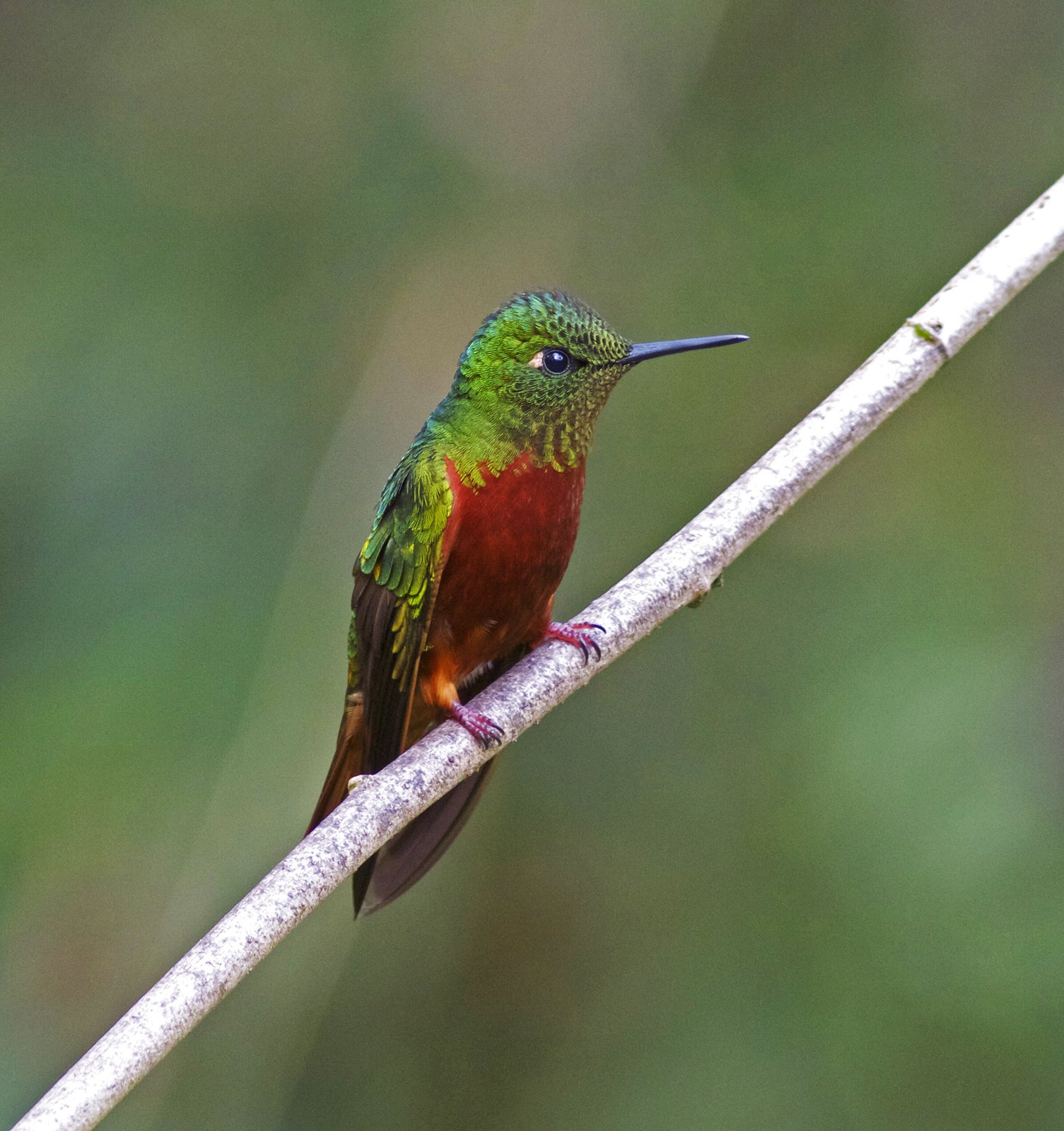
The Chestnut-breasted Coronet is a coronet with green upperparts and chestnut underparts, found in cloud forest from southern Colombia to southern Peru. Like its relatives it holds its wings raised for a moment after landing. At flowering trees and feeders it is territorial.
Voice
A high, thin, liquid tip, a rapid, sweet trill and various squeaky notes.
Recording: LUIS SALAGAJE — CC BY-NC-SA 4.0 · xeno-canto
Identification
11–12 cm, with a short, straight black bill and a small white spot behind the eye. The male is glossy green above; the throat is spotted green on a buff ground, and the breast and belly are plain chestnut, with some green spots on the flanks. The underwing is rufous. The tail is rufous with bronzy central feathers and bronzy tips. The female is very similar to the male but slightly paler below, with fewer spots on the throat.
Confusion species
Buff-tailed Coronet Boissonneaua flavescens is scaled green on a pale ground below and has a paler, buff tail. Fawn-breasted Brilliant Heliodoxa rubinoides has a longer bill, a green tail and a paler, buff breast. Females of starfrontlets and incas Coeligena with brown underparts have a much longer bill.
Habitat
Interior and edges of humid montane forest, clearings and gardens near forest, roughly between 1500 and 3300 m, most birds between 1900 and 2700 m. It feeds at flowering trees and shrubs at various heights and catches small insects. The nest is a cup of moss on a branch.
Where the bird is most at home, classified by the vegetation units of the Andes and the west coast.


Range and movements
In Colombia only in the far south. In Ecuador on the eastern slope along its whole length and on the western slope from the centre southwards. In Peru on the eastern slope south to Cusco and on the western slope in the north-west. Absent from Bolivia and the Galápagos. Does not occur outside the guide area.
- Resident
- dark = core range, pale = thinly spread
How and when to look
At lodge feeders on the eastern slope of Ecuador and Peru, where it often comes together with other large hummingbirds. In flowering trees along mountain roads through cloud forest.
Conservation status
Least Concern. The species tolerates forest edges and partly logged forest.
Scientific name
Boissonneaua matthewsii | (Bourcier, 1847)
Bourcier described the species in 1847 as Trochilus Matthewsii; because it was later moved to another genus, the author and year stand in brackets. The genus Boissonneaua was introduced in 1854 by Reichenbach. The genus name honours the French ornithologist Adolphe Boissonneau, who described hummingbirds in the first half of the 19th century. The species name honours Alexander Matthews (1801–1841), English botanist and collector, who collected on Pitcairn and in French Polynesia in 1830 and in Brazil, Peru and Chile from 1831 to 1841. The specimen the first description was based on came from Peru.