All species › Swifts › Hummingbirds › Velvet-purple Coronet
Velvet-purple Coronet | Boissonneaua jardini
Witstaarthoornkolibrie | Coronita aterciopelada | Coroinha-aveludada
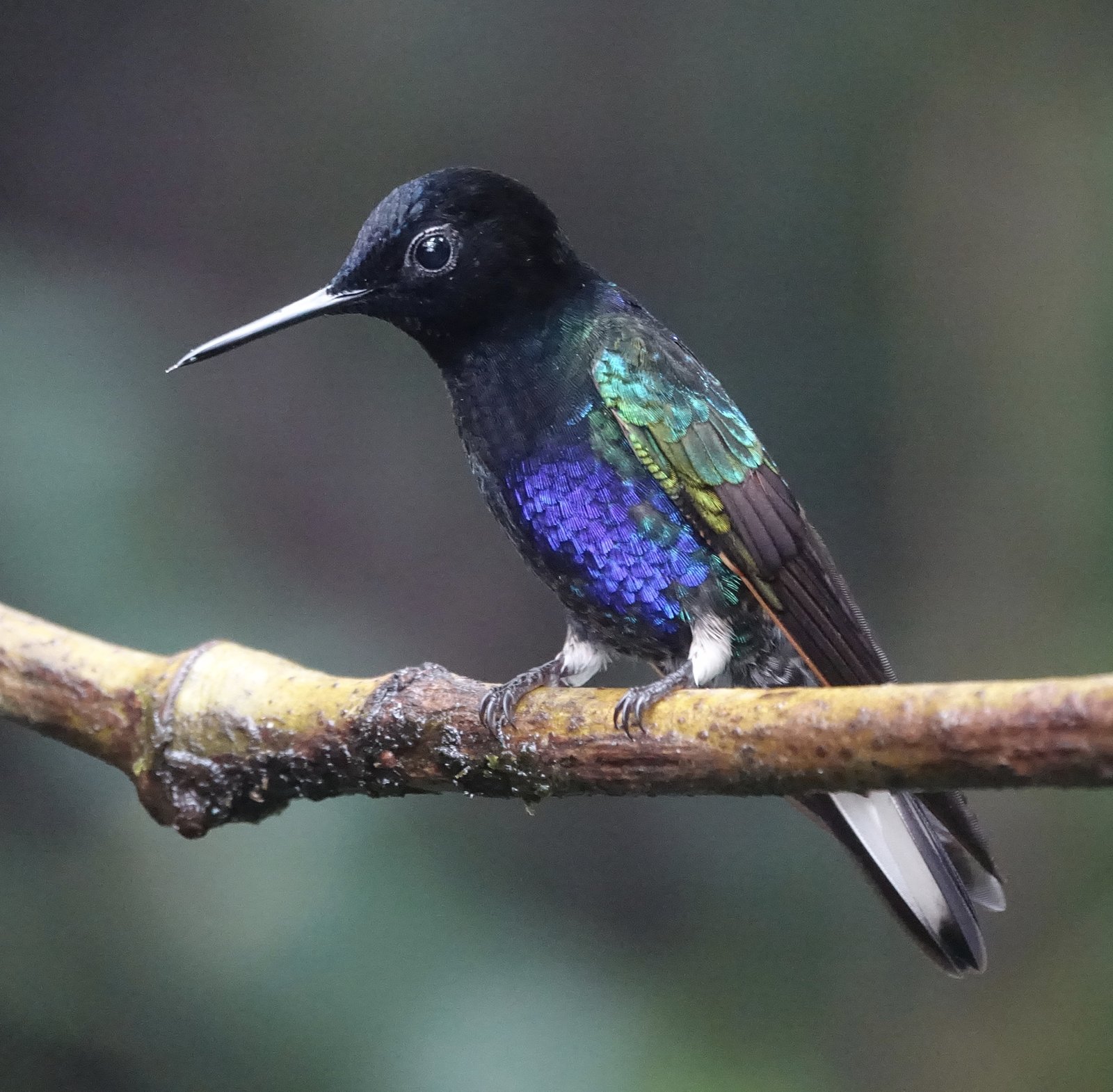
The Velvet-purple Coronet is a dark coronet of humid montane forest on the Pacific slope of the Andes in south-western Colombia and north-western Ecuador. The male is deep velvety purple below and has a largely white tail. The species occurs only in the Chocó region.
Voice
High, sharp tseet notes and a rapid twitter, mainly in chases around flowers and feeders.
Recording: Patricio Mena Valenzuela — CC BY-NC-SA 4.0 · xeno-canto
Identification
11–12 cm, with a short, straight black bill. The male looks black at a distance; at close range the underparts are deep purple-violet, the back has a glittering green to turquoise sheen and the crown glows blue. The underwing is chestnut. The tail is white, with dark central feathers and dark tips. The female resembles the male but is duller and sometimes has greyish-buff fringes on the underparts.
Confusion species
Buff-tailed Coronet Boissonneaua flavescens is green with pale underparts and a buff tail, and lives higher. Empress Brilliant Heliodoxa imperatrix is larger and green, with a long, deeply forked dark tail. The male Violet-tailed Sylph Aglaiocercus coelestis has a very long violet tail.
Habitat
Humid montane rainforest and cloud forest on the Pacific side, forest edges and clearings, roughly between 700 and 2300 m. It feeds mainly in the middle and upper levels of the forest, at flowering epiphytes and trees, and defends feeders. The nest is a cup of moss on a branch.
Where the bird is most at home, classified by the vegetation units of the Andes and the west coast.


Range and movements
In Colombia on the Pacific slope of the Western Andes, mainly in the south of the country. In Ecuador on the western slope of the Andes in the north. Absent from Peru, Bolivia and the Galápagos. Does not occur outside the guide area.
- Resident
- dark = core range, pale = thinly spread
How and when to look
At feeders in the lower cloud forest north-west of Quito and in Nariño. The male shows the purple colour and white tail mainly in good light.
Conservation status
Least Concern. Its range is small and deforestation affects its habitat, but the species remains fairly common in protected areas and forest fragments.
Scientific name
Boissonneaua jardini | (Bourcier, 1851)
Bourcier described the species in 1851 as Trochilus Jardini; because it was later moved to another genus, the author and year stand in brackets. The genus Boissonneaua was introduced in 1854 by Reichenbach. The genus name honours the French ornithologist Adolphe Boissonneau, who described hummingbirds in the first half of the 19th century. The species name honours Sir William Jardine (1800–1874), a Scottish naturalist and publisher of ornithological works. The specimen the first description was based on came from Nanegal, Pichincha, Ecuador.