All species › Jacamars and puffbirds › Jacamars › Bluish-fronted Jacamar
Bluish-fronted Jacamar | Galbula cyanescens
Blauwkruinglansvogel | Jacamará frentiazul | Ariramba-da-capoeira
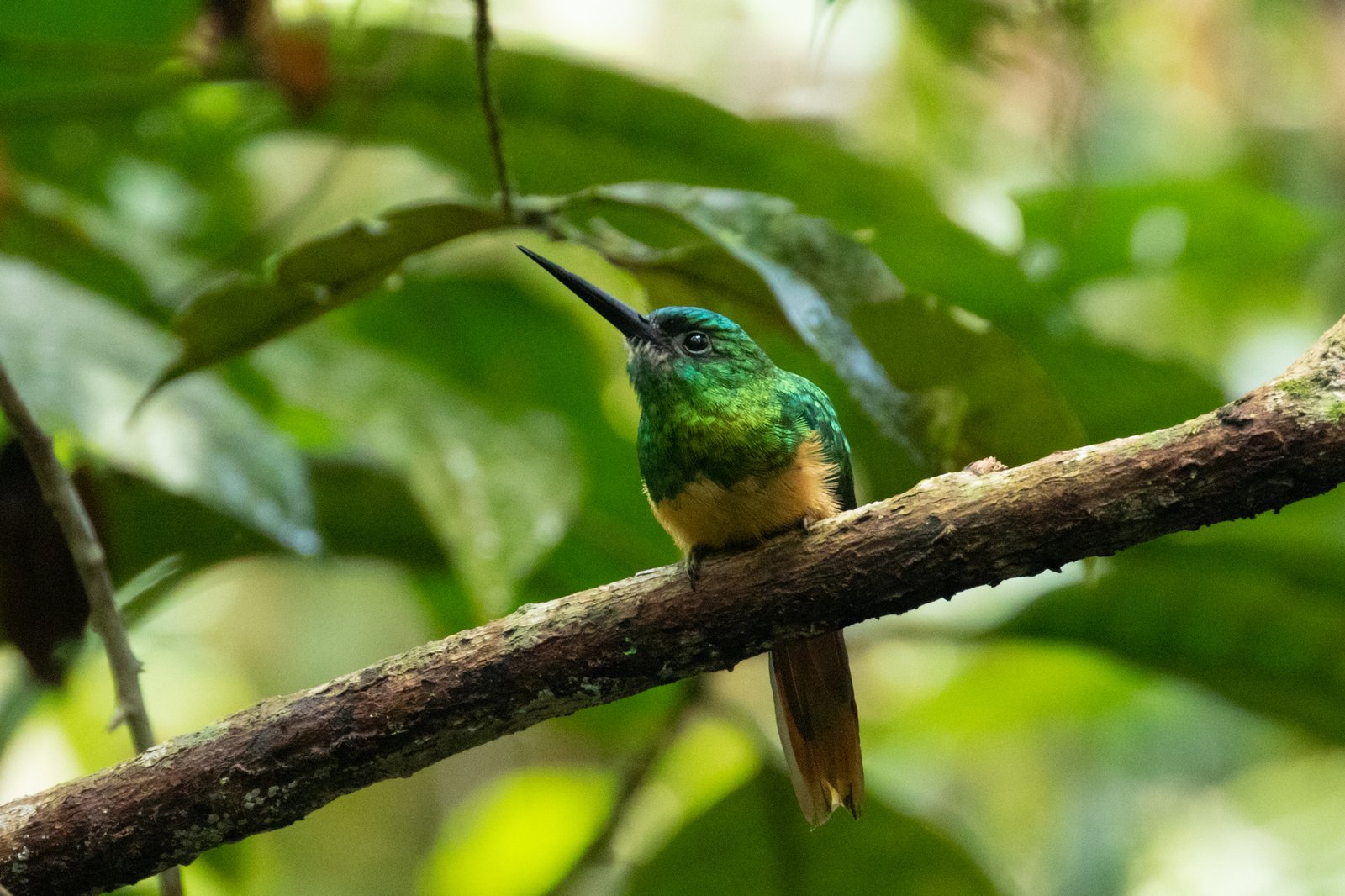
The Bluish-fronted Jacamar is a metallic green jacamar of forest edges and riverine forest in south-western Amazonia. It perches upright on an open branch, with its long, thin bill slightly raised, and sallies out in short flights for butterflies and dragonflies. North of the Marañón and the Amazon it is replaced by the closely related White-chinned Jacamar.
Voice
A series of high, thin whistles, pee-pee-pee, accelerating into a rising and falling trill; also single sharp pee-eep calls. Pairs often call together.
Recording: Juan Freile — CC BY-NC-SA 4.0 · xeno-canto
Identification
20–23 cm, with a long, straight, black bill and a long, graduated tail. The upperparts, throat and breast are glossy metallic green; the forehead and forecrown have a blue sheen. The belly and undertail coverts are rufous. The male has a green chin. The female is paler below, more cinnamon. Juveniles are duller, with a shorter bill.
Confusion species
White-chinned Jacamar Galbula tombacea has a white chin and a darker, brownish crown, and lives north of the Marañón and the Amazon. Yellow-billed Jacamar Galbula albirostris has a yellow bill and a rufous throat. Coppery-chested Jacamar Galbula pastazae has an orange eye-ring and lives higher, in the Andean foothills in the north. Rufous-tailed Jacamar Galbula ruficauda, in Bolivia, has a rufous underside to the tail, and the male has a white throat.
Habitat
Forest edges, riverine forest, várzea, secondary forest, bamboo forest and clearings in humid lowland forest, from the lowlands up to about 1300 m. It perches on low to middle branches along open spaces and catches flying insects, mainly butterflies, dragonflies, bees and wasps, which it beats against the branch. It nests in a self-dug tunnel in an earth bank or riverbank.
Where the bird is most at home, classified by the vegetation units of the Andes and the west coast.


Range and movements
In Peru in the Amazonian lowlands and the lowest eastern slope south of the Marañón and the Amazon. In Bolivia in the northern and central lowlands and the Andean foothills. A few records are known from the far east of Ecuador, where White-chinned Jacamar normally occurs. Absent from Colombia and the Galápagos. Outside the guide area in western Amazonian Brazil.
- Resident
- dark = core range, pale = thinly spread
How and when to look
Along forest trails, riverbanks and clearings near lodges in the lowlands of south-eastern Peru, such as in Madre de Dios. The bird often stays long on the same branch and returns to it after a sally; the high whistled series gives it away.
Conservation status
Least Concern. The species is common over a large area and tolerates forest edges and secondary forest.
Scientific name
Galbula cyanescens | Deville, 1849
Deville described the species in 1849 and placed it straight away in the genus where it still stands. The genus Galbula was introduced in 1760 by Brisson. The genus name comes from Latin galbula, the name for a small yellow bird. The species name comes from Latin cyanescens, 'bluish'. The specimen the first description was based on came from Sarayacu, Río Ucayali, Peru.