All species › Passerines › Tyrant flycatchers and allies › Boat-billed Flycatcher
Boat-billed Flycatcher | Megarynchus pitangua
Bootsnaveltiran | Luis pico grueso | Neinei
The Boat-billed Flycatcher is one of the largest flycatchers of the Neotropical lowlands, named after its strikingly broad, arched bill. It closely resembles the Great Kiskadee, but lives more in the canopy and is less tied to water. The species occurs from Mexico to northern Argentina.
Voice
A loud, nasal, rolling kirrrr-r-r and a shrill chee-ree, often repeated; at dawn a repeated, somewhat chattering song.
Recording: Mateus Gonçalves Santos — CC BY-NC-SA 4.0 · xeno-canto
Identification
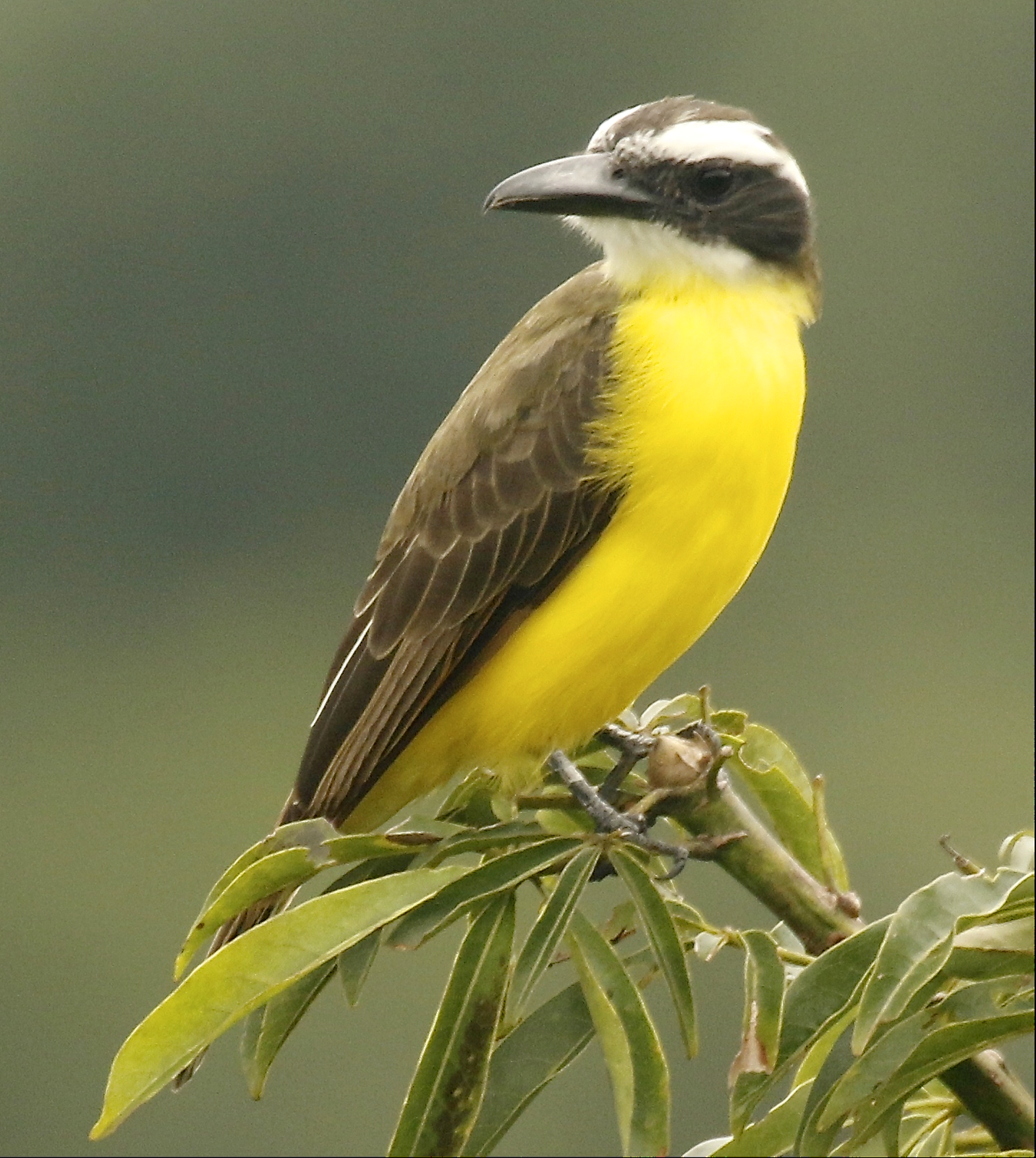
23–24 cm. A large, heavy flycatcher with a very broad black bill, arched on top. The crown is blackish with a concealed orange-yellow crown patch and is encircled by a broad white supercilium that continues around the nape; the mask is blackish. Back, wings and tail are olive-brown, without rufous. The throat is white, the rest of the underparts bright yellow. Sexes alike; juveniles have rufous edges to the wing and tail feathers.
Confusion species
Great Kiskadee Pitangus sulphuratus has a narrower bill, a browner back and distinct rufous edges to wings and tail, and is more often seen near water. Social Flycatcher Myiozetetes similis and Rusty-margined Flycatcher Myiozetetes cayanensis are much smaller, with a small bill. Lesser Kiskadee Philohydor lictor is smaller, with a slimmer bill, and lives close to water.
Habitat
Forest edges, canopy of humid and semi-humid forest, secondary forest, várzea, gallery forest, plantations and open country with tall trees, in the guide area mostly below 1500 m and locally higher. It sallies from a high perch for large insects, small lizards and frogs and also eats fruit. It builds a shallow, open nest of twigs high in a tree fork.
Where the bird is most at home, classified by the vegetation units of the Andes and the west coast.


Range and movements
Colombia: widespread in the lowlands and on the lower Andean slopes. Ecuador: in the western and eastern lowlands and on the lower slopes. Peru: in the Amazonian lowlands and foothills, and locally in the north-west. Bolivia: in the lowlands and foothills of the north and east. Absent from the Galápagos. Outside the guide area from Mexico to Venezuela, the Guianas, Brazil, Paraguay and northern Argentina.
- Resident
- dark = core range, pale = thinly spread
How and when to look
Search forest edges and tall trees along roads and rivers in the lowlands. It often perches high and in the open and is usually heard before it is seen, thanks to its loud, rolling call.
Conservation status
Least Concern. Widespread and fairly common over a very large range.
Scientific name
Megarynchus pitangua | (Linnaeus, 1766)
Linnaeus described the species in 1766 as [Lanius] Pitangua; because it was later moved to another genus, the author and year stand in brackets. The genus Megarynchus was introduced in 1824 by Thunberg. The genus name comes from Greek mega, 'great', and rhunkhos, 'bill', referring to the heavy bill. The species name comes from the Tupi name for the bird, Pitanguá guacú. The specimen the first description was based on came from Rio de Janeiro, Brazil.