All species › Passerines › Tyrant flycatchers and allies › Southern Bentbill
Southern Bentbill | Oncostoma olivaceum
Colombiaanse krombektiran | Mosquerito piquicurvo sureño | Bico-torto-do-sul
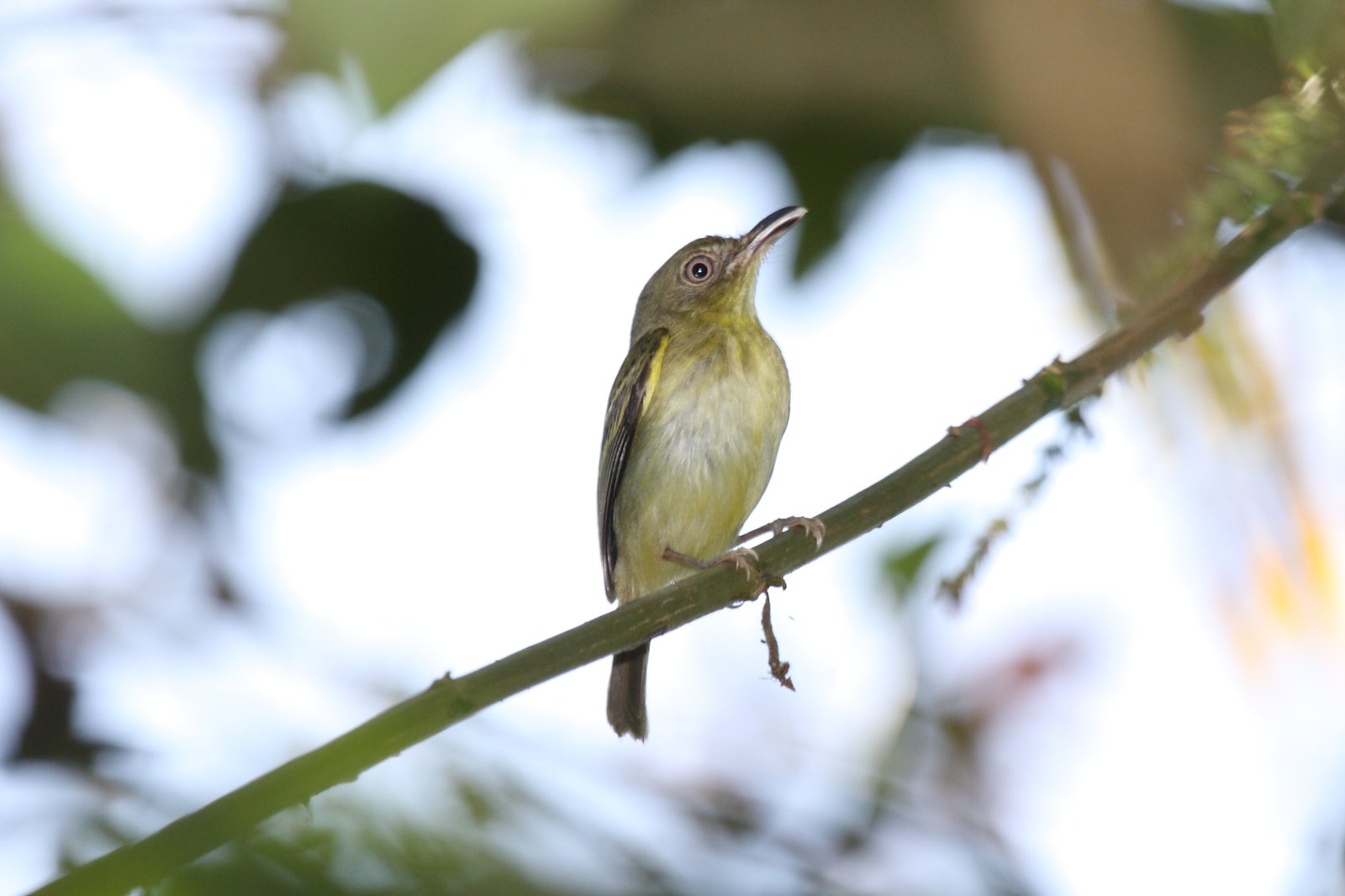
The Southern Bentbill is a small tyrant flycatcher of the understorey of lowland forest in northern Colombia. The thick, flat bill with a downcurved tip is unique in the guide area. It sits still for long periods and is mainly noticed by its low, rolling call.
Voice
A low, frog-like, rolling trill grrrrr, often repeated at intervals, and soft dry ticks.
Recording: Kent Livezey — CC BY-NC-SA 4.0 · xeno-canto
Identification
9.5 cm, with a short tail and a broad bill whose tip is distinctly bent downwards. The upperparts are olive-green, with two faint yellow wing bars. The throat and breast are yellowish olive with faint streaks, the belly yellow. The iris is pale. The sexes are alike.
Confusion species
Northern Bentbill Oncostoma cinereigulare has a grey throat and lives in Central America, outside the guide area. Common Tody-Flycatcher Todirostrum cinereum has a straight, long bill, a dark head and bright yellow underparts. Pale-eyed Pygmy Tyrant Atalotriccus pilaris has a straight bill and lives in drier woodland. Short-tailed Pygmy Tyrant Myiornis ecaudatus is smaller and has almost no tail.
Habitat
The dense understorey and lower storey of humid and semi-evergreen lowland forest, secondary forest, forest edges and scrub, also in shaded coffee and cacao plantations, up to about 1000 m. It sits still for long periods and makes sudden upward sallies to the undersides of leaves. The nest is a hanging, pear-shaped pouch with a side entrance.
Where the bird is most at home, classified by the vegetation units of the Andes and the west coast.


Range and movements
Colombia: in the north, in the Caribbean lowlands, the Urabá region, northern Chocó, the lower Cauca valley and the middle Magdalena valley. Absent from Ecuador, Peru, Bolivia and the Galápagos. Outside the guide area in central and eastern Panama.
- Resident
- dark = core range, pale = thinly spread
How and when to look
Listen in the understorey of lowland forest in northern Colombia for a low, rolling trill; the bird sits still on a thin branch close to the ground and can be found by following the sound.
Conservation status
Least Concern. The species also occurs in secondary forest and scrub, although much lowland forest in northern Colombia has been converted to farmland.
Scientific name
Oncostoma olivaceum | (Lawrence, 1862)
Lawrence described the species in 1862 as Todirostrum olivaceum; because it was later moved to another genus, the author and year stand in brackets. The genus Oncostoma was introduced in 1862 by Sclater. The genus name comes from Greek onkos, 'hook, barb', and stoma, 'mouth', referring to the bent bill. Latin olivaceus means 'olive-green', referring to the plumage. The specimen the first description was based on came from Lion Hill, Panama.