All species › Passerines › Tyrant flycatchers and allies › Cinnamon Neopipo
Cinnamon Neopipo | Neopipo cinnamomea
Kaneelmanakin | Neopipo canelo | Enferrujadinho
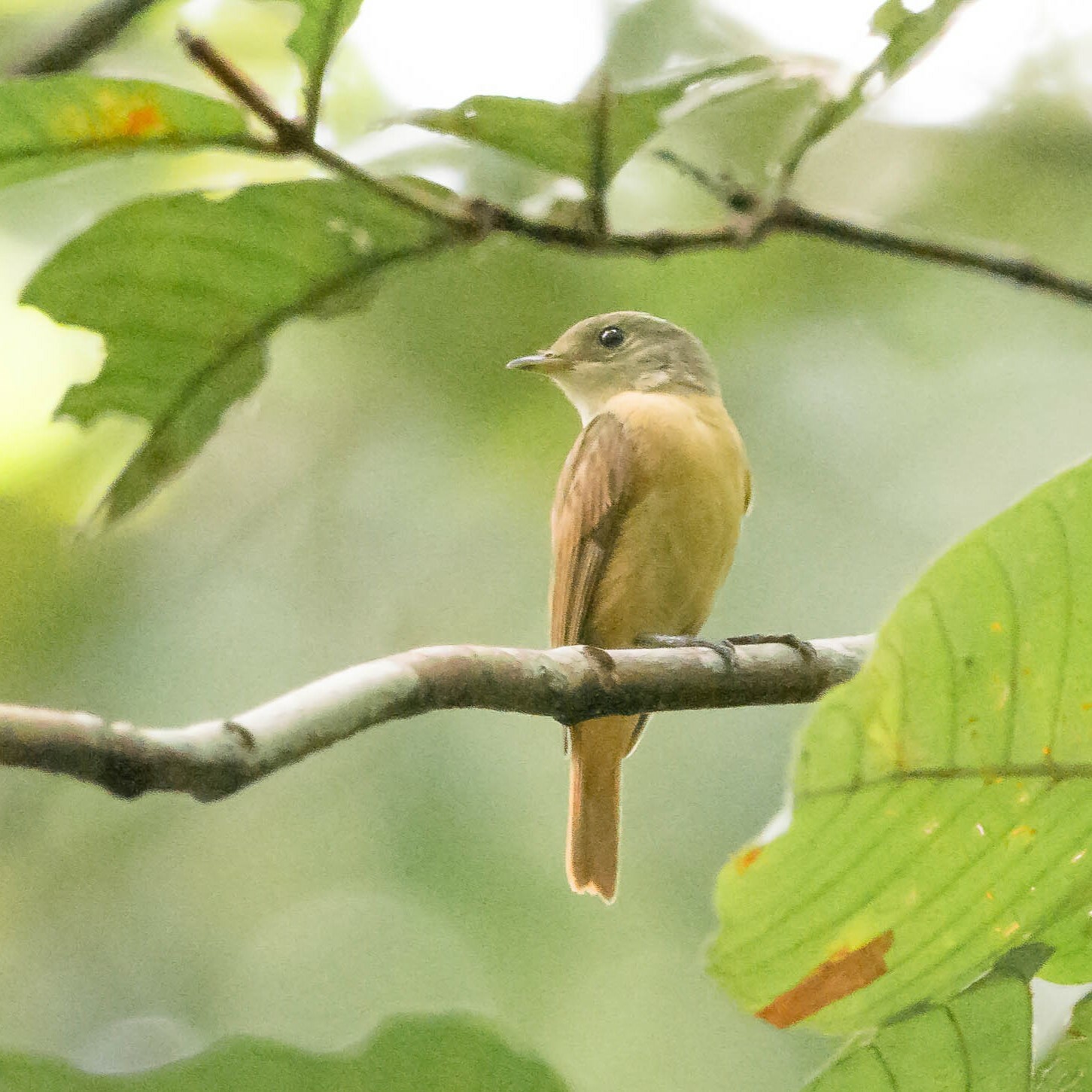
The Cinnamon Neopipo is a very small, cinnamon-brown tyrant flycatcher of the lower storey of Amazonian lowland forest. In colour and posture it closely resembles the Ruddy-tailed Flycatcher; for a long time it was placed with the manakins, but it is now classed with the tyrant flycatchers. Relatively few records are known from its entire range.
Voice
A high, thin series of whistles that accelerates and falls in pitch; also short, sharp calls.
Recording: JAYRSON ARAUJO DE OLIVEIRA — CC BY-NC-SA 4.0 · xeno-canto
Identification
9–10 cm, with a round head and a small, narrow bill. The head and nape are grey, with a concealed yellow to orange-yellow crown stripe. The back is olive-brown, grading into a cinnamon rump and tail; the wings are dark with rufous edges. The throat and underparts are cinnamon, the belly paler. The sexes are nearly alike.
Confusion species
Ruddy-tailed Flycatcher Terenotriccus erythrurus is the most similar, but has a browner head without a yellow crown stripe and a brighter rufous tail. Dwarf Tyrant-Manakin Tyranneutes stolzmanni is olive-green with a pale iris and lacks the cinnamon colour. Females of the Myiobius species have a yellow rump and a dark tail.
Habitat
The lower and middle storeys of humid lowland terra firme forest, often on poor, sandy soils, up to about 900 m. It perches upright on thin twigs and catches insects in short sallies to leaves. Little is known about the nest.
Where the bird is most at home, classified by the vegetation units of the Andes and the west coast.


Range and movements
In Colombia in the Amazonian south-east. In Ecuador and Peru locally in the eastern lowlands, mainly in northern and central Peru. Its occurrence in Bolivia is uncertain. Absent west of the Andes and from the Galápagos. Outside the guide area in southern Venezuela, the Guianas and Amazonian Brazil.
- Resident
- dark = core range, pale = thinly spread
How and when to look
Search the lower storey of tall, undisturbed terra firme forest, especially on sandy soils, and check every Ruddy-tailed Flycatcher for a grey head and a yellow crown stripe. The song helps with identification.
Conservation status
Least Concern. The species has a large range in a largely forested region, but is scarce everywhere.
Scientific name
Neopipo cinnamomea | (Lawrence, 1869)
Lawrence described the species in 1869 as Pipra ? cinnamomea; because it was later moved to another genus, the author and year stand in brackets. The genus Neopipo was introduced in 1869 by Sclater & Salvin. The genus name combines Greek neos, 'new, strange', with Modern Latin pipo, 'manakin' (from Greek pipōn, an unidentified small bird); Sclater and Salvin found the bird the size of a Pipra, but with a longer tail. Latin cinnamomeus, 'cinnamon-coloured', for the cinnamon plumage. The specimen the first description was based on came from Chamicuros, Peru.