All species › Passerines › Ovenbirds and woodcreepers › Bolivian Earthcreeper
Bolivian Earthcreeper | Tarphonomus harterti
Boliviaanse aardkruiper | Bandurrita boliviana | Bandurrita-boliviana
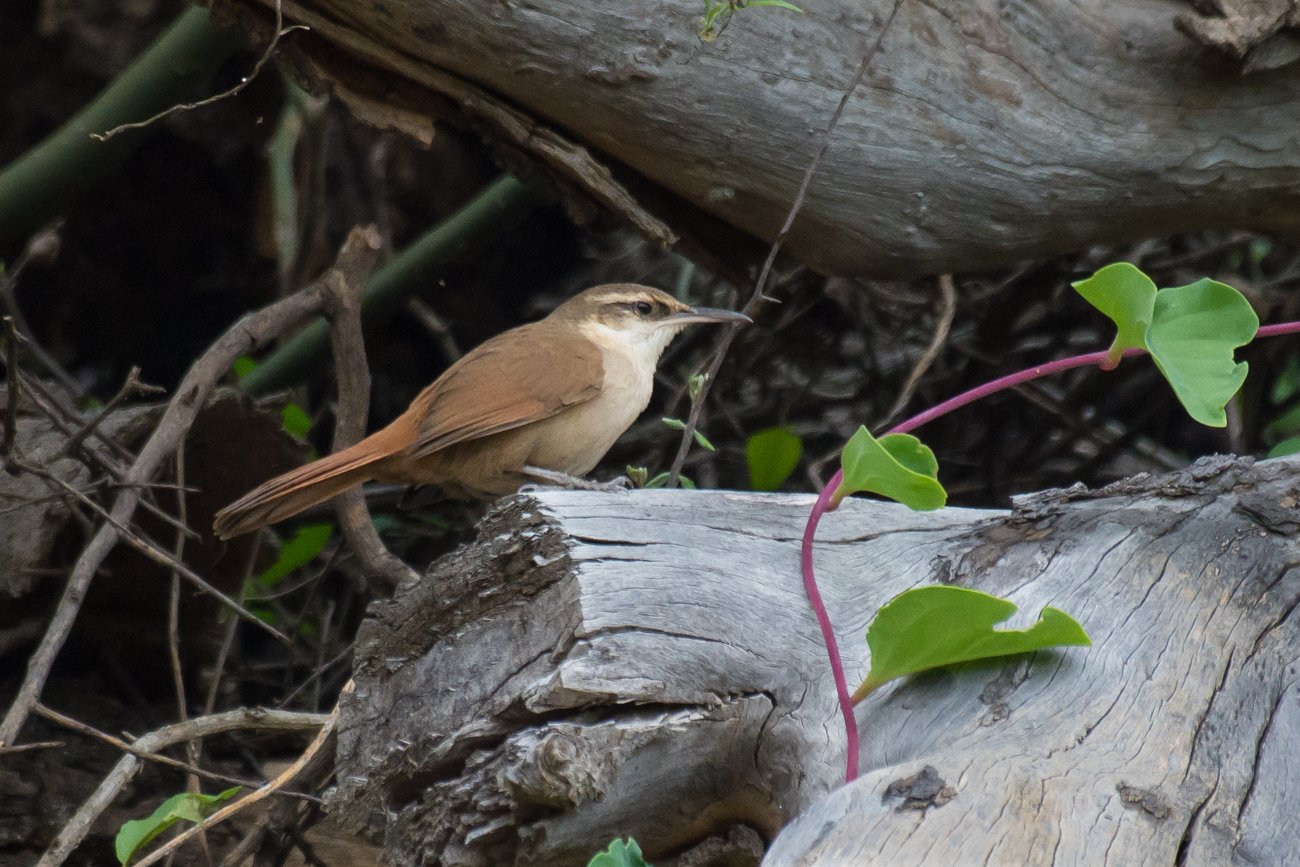
The Bolivian Earthcreeper is a greyish-brown ovenbird with a slightly decurved bill of dry scrub in the valleys of the Bolivian Andes. It feeds mainly on or just above the ground, among bushes and cacti. Its range lies almost entirely within Bolivia.
Voice
The song is a rapid series of hard, dry notes, often given from a bush. Also gives short, sharp calls.
Recording: Ross Gallardy — CC BY-NC-SA 4.0 · xeno-canto
Identification
18 cm, with a medium-length, slightly decurved, dark bill and a fairly long tail. The upperparts are greyish brown, the wings with rufous patches and the tail rufous. A faint pale supercilium. The throat is whitish, the breast and belly pale greyish buff, the flanks browner. The sexes are alike.
Confusion species
Chaco Earthcreeper Tarphonomus certhioides is smaller, with a rufous-tinged forehead, and lives lower, in Chaco dry forest. Scale-throated Earthcreeper Upucerthia dumetaria has a longer, more strongly decurved bill and a scaly throat and breast. Straight-billed Earthcreeper Ochetorhynchus ruficaudus has a straight bill and lives in open, rocky terrain higher in the Andes.
Habitat
Dry scrub, thorn woodland and cactus-rich slopes in the dry Andean valleys, roughly between 1400 and 3000 m, also in hedges and shrubby edges around fields. It forages on the ground and in low bushes for insects and other invertebrates. Little is known about the nest.
Where the bird is most at home, classified by the vegetation units of the Andes and the west coast.


Range and movements
Absent from Colombia, Ecuador, Peru and the Galápagos. Bolivia: in the dry valleys of the eastern Andes, from Cochabamba and western Santa Cruz south through Chuquisaca to Tarija. Hardly or not at all found outside the guide area.
- Resident
- dark = core range, pale = thinly spread
How and when to look
Search dry, shrubby valleys in Cochabamba, Santa Cruz and Chuquisaca and listen for the song in the early morning. The bird often runs beneath bushes and appears briefly in an open spot or on top of a bush.
Conservation status
Least Concern. The range is small, but the species also lives in a mosaic of scrub and small-scale farmland.
Scientific name
Tarphonomus harterti | (Berlepsch, 1892) (GBIF: Upucerthia harterti)
Berlepsch described the species in 1892 as Upucerthia harterti; because it was later moved to another genus, the author and year stand in brackets. The genus Tarphonomus was introduced in 2007 by Chesser & Brumfield. The genus name comes from Greek tarphos, 'thicket', and nomos, 'place for living', after the habitat of thickets in arid scrub. The species name honours the German ornithologist Ernst Hartert (1859–1933), curator of Walter Rothschild's museum at Tring. The specimen the first description was based on came from Trigal and Vallegrande, Bolivia.