All species › Passerines › Antpittas › Boyaca Antpitta
Boyaca Antpitta | Grallaria alticola
Boyacámierpitta | Tororoí leonado norteño | Tovacuçu-de-boyacá
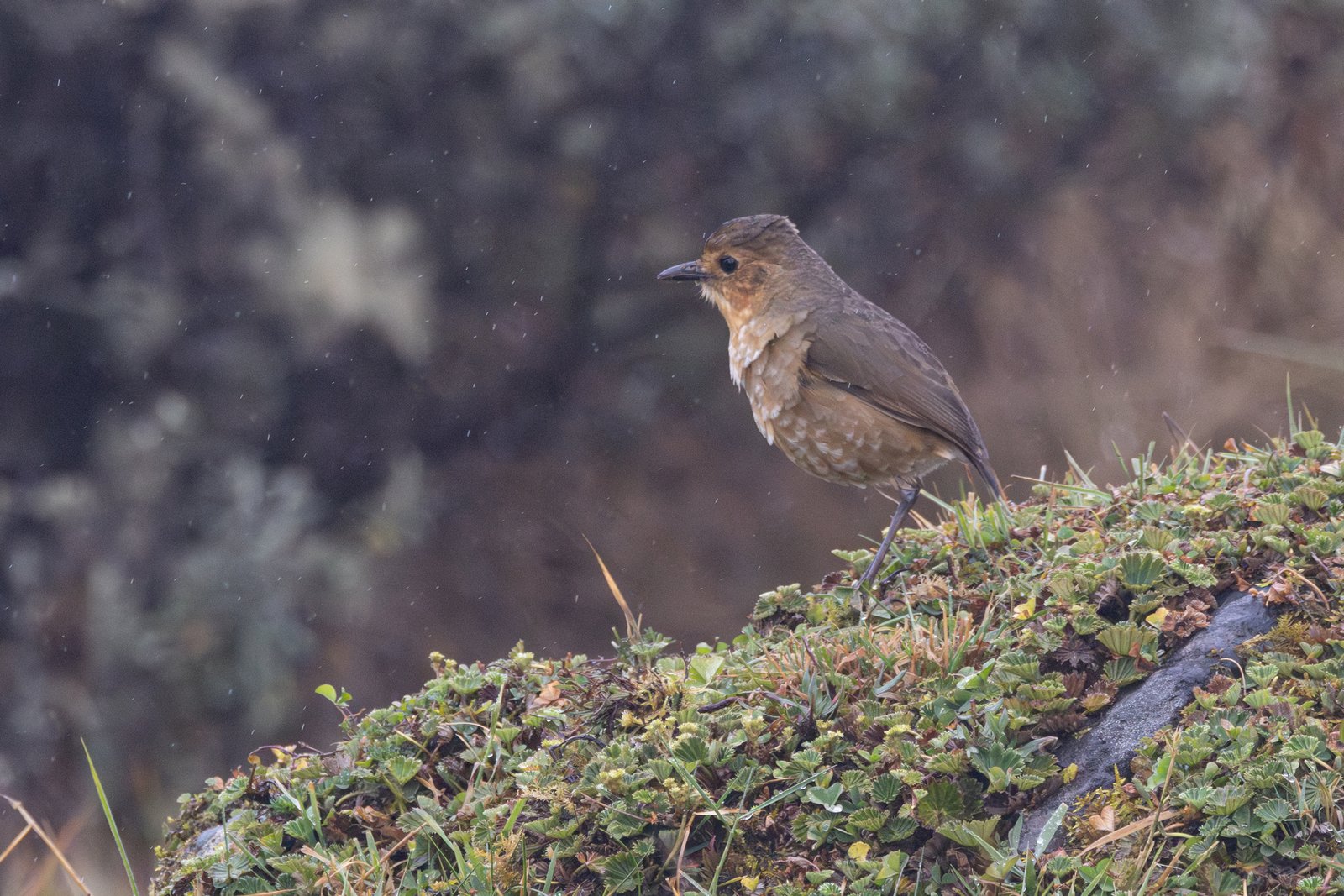
Boyaca Antpitta is the northern form of the former Tawny Antpitta and is found only in the Eastern Andes of Colombia. It is named after the department of Boyacá. Like Tawny Antpitta it lives mainly in open terrain above and along the treeline.
Voice
The song starts with a slurred note, followed by a short pause and then three to five stuttered notes; the whole lasts about 1 to 1.5 seconds. The call is a repeated single note. It is mainly heard around dawn.
No recording with a suitable Creative Commons licence is available for this species yet.
Identification
About 16 cm, round and short-tailed, on long dark legs, with a dark bill. The face is olive-brown to rufous olive-brown, with pale buff lores and whitish around the eye. The upperparts are pale to olive-brown with a grey wash, the rump browner; the primaries have pale buff edges. The underparts are mostly tawny-brown with faint white mottling; the undertail coverts are richer tawny. The sexes are alike.
Confusion species
Tawny Antpitta Grallaria quitensis in the Central Andes and further south is very similar, but does not occur in the same area and sings differently. Muisca Antpitta Grallaria rufula is smaller, uniformly rufous and lives in bamboo inside forest. Cundinamarca Antpitta Grallaria kaestneri is darker olive-brown and lives lower in forest on the east slope.
Habitat
Páramo and adjacent montane forest, and almost any open landscape within its elevation band, mainly between 2800 and 4000 m, including scrub and pasture. It searches the ground for insects and other invertebrates. Little is known about its breeding; probably as in Tawny Antpitta.
Where the bird is most at home, classified by the vegetation units of the Andes and the west coast.


Range and movements
Only in Colombia, in the Eastern Andes in Santander, Boyacá and Cundinamarca, including the capital district of Bogotá. Absent from Ecuador, Peru, Bolivia and the Galápagos. Does not occur outside the guide area.
- Resident
- dark = core range, pale = thinly spread
How and when to look
Search early in the morning in the páramo east of Bogotá, for example in Chingaza, or in Sumapaz, along trails and open patches. The bird often stands upright on a grass tussock or stone and sings from there.
Conservation status
Least Concern. The range is restricted, but the population is considered stable. The loss of páramo to agriculture and livestock is, however, a growing concern.
Scientific name
Grallaria alticola | Todd, 1919
Todd described the species in 1919 and placed it straight away in the genus where it still stands. The genus Grallaria was introduced in 1816 by Vieillot. The genus name comes from New Latin grallarius, 'stilt-walker', referring to the long legs. The species name comes from Latin altus, 'high', and -cola, 'dweller': dweller of high places. The specimen the first description was based on came from Lagunillas, Boyacá, Colombia.