All species › Passerines › Antpittas › Tawny Antpitta
Tawny Antpitta | Grallaria quitensis
Bergmierpitta | Tororoí leonado | Tovacuçu-fulvo
Tawny Antpitta is an antpitta of páramo and the open edges of the highest forest, from the Central Andes of Colombia through Ecuador to the far north of Peru. Unlike most antpittas it lives mainly in open terrain. It walks and hops upright across open ground between grass tussocks and shrubs. Since Boyaca Antpitta and Atuen Antpitta were split off, the species comprises only the birds of Colombia, Ecuador and northern Peru.
Voice
The song consists of three notes: a short note, a pause and then two slightly longer, lower notes, tuk, tu-tu. The call is a loud, explosive, strongly falling note. It sings mainly around dawn, but also at other times of day.
Recording: Germán Darío Gallego Chica — CC BY-NC-SA 4.0 · xeno-canto
Identification
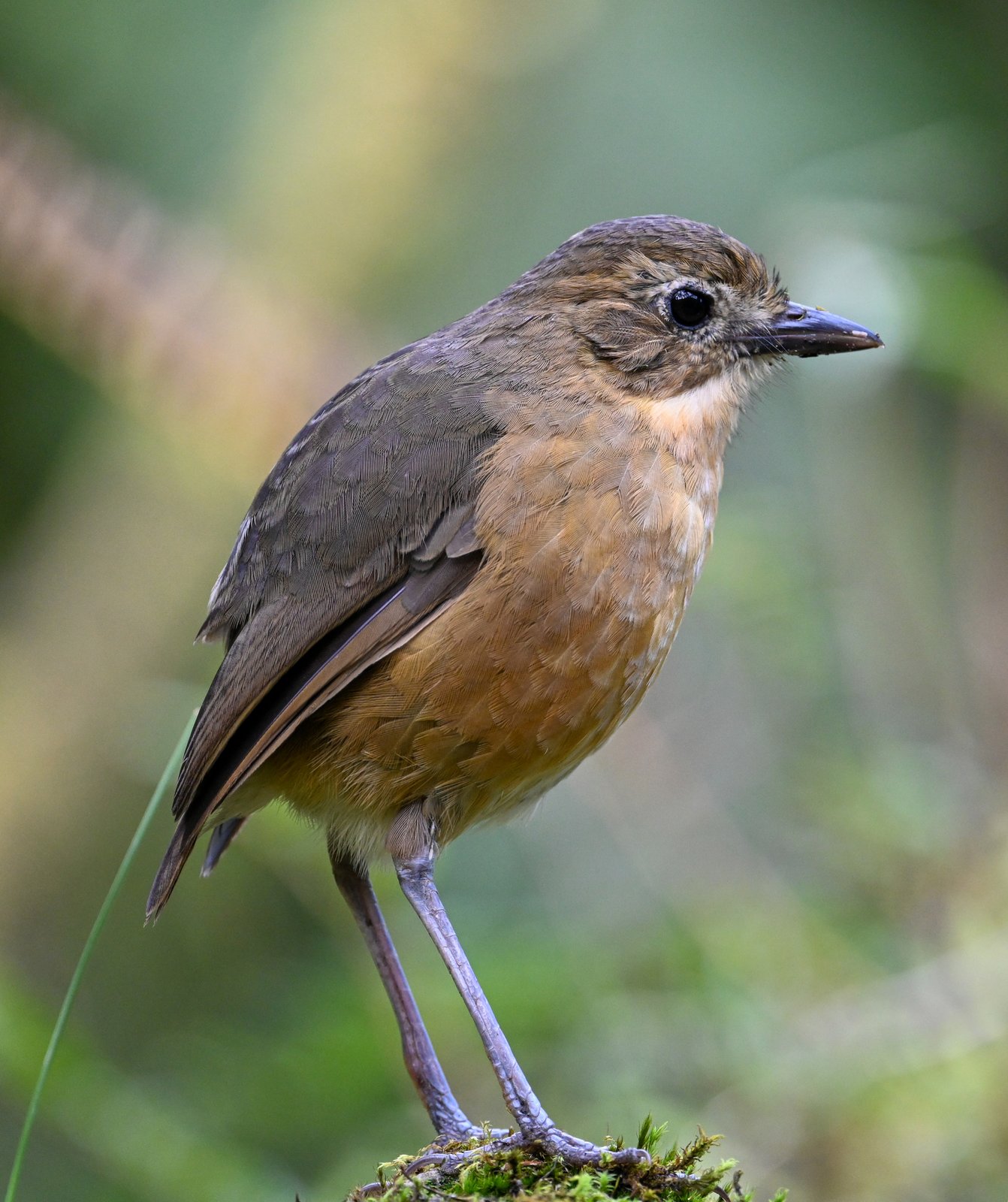
16–18 cm, round and short-tailed, on long dark legs, with a black to grey bill. The face is olive-brown to rufous olive-brown, with pale buff lores and a whitish eye-ring. The upperparts are pale to olive-brown with a grey wash, the rump browner; the primaries have pale buff edges. The chin and throat are whitish, the underparts mostly tawny-brown with faint white mottling. The sexes are alike.
Confusion species
Boyaca Antpitta Grallaria alticola in the Eastern Andes of Colombia and Atuen Antpitta Grallaria atuensis south of the Marañón are very similar; they are best separated by voice and range. The rufous antpittas of the Grallaria rufula group, such as Equatorial Antpitta Grallaria saturata, are smaller, uniformly rufous and live in dense bamboo inside forest. Chestnut-crowned Antpitta Grallaria ruficapilla has a rufous head and a streaked belly.
Habitat
Páramo and the semi-open edges of elfin forest and Polylepis woodland, with a preference for lakeshores and boggy places; it tolerates disturbance and also occurs in scrub, young second growth and farmland. In Colombia roughly between 2200 and 4000 m, in Ecuador mainly between 3000 and 4500 m, in Peru between 2850 and 3400 m. It searches the ground for insects and other invertebrates. Like other antpittas it builds a cup-shaped nest of moss and plant material.
Where the bird is most at home, classified by the vegetation units of the Andes and the west coast.


Range and movements
In Colombia in the Andes from Caldas southwards, mainly in the Central Andes and in Nariño. In Ecuador throughout the Andes. In Peru only in the far north, north and west of the Marañón. Absent from Bolivia and the Galápagos. Does not occur outside the guide area.
- Resident
- dark = core range, pale = thinly spread
How and when to look
Search the páramo of Ecuador, for example at Papallacta and in Antisana and Cayambe-Coca, or in Colombia in Los Nevados and Puracé, early in the morning along trails and road edges. The bird often stands upright on a grass tussock, stone or open patch and also sings from there.
Conservation status
Least Concern. The range is large and the population is considered stable; it is common in Colombia and numerous in Ecuador. The páramo, however, is under increasing pressure from agriculture and the cutting of Polylepis.
Scientific name
Grallaria quitensis | Lesson, 1844
Lesson described the species in 1844 and placed it straight away in the genus where it still stands. The genus Grallaria was introduced in 1816 by Vieillot. The genus name comes from New Latin grallarius, 'stilt-walker', referring to the long legs. The species name quitensis refers to Quito in Ecuador, not necessarily the type locality. The specimen the first description was based on came from Vicinity of Quito, Ecuador.