All species › Passerines › Tyrant flycatchers and allies › Bronze-olive Pygmy Tyrant
Bronze-olive Pygmy Tyrant | Pseudotriccus pelzelni
Bronzen dwergtiran | Tiranuelo bronceado | Maria-bronzeada
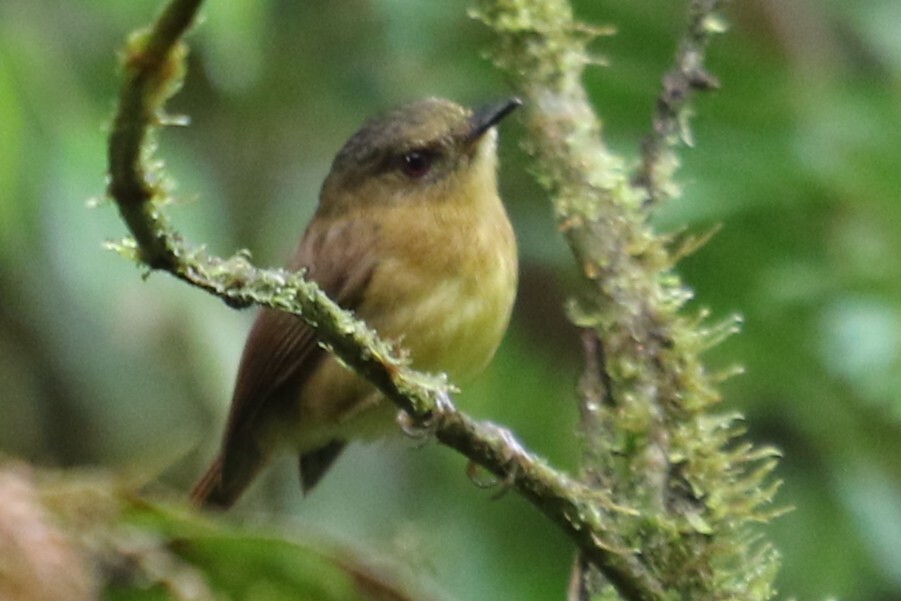
The Bronze-olive Pygmy Tyrant is a small, dark tyrant flycatcher of the understorey of humid montane forest. It sits quietly and low in dense vegetation and is mainly noticed by the whirring and snapping sounds it makes with its wings and bill. It is the most widespread of the three Pseudotriccus species in the guide area.
Voice
A high, thin, slightly descending trill and short, sharp calls. In flight and when moving between branches a whirring wing sound; also dry bill snaps.
Recording: Daan van der Hoeven — CC BY-NC-SA 4.0 · xeno-canto
Identification
11 cm, with a short, flat bill and a rather long tail. The upperparts are dark olive-green with a bronzy sheen, the wings and tail dusky with rufous-brown edges. The throat and breast are dark olive, the centre of the belly yellowish. There are no wing bars and no obvious head pattern. The sexes are alike; juveniles are browner.
Confusion species
Hazel-fronted Pygmy Tyrant Pseudotriccus simplex has a rufous-brown forehead and face and lives only in south-eastern Peru and Bolivia. Rufous-headed Pygmy Tyrant Pseudotriccus ruficeps has an entirely orange-rufous head and lives higher, in upper montane forest. Scale-crested Pygmy Tyrant Lophotriccus pileatus has a crest with rufous feather edges and a streaked breast. Olive-striped Flycatcher Mionectes olivaceus is larger, with a streaked breast and a pale spot behind the eye.
Habitat
The dense understorey of humid foothill and lower montane forest, often in ravines, along streams and in regrowth, roughly between 500 and 2100 m, locally lower on the Pacific side. It catches small insects with short sallies to leaves and twigs, usually alone and not in mixed flocks. The nest has been little described.
Where the bird is most at home, classified by the vegetation units of the Andes and the west coast.


Range and movements
Colombia: in montane forest of the Andean ranges and in the foothills on the Pacific side. Ecuador: on both slopes of the Andes. Peru: on the east slope, from the north south to Cuzco and Puno. Absent from Bolivia and the Galápagos. Outside the guide area in eastern Panama.
- Resident
- dark = core range, pale = thinly spread
How and when to look
Listen in the understorey of montane forest at 800–1800 m for a short whirring wing sound; stand still and search low in the undergrowth for a small, dark bird that sits quietly and makes short sallies.
Conservation status
Least Concern. The species is tied to forest with a dense understorey and disappears with deforestation, but it occurs over a large area.
Scientific name
Pseudotriccus pelzelni | Taczanowski & Berlepsch, 1885
Taczanowski & Berlepsch described the species in 1885 and placed it straight away in the genus where it still stands. He introduced the genus Pseudotriccus in that same work. The genus name comes from Greek pseudos, 'false', and trikkos, a small unidentified bird, used in ornithology for tyrant flycatchers. The species name honours the Austrian ornithologist August von Pelzeln (1825–1891) of the natural history museum in Vienna. The specimen the first description was based on came from Machay and Mapoto, Tungurahua, Ecuador.