All species › Passerines › Tyrant flycatchers and allies › Black-crowned Monjita
Black-crowned Monjita | Neoxolmis coronatus
Zwartkruinmonjita | Monjita coronada | Noivinha-coroada
The Black-crowned Monjita is a grey and white flycatcher that breeds in Patagonia and central Argentina and moves north in the austral winter. In the guide area it is a rare winter visitor to the Chaco of southern Bolivia. It often forages by walking over bare ground.
Voice
Usually silent in winter; a soft, short call.
Recording: Marco Cruz — CC BY-NC-SA 4.0 · xeno-canto
Identification
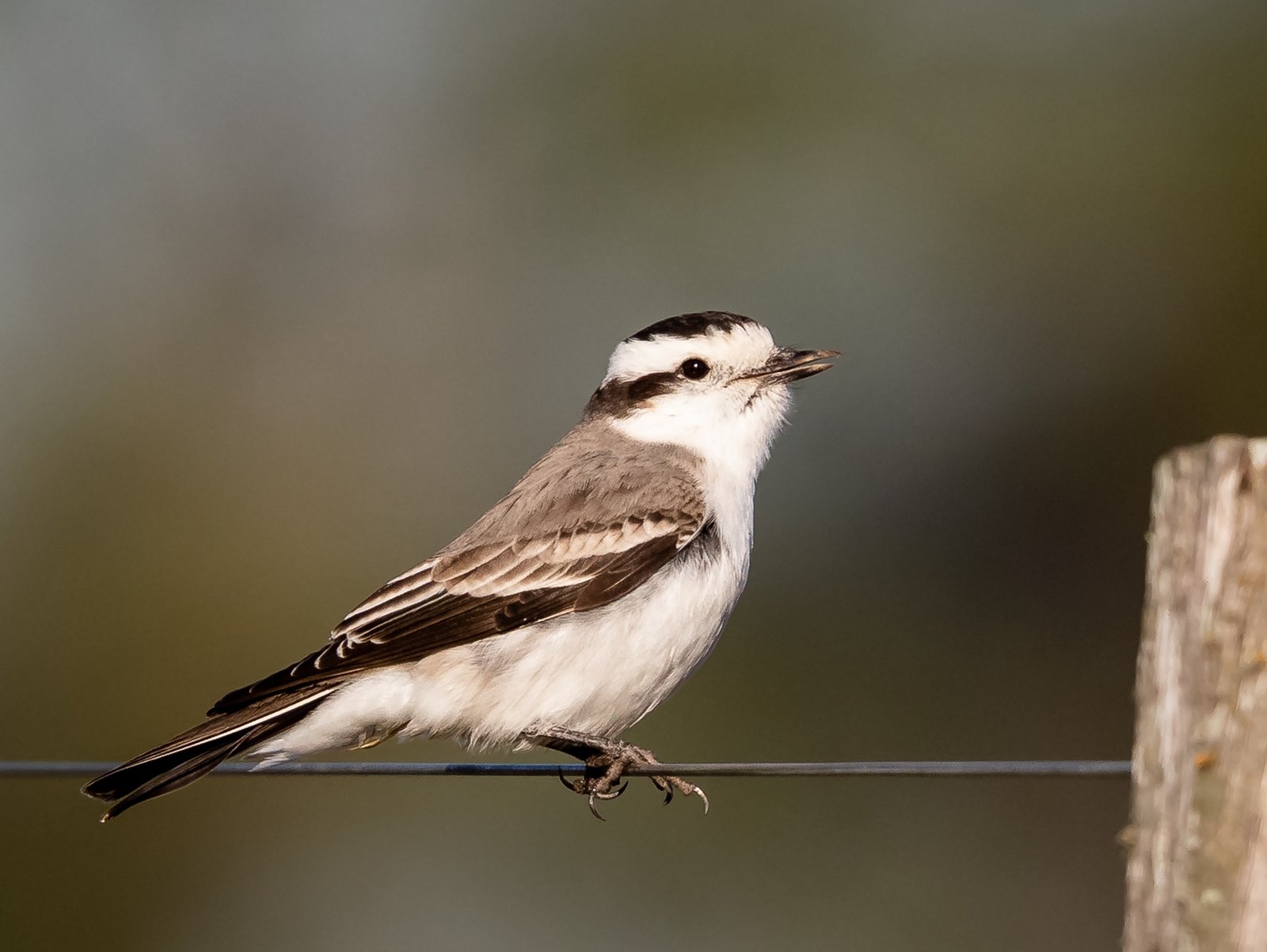
20–21 cm, with a black bill. The crown is black, surrounded by a broad white band across the forehead and supercilium. The back is greyish brown, the underparts white with a greyish wash on the breast. The wings are black, with white edges to the coverts and secondaries and a white patch at the base of the primaries; the tail is black with white outer edges. The sexes are alike.
Confusion species
Grey Monjita Nengetus cinereus is larger, with a grey crown and a black malar stripe. White Monjita Xolmis irupero is almost entirely white, without a black crown. Lesser Shrike-Tyrant Agriornis murinus is plain greyish brown, without a black crown, and has a heavier bill.
Habitat
In winter open, dry country with scattered shrubs, the Chaco, pastures and field edges in the lowlands. It walks over the ground and catches insects and other small invertebrates, often after a short run. On the breeding grounds the nest is in a low shrub.
Where the bird is most at home, classified by the vegetation units of the Andes and the west coast.


Range and movements
Bolivia: only as a winter visitor to the Chaco of the south, in Tarija, Chuquisaca and southern Santa Cruz, mainly from May to September. Absent from Colombia, Ecuador, Peru and the Galápagos. Outside the guide area it breeds in central and southern Argentina; in winter it moves north to Paraguay, Uruguay and southern Brazil.
- Summer visitor (c. Apr–Sep)
- dark = core range, pale = thinly spread
How and when to look
In the austral winter, search the open Chaco of south-eastern Bolivia for a grey and white flycatcher walking over bare ground.
Conservation status
Least Concern. The species is widespread on its breeding grounds; in the guide area it occurs only in small numbers.
Scientific name
Neoxolmis coronatus | (Vieillot, 1823) (GBIF: Xolmis coronatus)
Vieillot described the species in 1823 as Tyrannus coronatus; because it was later moved to another genus, the author and year stand in brackets. The genus Neoxolmis was introduced in 1927 by Hellmayr. The genus name combines Greek neos, 'new', with the genus Xolmis (monjitas). Latin coronatus, 'crowned', for the black crown. The specimen the first description was based on came from Paraguay and Río de la Plata.