All species › Passerines › Tyrant flycatchers and allies › Yellow-bellied Chat-Tyrant
Yellow-bellied Chat-Tyrant | Silvicultrix diadema
Geelbuiktapuittiran | Pitajo ventriamarillo | Papa-moscas-de-barriga-amarela
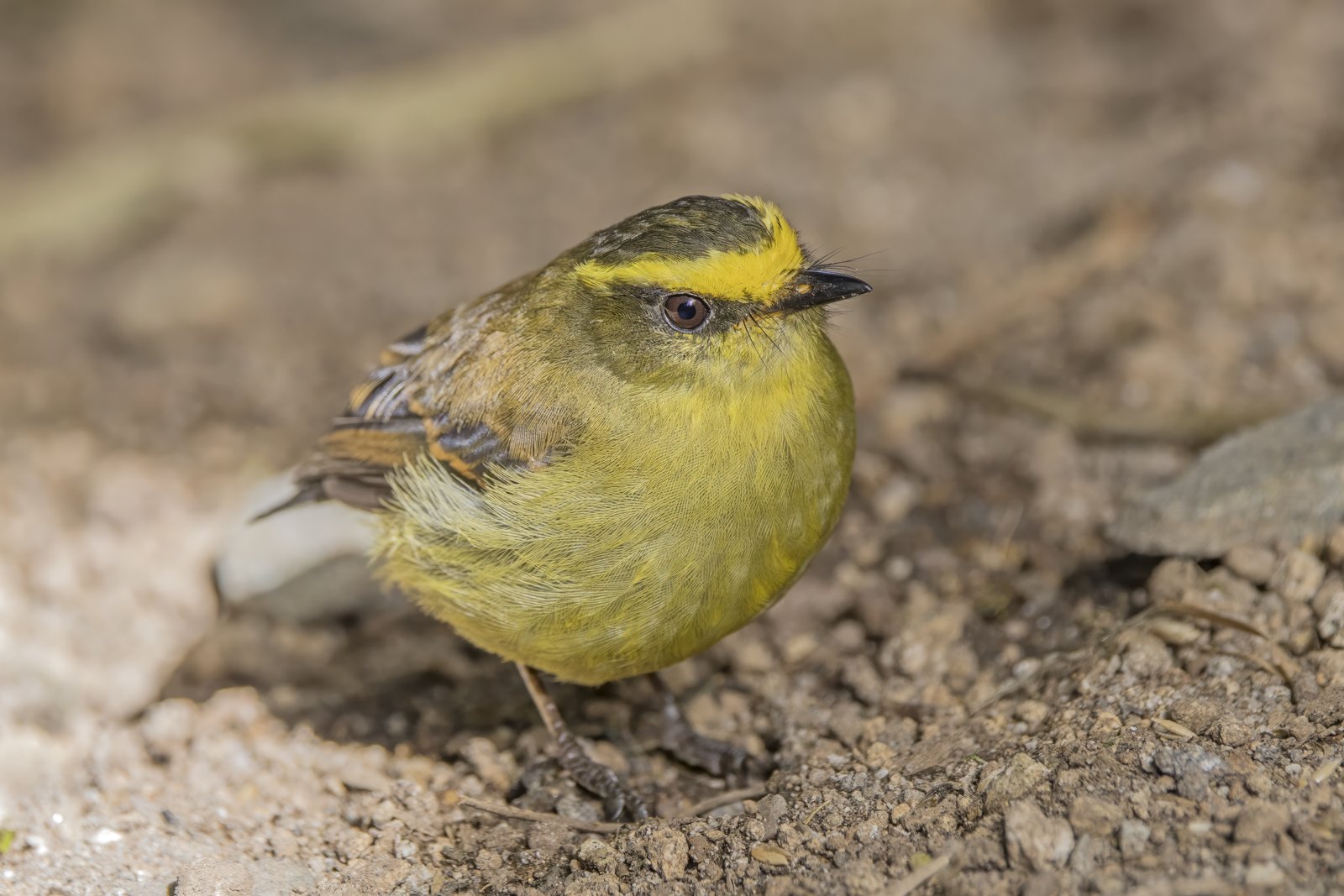
The Yellow-bellied Chat-Tyrant is a small chat-tyrant of the understorey of humid montane forest in the northern Andes. It is the only chat-tyrant in the guide area with yellow underparts, besides a yellow supercilium and rufous wing bars. It lives low and hidden, often in bamboo.
Voice
A high, thin whistle, roughly tsiiu, and a rapid, dry trill that sometimes sounds as a duet.
Recording: Juan Freile — CC BY-NC-SA 4.0 · xeno-canto
Identification
12.5 cm, with a thin, black bill and an upright posture. The upperparts are dark olive-brown, the crown darker. The forehead and the long supercilium are bright yellow. The wings have two rufous to cinnamon wing bars. The underparts are yellow, with an olive wash on the breast and flanks. The sexes are alike.
Confusion species
Crowned Chat-Tyrant Silvicultrix frontalis has dark grey underparts and lives higher, near treeline. Golden-browed Chat-Tyrant Silvicultrix pulchella has a grey breast and lives further south, in Peru and Bolivia. Orange-banded Flycatcher Nephelomyias lintoni has orange wing bars, lacks the yellow supercilium and forages higher in the trees. Cinnamon Flycatcher Pyrrhomyias cinnamomeus has cinnamon underparts and perches in the open on branches at the forest edge.
Habitat
The dense understorey of humid, mossy montane forest and cloud forest, often with bamboo (Chusquea), roughly between 1800 and 3000 m. It lives alone or in pairs and perches low on twigs, from where it makes short sallies to insects; it sometimes joins mixed flocks. The nest is a cup of moss against a bank or in a cavity.
Where the bird is most at home, classified by the vegetation units of the Andes and the west coast.


Range and movements
Colombia: in all three Andean ranges, also in the Sierra de Perijá. Ecuador: along both slopes of the Andes. Peru: in the north, in the Andes of Piura and Cajamarca and north of the Marañón. Absent from Bolivia and the Galápagos. Outside the guide area in the mountains of Venezuela.
- Resident
- dark = core range, pale = thinly spread
How and when to look
Search bamboo-rich understorey along trails through cloud forest, for instance in the early morning; the bird often sits still and low and gives itself away by its high whistle.
Conservation status
Least Concern. The species is widespread, but montane forest is locally cleared for crops and cattle.
Scientific name
Silvicultrix diadema | (Hartlaub, 1843) (GBIF: Ochthoeca diadema)
Hartlaub described the species in 1843 as Myiobius diadema; because it was later moved to another genus, the author and year stand in brackets. The genus Silvicultrix was introduced in 1986 by Lanyon. The genus name is Latin silvicultrix, 'forest-dweller', from silva, 'forest', and cultrix, 'inhabitant'. The species name comes from Latin diadema, 'diadem, crown', after the yellow band above the bill and eyes. The specimen the first description was based on came from Bogotá, Colombia.