All species › Swifts › Hummingbirds › Bronzy Hermit
Bronzy Hermit | Glaucis aeneus
Bronzen heremietkolibrie | Ermitaño bronceado | Balança-rabo-bronzeado
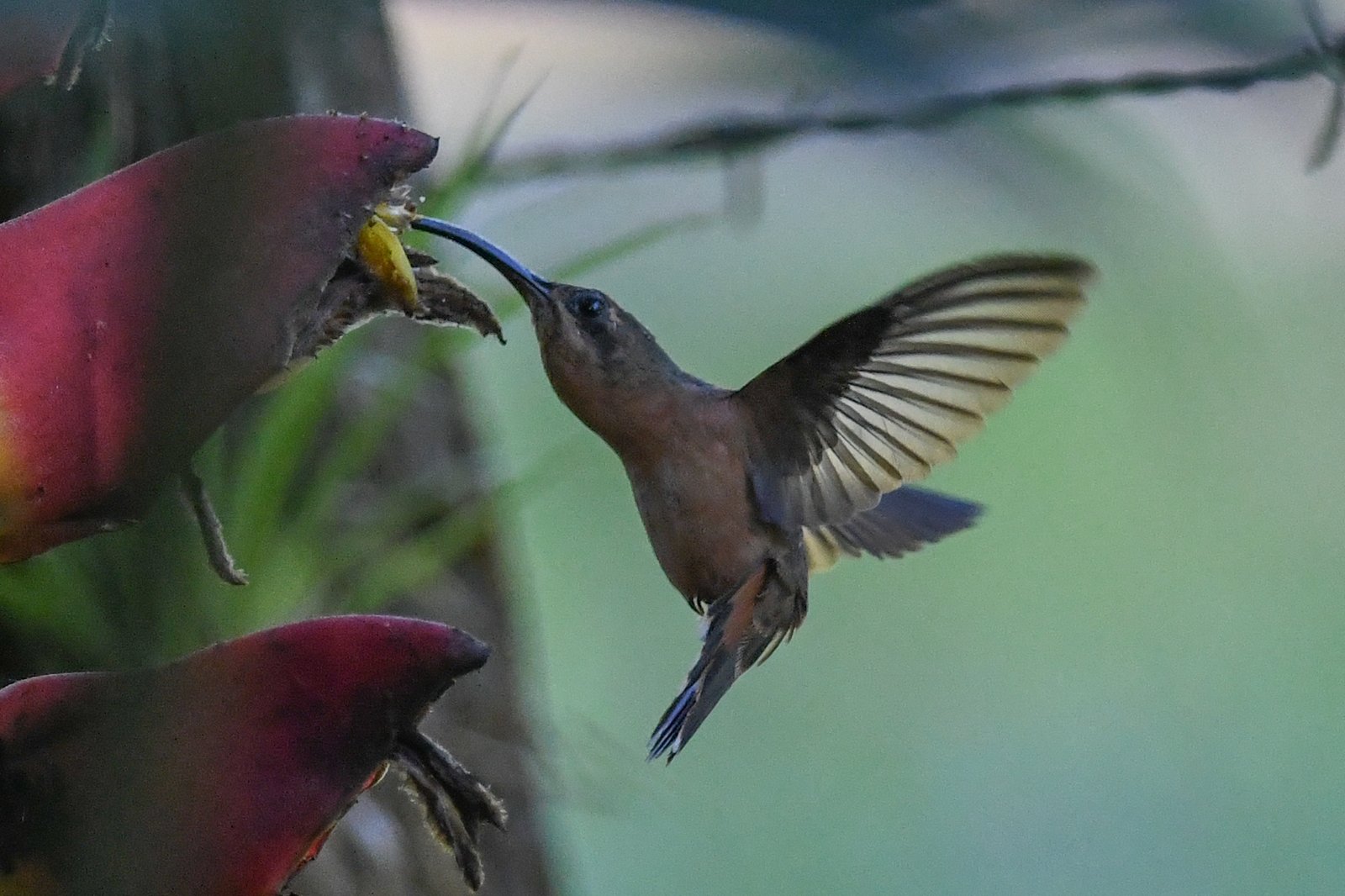
The Bronzy Hermit is a hermit with a decurved bill and rufous underparts that lives in heliconia thickets in the humid lowlands west of the Andes. It is the western counterpart of Rufous-breasted Hermit, with which it was formerly treated as one species. Like other hermits it flies a fixed route along scattered flowers.
Voice
A high, sharp tseep in flight; the song is a short series of high, squeaky notes.
Recording: GABRIEL LEITE — CC BY-NC-SA 4.0 · xeno-canto
Identification
10–11 cm, with a fairly long, distinctly decurved bill with a yellowish lower mandible. The upperparts are bronzy green to coppery bronze. The face has a dark mask with pale stripes above and below. The underparts are uniform dark cinnamon-rufous. The tail is rounded, rufous with a broad black band before the white tips; the central feathers are green. The sexes are similar.
Confusion species
Rufous-breasted Hermit Glaucis hirsutus is greener above and paler rufous below, and lives east of the Andes and in northern Colombia. Band-tailed Barbthroat Threnetes ruckeri has a dark throat with a rufous breast band, a grey belly and a tail with a white base. Hermits of the genus Phaethornis have a long, pointed tail with white central feathers.
Habitat
Heliconia thickets along streams and rivers, forest edges, secondary forest, gardens and plantations in the humid lowlands, from sea level to about 1000 m. It visits mainly flowers of heliconias and other plants with tubular flowers in the understorey. The nest hangs from the underside of a heliconia or palm leaf, often over water.
Where the bird is most at home, classified by the vegetation units of the Andes and the west coast.


Range and movements
In Colombia in the Pacific lowlands and on the lower western slope of the Andes. In Ecuador in the western lowlands and on the lower western slope, south to the south-west of the country. Absent from Peru, Bolivia and the Galápagos. Outside the guide area from Nicaragua through Costa Rica to Panama.
- Resident
- dark = core range, pale = thinly spread
How and when to look
Wait at flowering heliconias along streams and forest edges in the lowlands of western Colombia and Ecuador. A bird returns to the same flowers at intervals.
Conservation status
Least Concern. The species also uses forest edges, secondary forest and gardens.
Scientific name
Glaucis aeneus | Lawrence, 1868
Lawrence described the species in 1868 and placed it straight away in the genus where it still stands. The genus Glaucis was introduced in 1831 by Boie. The genus name comes from Greek glaukos, 'blue-grey' or 'pale green'. The species name is Latin aeneus, 'bronze', referring to the bronzy-green upperparts. The specimen the first description was based on came from Costa Rica.