All species › Swifts › Hummingbirds › White-tipped Sicklebill
White-tipped Sicklebill | Eutoxeres aquila
Haaksnavelkolibrie | Pico de hoz puntiblanco | Bico-de-foice-de-ponta-branca
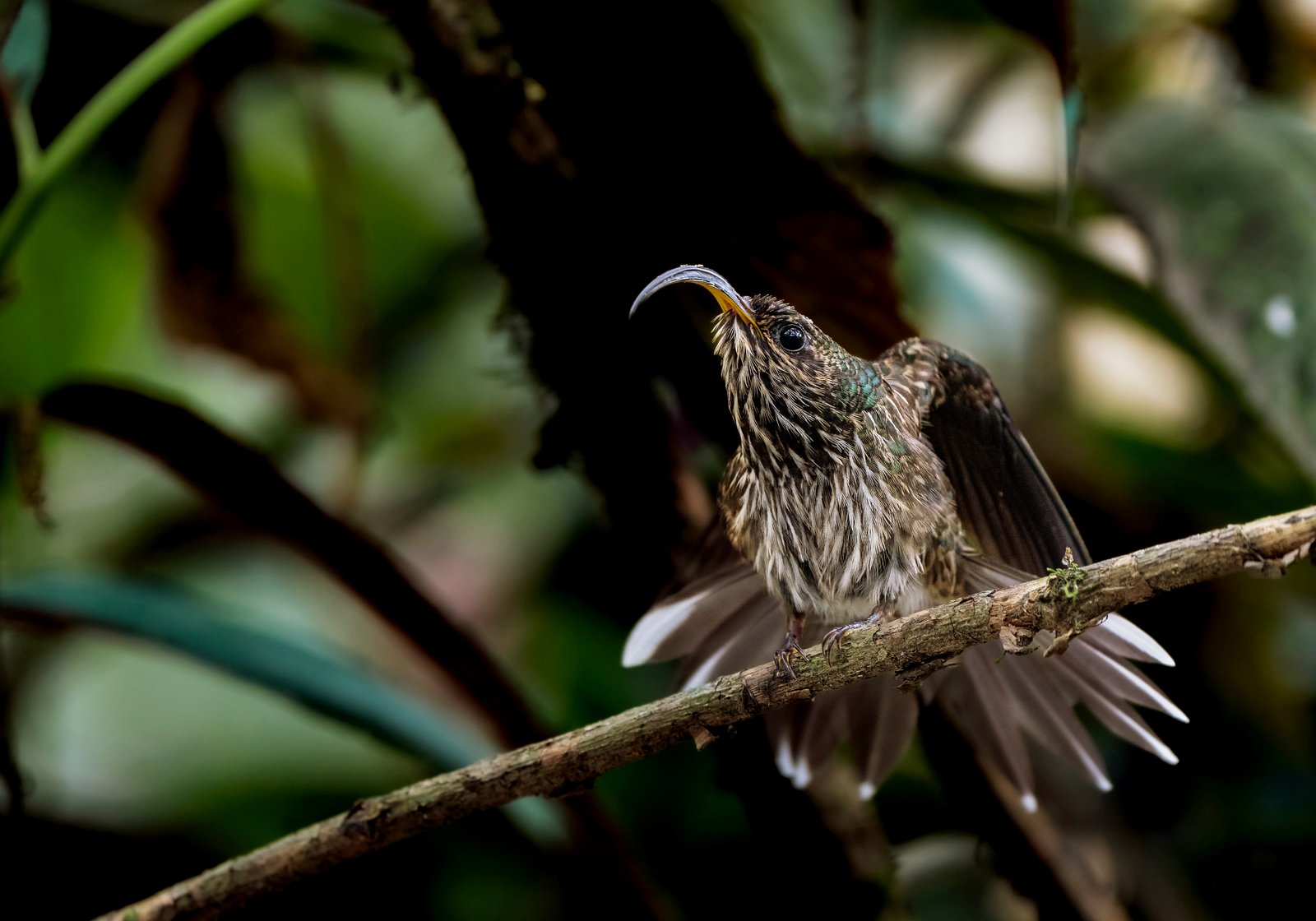
The White-tipped Sicklebill owes its name to its thick, strongly sickle-shaped bill, which fits the curved flowers of heliconias. When feeding it often clings to the flower instead of hovering in front of it. It lives in the understorey of humid forest, mainly west of the Andes, and also occurs on the eastern slope in the north of the guide area.
Voice
A high, thin tseet, often in flight; otherwise rather silent.
Recording: Johan Chaves — CC BY-NC-SA 4.0 · xeno-canto
Identification
12–13 cm, with a thick, strongly decurved bill. The upperparts are dark green. The underparts are white with broad, blackish streaks. The tail is broad and graduated, green with distinct white tips to all feathers. The sexes are alike.
Confusion species
Buff-tailed Sicklebill Eutoxeres condamini has the same bill, but cinnamon to buff outer tail feathers and a blue-green neck patch; it lives only on the eastern slope of the Andes. Hermits of the genus Phaethornis, such as Green Hermit Phaethornis guy, have a much less strongly decurved bill and a long, pointed tail with white central feathers.
Habitat
Understorey of humid lowland forest, foothill forest and lower montane forest, often in ravines, along streams and on slopes with heliconias, from the lowlands to about 2100 m, mainly in the hills and on the lower slopes. It visits mainly flowers of heliconias and Centropogon and catches small insects and spiders. The nest hangs from the underside of the tip of a large leaf.
Where the bird is most at home, classified by the vegetation units of the Andes and the west coast.


Range and movements
In Colombia in the Pacific lowlands and on the western slope and inner slopes of the Andes, and on the eastern slope. In Ecuador on the western slope and in the western lowlands, and on the eastern slope of the Andes. In Peru on the eastern slope of the Andes in the north and centre of the country. Absent from Bolivia and the Galápagos. Outside the guide area from Costa Rica and Panama to western Venezuela.
- Resident
- dark = core range, pale = thinly spread
How and when to look
Wait at flowering heliconias in ravines and along streams in humid forest in western Colombia and Ecuador. Birds follow a fixed route along their flowers and reappear at intervals.
Conservation status
Least Concern. Deforestation in the lowlands and on the lower slopes affects its habitat locally.
Scientific name
Eutoxeres aquila | (Bourcier, 1847)
Bourcier described the species in 1847 as Trochilus Aquila; because it was later moved to another genus, the author and year stand in brackets. The genus Eutoxeres was introduced in 1849 by Reichenbach. The genus name comes from Greek eu, 'well', and toxērēs, 'archer, armed with a bow' (from toxon, 'bow'), referring to the strongly curved bill. The species name is Latin aquila, 'eagle', possibly derived from aquilus, 'dark-coloured'. The specimen the first description was based on came from Vicinity of Bogotá, Colombia.