All species › Swifts › Hummingbirds › Buff-tailed Sicklebill
Buff-tailed Sicklebill | Eutoxeres condamini
Roodstaarthaaksnavelkolibrie | Picohoz colicanela | Bico-de-foice-de-cauda-canela
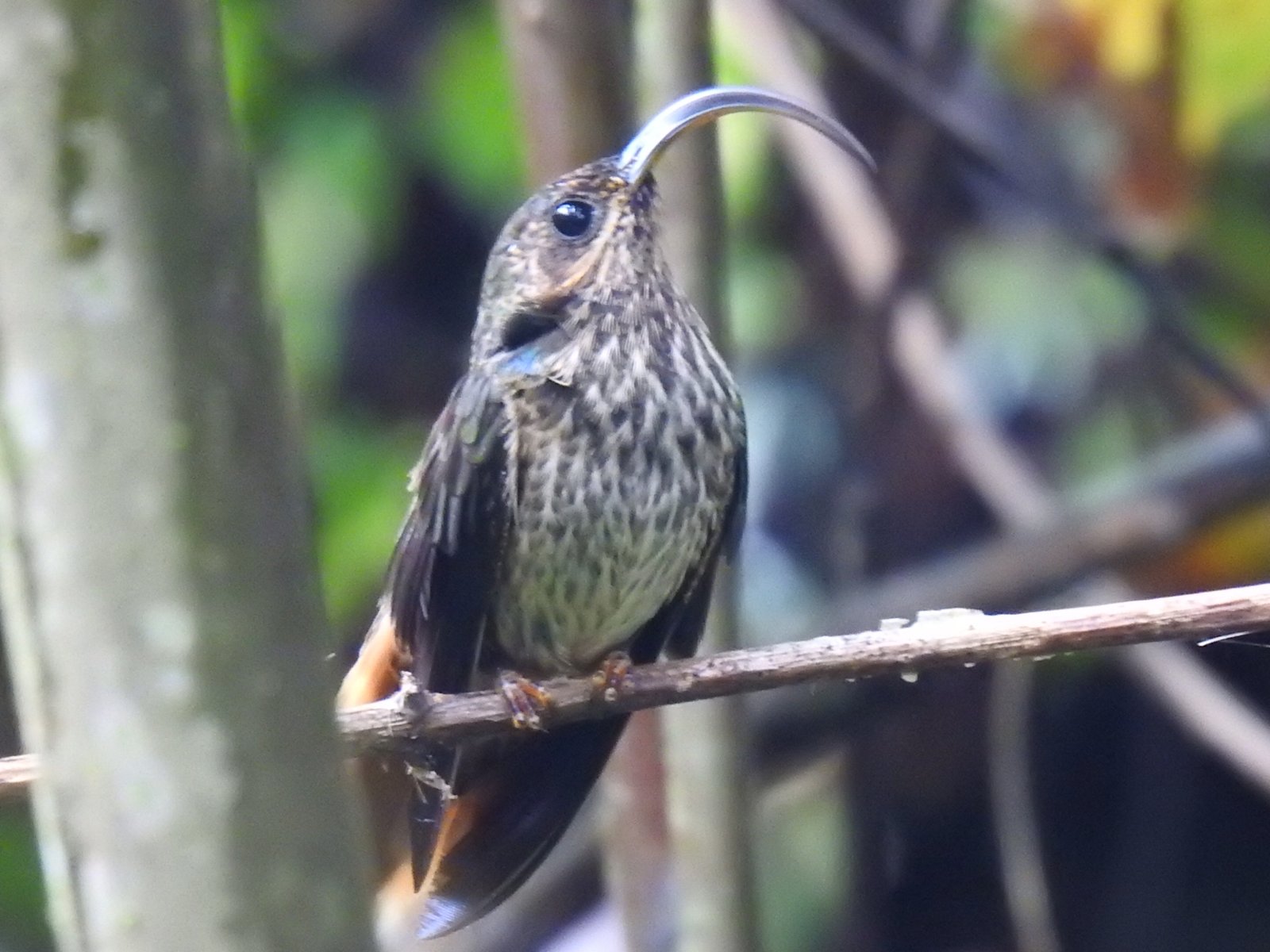
The Buff-tailed Sicklebill has a strongly sickle-shaped, decurved bill with which it reaches the nectar in the curved flowers of heliconias and Centropogon. Unlike most hummingbirds, it often clings to the flower while feeding instead of hovering in front of it. It lives in the understorey of montane and foothill forest on the eastern slope of the Andes.
Voice
A high, thin tseet, often in flight; otherwise rather silent.
Recording: Paul Coopmans — CC BY-NC-SA 4.0 · xeno-canto
Identification
13–14 cm, with a thick, strongly decurved bill. The upperparts are green, with a blue-green patch on the side of the neck. The underparts are creamy white with broad, dark streaks. The tail is broad and graduated, with bronzy green central feathers and cinnamon to buff outer feathers. The sexes are alike.
Confusion species
White-tipped Sicklebill Eutoxeres aquila has the same bill, but a green tail with white tips and no buff; it lives mainly west of the Andes, but also on the eastern slope in Colombia, Ecuador and northern Peru. Hermits of the genus Phaethornis have a much less strongly decurved bill and a long, pointed tail with white central feathers.
Habitat
Understorey and edges of humid montane and foothill forest, often in ravines and along streams with heliconias, roughly between 600 and 2200 m. It visits mainly flowers of heliconias and Centropogon and catches small insects and spiders. The nest hangs, as in hermits, from the underside of the tip of a large leaf.
Where the bird is most at home, classified by the vegetation units of the Andes and the west coast.


Range and movements
In Colombia on the eastern slope of the Andes in the south of the country. In Ecuador on the eastern slope of the Andes. In Peru along the entire eastern slope of the Andes. In Bolivia on the eastern slope of the Andes in the north and centre of the country. Absent from the Galápagos. Does not occur outside the guide area.
- Resident
- dark = core range, pale = thinly spread
How and when to look
Wait at flowering heliconias along streams and forest edges in the foothills of the eastern slope, for example along roads descending from the Andes to the Amazonian lowlands. Birds follow a fixed route along their flowers and reappear at intervals.
Conservation status
Least Concern. Deforestation of the lower slopes affects its habitat locally.
Scientific name
Eutoxeres condamini | (Bourcier, 1851)
Bourcier described the species in 1851 as Trochilus Condamini; because it was later moved to another genus, the author and year stand in brackets. The genus Eutoxeres was introduced in 1849 by Reichenbach. The genus name comes from Greek eu, 'well', and toxērēs, 'archer, armed with a bow' (from toxon, 'bow'), referring to the strongly curved bill. The species name honours Charles-Marie de La Condamine (1701–1774), a French scientist who took part in the geodesic expedition to Ecuador and then travelled down the Amazon. The specimen the first description was based on came from Archidona, Napo, Ecuador.