All species › Swifts › Hummingbirds › Fiery Topaz
Fiery Topaz | Topaza pyra
Vuurtopaaskolibrie | Topacio de fuego | Topázio-de-fogo
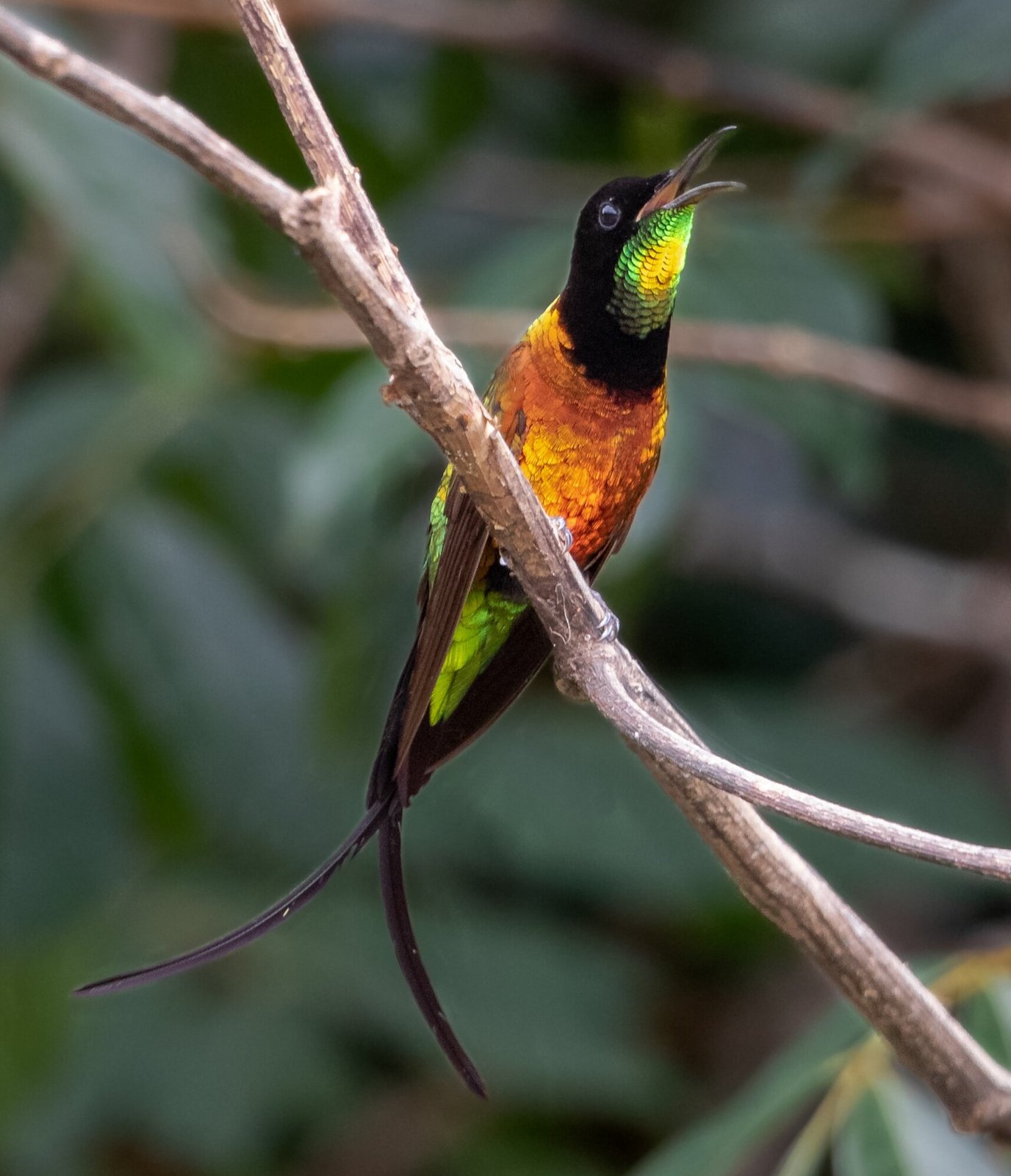
The Fiery Topaz is one of the largest hummingbirds of the Amazonian lowlands. The male is glossy red and orange, with a black head and two long, crossed tail feathers. It lives mainly along shady forest streams and blackwater rivers in the north-west of the Amazon basin.
Voice
Usually rather silent. It calls with dry, sharp chik notes and short twittering series, mainly during chases over the water.
Recording: Juan Freile — CC BY-NC-SA 4.0 · xeno-canto
Identification
Male including the elongated tail feathers 20–23 cm, female about 13 cm; the bill is black and slightly decurved. The male has a velvety black head and a glittering green throat with a golden-yellow centre. The back, breast and belly are glossy red to orange-red. The tail is dark purplish, with two long, narrow central feathers that cross each other. The female is green, with a glittering reddish throat patch and a dark tail without elongated feathers.
Confusion species
The related Crimson Topaz Topaza pella is very similar, but the male has rufous outer tail feathers; that species lives further east, in the Guianas and the eastern Amazon basin, and is absent from the guide area. The female may resemble other large green hummingbirds, such as females of White-necked Jacobin Florisuga mellivora, but these have a scaled throat without a red patch and a shorter tail with white tips.
Habitat
Forest along blackwater rivers and small forest streams, flooded forest (igapó) and the edges of terra firme forest in the lowlands, up to about 500 m. It forages mainly in the crowns and over the water, visits flowering trees and lianas and catches insects in the air. Males defend flowering trees against other hummingbirds.
Where the bird is most at home, classified by the vegetation units of the Andes and the west coast.


Range and movements
In Colombia in the south-east, in the Amazon basin and the Orinoco drainage east of the Andes. In Ecuador in the eastern lowlands. In Peru in the north of the Amazonian lowlands, mainly in Loreto. Absent from Bolivia and the Galápagos. Outside the guide area in southern Venezuela and north-western Brazil.
- Resident
- dark = core range, pale = thinly spread
How and when to look
Travel by boat or on foot along blackwater streams and watch flowering trees over the water, for example in eastern Ecuador or around Iquitos in Peru. Males often use a regular perch on a bare branch over a stream.
Conservation status
Least Concern. Its range lies largely in little-disturbed rainforest.
Scientific name
Topaza pyra | (Gould, 1846)
Gould described the species in 1846 as Trochilus (Topaza) pyra; because it was later moved to another genus, the author and year stand in brackets. The genus Topaza was introduced in 1840 by Gray. The genus name comes from Latin topazus (Greek topazos), 'topaz', after the golden glittering throat. The specific name comes from Greek pur, 'fire', after the fiery red plumage. The specimen the first description was based on came from Rio Negro, Brazil.