All species › Swifts › Hummingbirds › White-necked Jacobin
White-necked Jacobin | Florisuga mellivora
Witnekkolibrie | Colibrí nuca blanca | Beija-flor-azul-de-rabo-branco
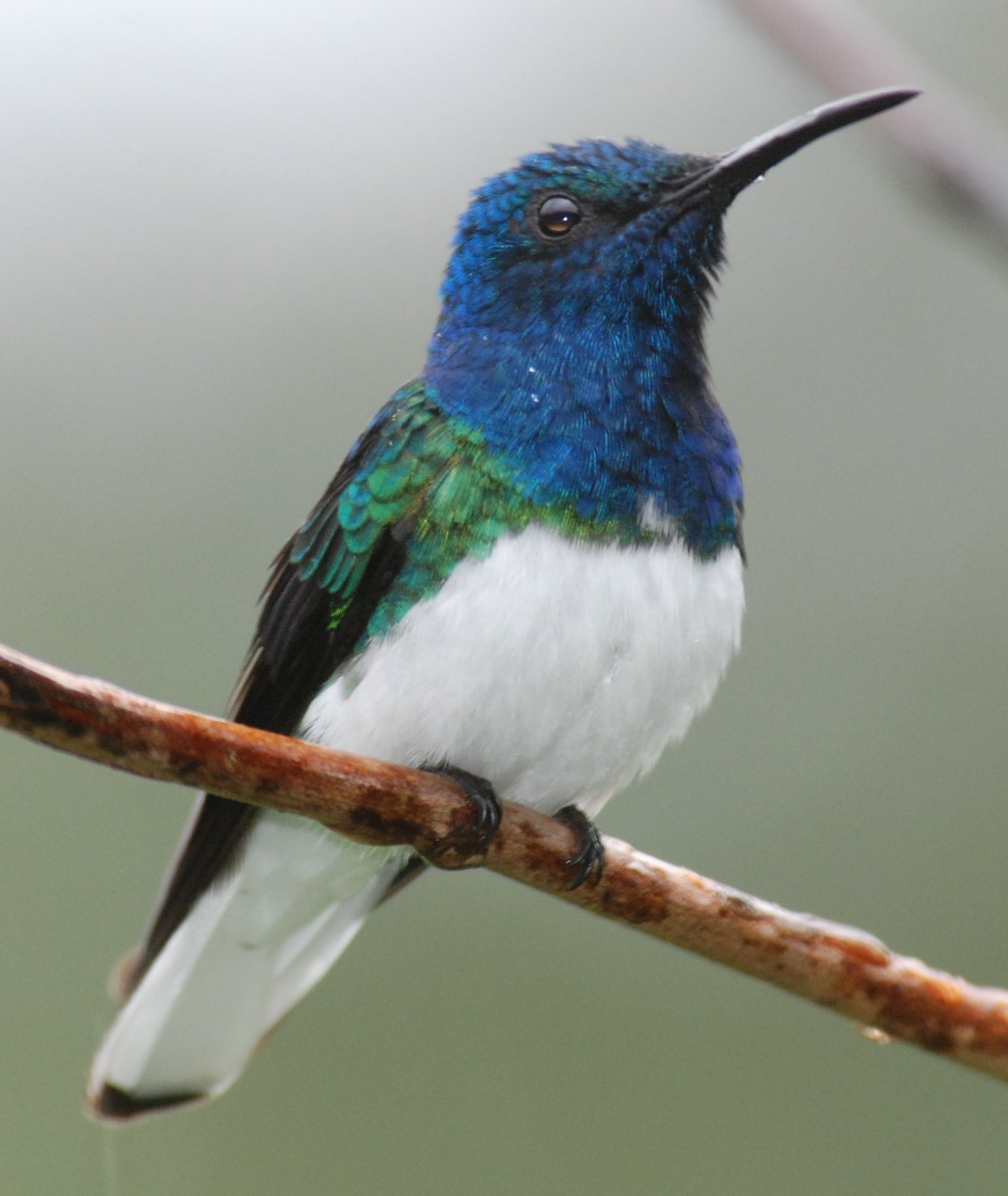
The White-necked Jacobin is a fairly large hummingbird of the warm lowlands. The male has a blue head, a white crescent on the nape and an almost entirely white tail. It often forages high in the canopy and along forest edges and catches many insects in the air. Females vary in plumage: some of them wear a plumage that resembles that of the male.
Voice
High, thin tsee notes and series of sharp, squeaky calls, often from a high perch; during chases dry, twittering notes.
Recording: Brice de la Croix — CC BY-NC-SA 4.0 · xeno-canto
Identification
11–12 cm, with a straight, black bill of medium length. The male has the head, throat and breast glossy dark blue, a white band on the hindneck and a green back. The belly is white. The tail is white with a narrow black edge at the tip; in flight the white of the tail stands out. The female is green above; the throat and breast are scaled green and greyish white, the belly is white and the tail is green with a dark band and white tips. Some females have a plumage that closely resembles that of the male. Young birds have a rufous wash on the sides of the throat.
Confusion species
The male is unmistakable because of the combination of blue head, white nape band and white tail. Females of woodnymphs, such as Fork-tailed Woodnymph Thalurania furcata and Crowned Woodnymph Thalurania colombica, are plain grey below, without a scaled throat, and have a dark, forked tail. Black-eared Fairy Heliothryx auritus is clean white below, with a black ear patch and a long tail with white outer feathers.
Habitat
Canopy and edges of humid lowland forest, clearings, riverbanks, secondary forest and plantations with shade trees, from sea level to about 1000 m, locally higher. It visits flowering trees and epiphytes high in the forest and hunts insects in short flights above the canopy or over water. The nest is a small cup of plant down on a leaf or a thin twig.
Where the bird is most at home, classified by the vegetation units of the Andes and the west coast.


Range and movements
In Colombia in the lowlands on both sides of the Andes, from the Pacific coast and the Caribbean lowlands to the Amazon basin. In Ecuador in the western and eastern lowlands. In Peru in the Amazonian lowlands and the Andean foothills. In Bolivia in the lowlands of the north and centre. Absent from the Galápagos. Outside the guide area from southern Mexico through Central America to Venezuela, the Guianas, Trinidad and Tobago and Amazonian Brazil.
- Resident
- dark = core range, pale = thinly spread
How and when to look
Watch flowering trees at forest edges and along rivers; from a canopy tower or a bridge you look down on the canopy. It regularly comes to feeders at lowland lodges.
Conservation status
Least Concern. The species has a large range and also uses forest edges and secondary forest.
Scientific name
Florisuga mellivora | (Linnaeus, 1758)
Linnaeus described the species in 1758 as Trochilus mellivorus; because it was later moved to another genus, the author and year stand in brackets. The genus Florisuga was introduced in 1850 by Bonaparte. The genus name combines Latin flos (floris), 'flower', with sugere, 'to suck'. The species name combines Latin mel, 'honey', with -vorus, 'eating': 'honey-eating'. The specimen the first description was based on came from Suriname.