All species › Passerines › Tyrant flycatchers and allies › Brown-capped Tyrannulet
Brown-capped Tyrannulet | Ornithion brunneicapillus
Bruinkapvliegenpikker | Mosquerito coronipardo | Poiaeiro-de-boné-castanho
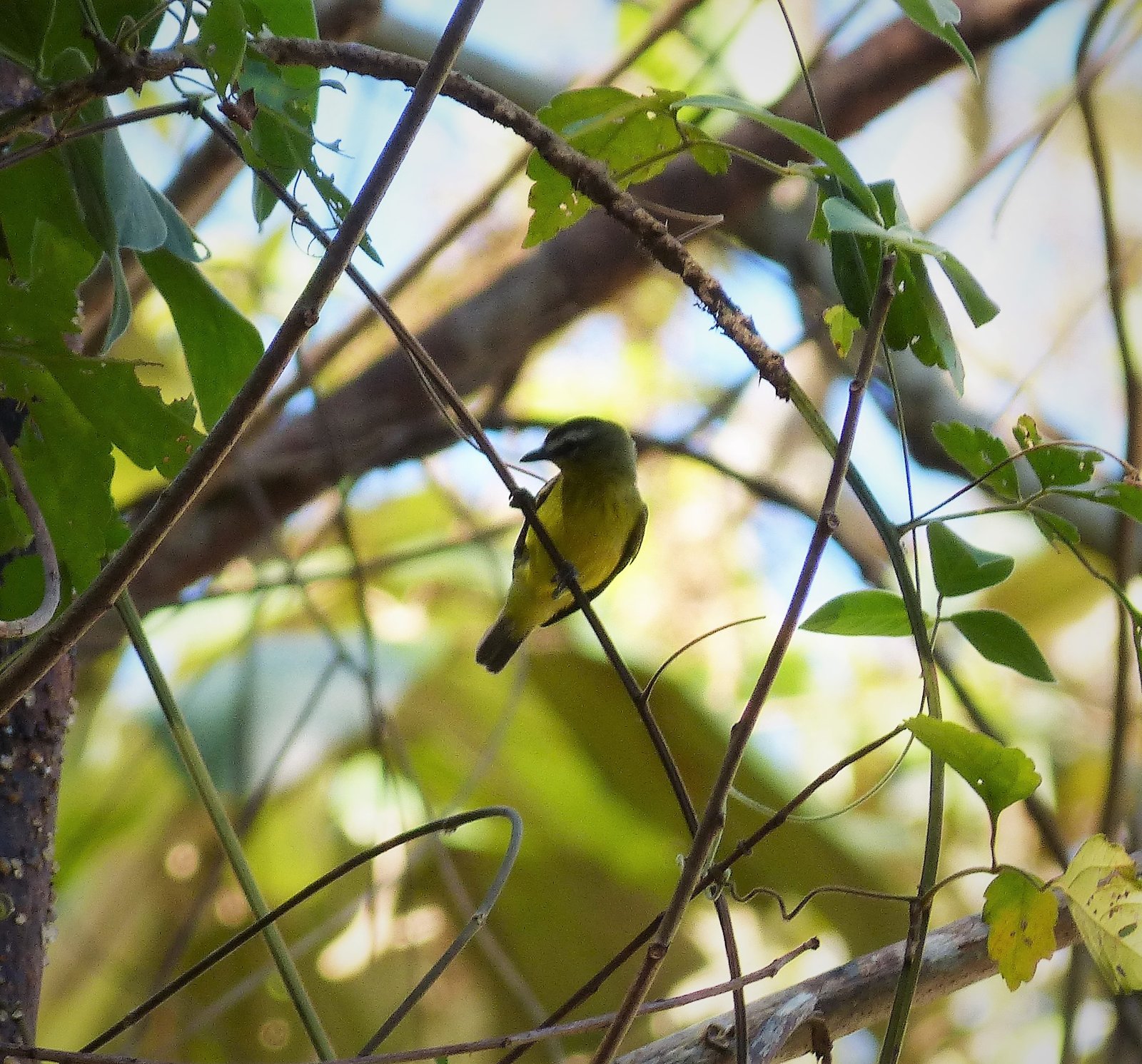
The Brown-capped Tyrannulet is one of the smallest tyrannulets of the humid lowland forests west of the Andes. It has a brown cap, a white eyebrow and bright yellow underparts. It lives high in the canopy and is often first noticed by its whistled call.
Voice
A series of three to five high, clear whistles that descend in pitch, such as pee, pi-pi-pi.
Recording: Kent Livezey — CC BY-NC-SA 4.0 · xeno-canto
Identification
8 cm, compact, with a short bill and a very short tail. The crown is dark brown, with a short white eyebrow. The upperparts are olive-green. The wings lack wing bars. The underparts are bright yellow, the throat slightly paler. The sexes are alike.
Confusion species
White-lored Tyrannulet Ornithion inerme lives east of the Andes and has two rows of white spots on the wing. Yellow-crowned Tyrannulet Tyrannulus elatus has a grey face, two white wing bars and a yellow crown stripe. Golden-faced Tyrannulet Zimmerius chrysops is larger, with a yellow face and a longer tail.
Habitat
The canopy and edges of humid lowland and foothill forest, also tall secondary forest and shady plantations, up to about 900 m. It searches for small insects among the leaves in the treetops, often in mixed flocks. The nest has been little described.
Where the bird is most at home, classified by the vegetation units of the Andes and the west coast.


Range and movements
Colombia: in the Pacific lowlands, the north and the Magdalena valley. Ecuador: in the western lowlands and foothills. Absent from Peru, Bolivia and the Galápagos. Outside the guide area in Costa Rica, Panama and north-western Venezuela.
- Resident
- dark = core range, pale = thinly spread
How and when to look
Listen at forest edges in the Chocó lowlands for the descending whistles, then search the treetops for a tiny yellow bird with a short tail.
Conservation status
Least Concern. Lowland forest west of the Andes is being cleared in many places, but the species also lives in secondary forest.
Scientific name
Ornithion brunneicapillus | (Lawrence, 1862)
Lawrence described the species in 1862 as Tyrannulus brunneicapillus; because it was later moved to another genus, the author and year stand in brackets. The genus Ornithion was introduced in 1853 by Hartlaub. The genus name comes from Greek ornithion, 'little bird', a diminutive of ornis, 'bird'. The species name comes from Medieval Latin brunneus, 'brown', and Latin capillus, 'hair of the head', so 'brown-capped'. The specimen the first description was based on came from Isthmus of Panama, Panama.