All species › Passerines › Tyrant flycatchers and allies › White-lored Tyrannulet
White-lored Tyrannulet | Ornithion inerme
Witteugelvliegenpikker | Tiranolete loriblanco | Poiaeiro-de-sobrancelha
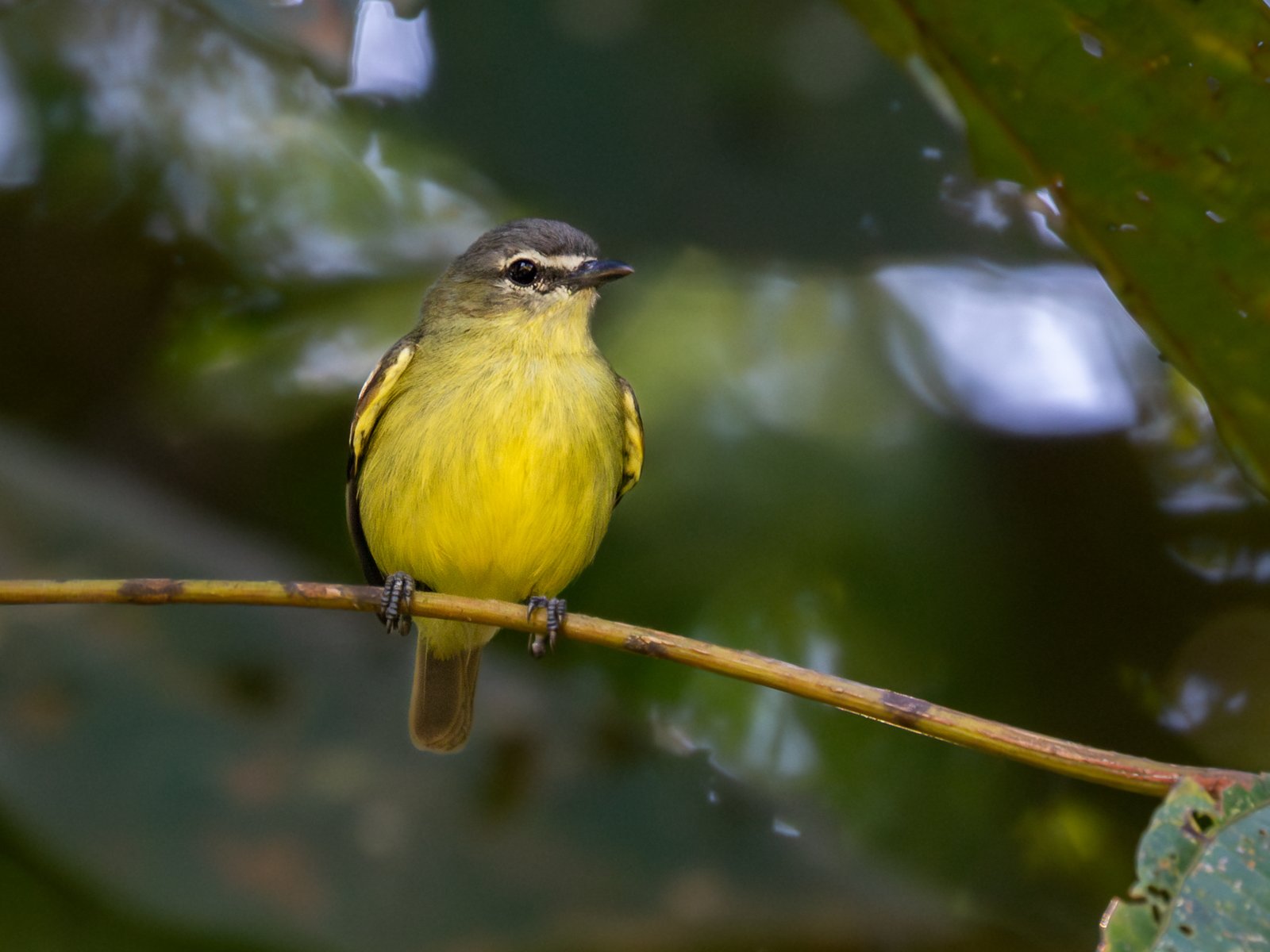
The White-lored Tyrannulet is a tiny tyrannulet of the canopy of the Amazon rainforest. Two rows of white spots on the wing and white lores and eye-ring separate it from other small tyrannulets. Its high, whistled call is often the first sign of its presence.
Voice
A high, clear whistle followed by a rapid series of shorter notes, such as deee, di-di-di.
Recording: JAYRSON ARAUJO DE OLIVEIRA — CC BY-NC-SA 4.0 · xeno-canto
Identification
8.5 cm, with a short bill and a short tail. The crown is grey to olive-grey, with white lores and a short white eyebrow that forms spectacles with the white eye-ring. The upperparts are olive-green. The wings are dark, with two rows of round white spots. The throat is greyish, the breast olive-yellow, the belly pale yellow. The sexes are alike.
Confusion species
Brown-capped Tyrannulet Ornithion brunneicapillus lives west of the Andes and has a brown cap and no wing spots. Yellow-crowned Tyrannulet Tyrannulus elatus has a yellow crown stripe, a grey face and continuous wing bars. Red-billed Tyrannulet Zimmerius cinereicapilla and Slender-footed Tyrannulet Zimmerius gracilipes lack the white wing spots.
Habitat
The canopy and edges of humid lowland forest, both terra firme and várzea, and tall secondary forest, up to about 1000 m. It searches for small insects among leaves in the treetops, often in mixed flocks. The nest has been little described.
Where the bird is most at home, classified by the vegetation units of the Andes and the west coast.


Range and movements
Colombia, Ecuador and Peru: in the Amazonian lowlands east of the Andes. Bolivia: in the north and east of the lowlands. Absent from the Galápagos. Outside the guide area in Venezuela, the Guianas and much of Brazil, including the Atlantic Forest.
- Resident
- dark = core range, pale = thinly spread
How and when to look
Listen in Amazonian forest for the high whistles, especially along forest edges, clearings and from canopy towers, then search the treetops for the white wing spots.
Conservation status
Least Concern. The species has a very large range.
Scientific name
Ornithion inerme | Hartlaub, 1853
Hartlaub described the species in 1853 and placed it straight away in the genus where it still stands. He introduced the genus Ornithion in that same work. The genus name comes from Greek ornithion, 'little bird', a diminutive of ornis, 'bird'. The species name comes from Latin inermis, 'helpless, inoffensive', from in-, 'not', and arma, 'arms'. The specimen the first description was based on came from Bahia, Brazil.