All species › Passerines › Tyrant flycatchers and allies › Black-crested Tit-Tyrant
Black-crested Tit-Tyrant | Anairetes nigrocristatus
Zwartkuifmeestiran | Cachudito crestinegro | Tiranete-chapim-de-crista-preta
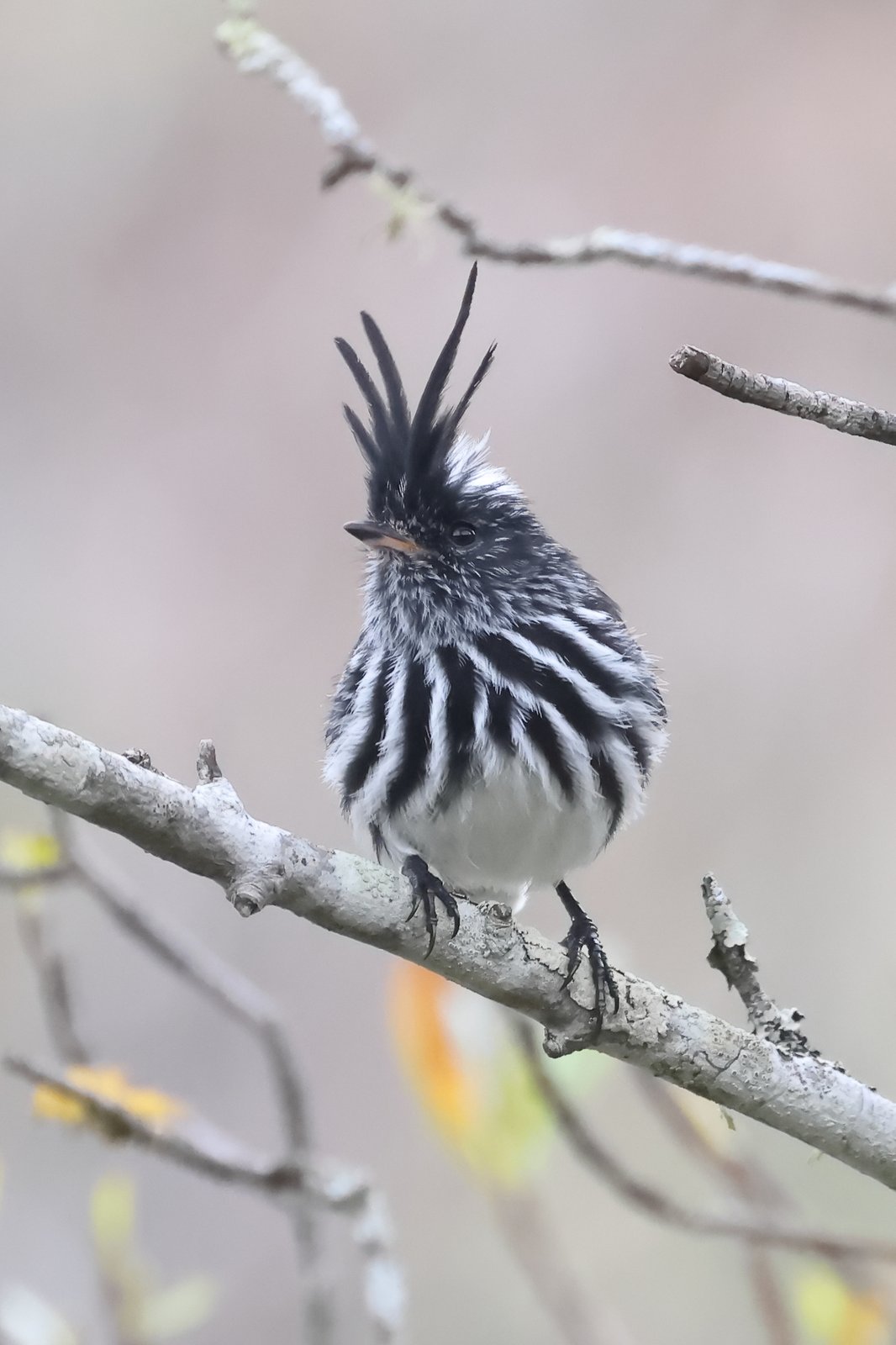
The Black-crested Tit-Tyrant is the largest and most boldly patterned member of its genus. The male has a long black crest of elongated crown feathers and an orange bill. The species lives in Polylepis woodland and montane scrub in northern Peru and the far south of Ecuador.
Voice
A squeaky, sputtering trreek!, repeated, a descending chatter tee! titititititer and a rising and falling trill.
Recording: Paul Coopmans — CC BY-NC-SA 4.0 · xeno-canto
Identification
13 cm. Male: head black with a long, erect black crest of elongated central crown feathers; upperparts and underparts broadly streaked black and white; wing coverts black with two white wing bars. Bill bright orange with a blackish tip; iris dark brown. Female has a shorter crest and darker forehead, dusky and white where the male is black and white; the bill is mostly black with some yellow-orange at the base of the lower mandible. Juveniles have a dusky crown, an even shorter crest, olive-streaked upperparts and dirty white underparts with brown streaks.
Confusion species
Pied-crested Tit-Tyrant Anairetes reguloides is smaller, with a white hindcrown and nape and a yellow to orange-red bill; it lives further south and lower, and where both species occur it mostly stays below about 2800 m. Tufted Tit-Tyrant Anairetes parulus is smaller and greyer, with a curled crest, a pale iris and a black bill. Yellow-billed Tit-Tyrant Anairetes flavirostris has a white crown, grey-brown upperparts, a yellow lower mandible and a yellowish belly.
Habitat
Polylepis woodland and adjacent montane scrub near the treeline and in ravines, mostly between 2100 and 4000 m. It searches for insects in shrubs and low trees, usually in pairs. Little is known about its breeding; the breeding season probably includes June and July.
Where the bird is most at home, classified by the vegetation units of the Andes and the west coast.


Range and movements
Ecuador: only in the far south of Loja. Peru: on the west slope of the Andes south to Áncash, in the upper Marañón valley and very locally on the east slope in Huánuco. Colombia and Bolivia: absent. Absent from the Galápagos.
- Resident
- dark = core range, pale = thinly spread
How and when to look
Search Polylepis groves and scrub in ravines in northern Peru, for example in Áncash; look for the black-and-white plumage, the crest and the male's orange bill.
Conservation status
Least Concern. The range is restricted, but the population is believed to be stable and no immediate threats are known. Very local in Ecuador, uncommon to locally fairly common in Peru, including in national parks.
Scientific name
Anairetes nigrocristatus | Taczanowski, 1884
Taczanowski described the species in 1884 and placed it straight away in the genus where it still stands. The genus Anairetes was introduced in 1850 by Reichenbach. The genus name comes from Greek anairetēs, 'destroyer, slayer'. The species name comes from Latin niger, 'black', and cristatus, 'crested'. The specimen the first description was based on came from Chota, Cajamarca, Peru.