All species › Passerines › Tyrant flycatchers and allies › Pied-crested Tit-Tyrant
Pied-crested Tit-Tyrant | Anairetes reguloides
Gestreepte meestiran | Cachudito crestiblanco | Tiranete-chapim-de-crista-malhada
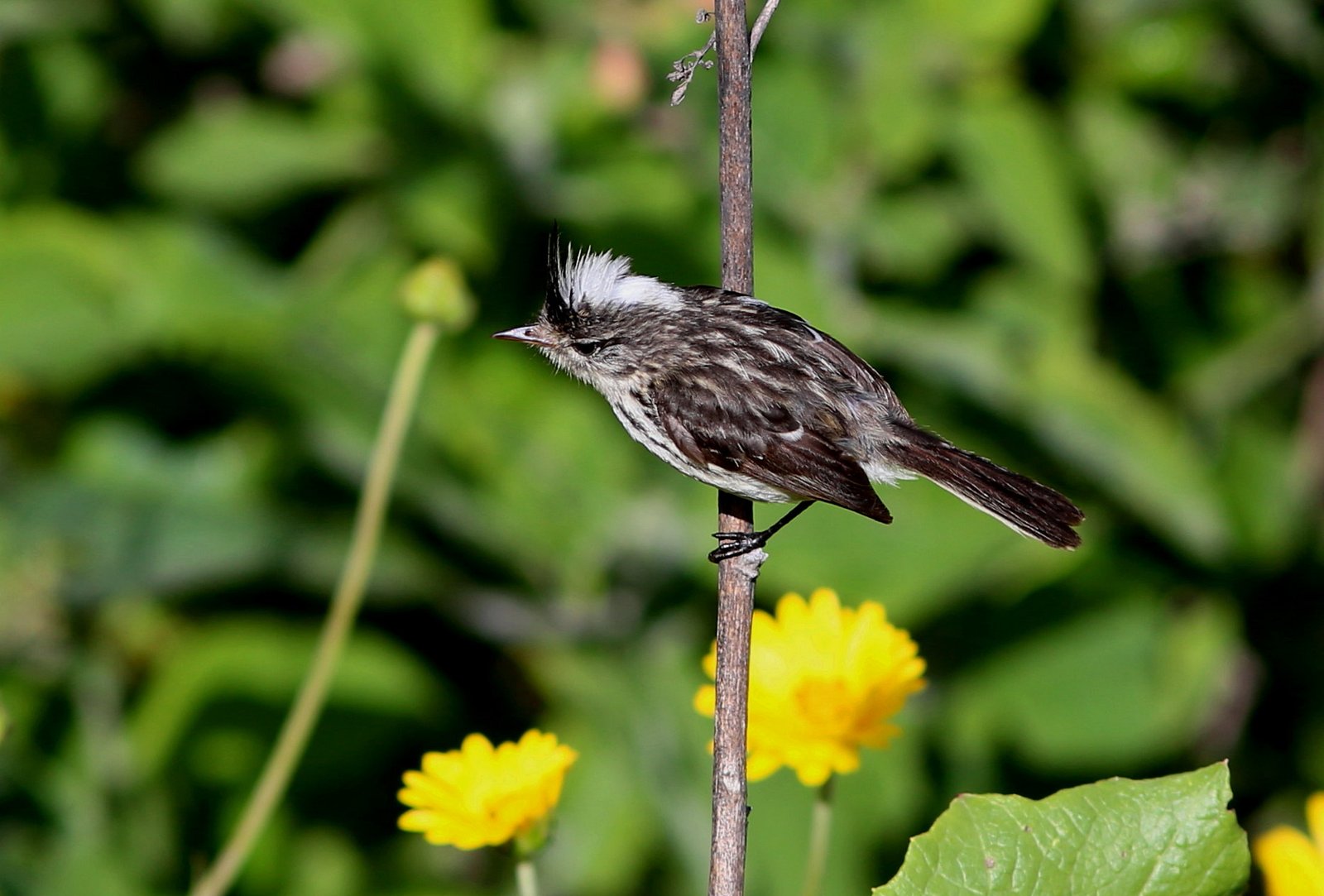
The Pied-crested Tit-Tyrant is a small, black-and-white streaked tyrant of dry scrub on the Pacific side of Peru, from the coast high into the Andes. The male has a split black crest above a white hindcrown. It also lives in hedgerows and riparian thickets, even within Lima.
Voice
The dawn song is a squeaky series of notes with rising churrs; the call is a descending series of squeaky, mewing notes, sometimes with a dry rattle.
Recording: Nick Athanas — CC BY-NC-SA 3.0 · xeno-canto
Identification
11–12 cm. Male: split black crest, hindcrown and nape white, rest of head black; upperparts black with thin white streaks; wings with two white wing bars; tail black with thin white tips and white outer webs to the outer feathers; breast and flanks streaked black and white, belly whitish with a faint yellow tinge. Female has a shorter crest, a white crescent below the eye and a black throat with thin white streaks, otherwise dark grey and white. Bill yellow to orange-red with a dark tip; iris dark brown. Juveniles have an even shorter crest, dark buffy-brown upperparts and pale buffy underparts. The northern subspecies albiventris has a longer crest, a pure white belly and more white on crown, nape and tail.
Confusion species
Black-crested Tit-Tyrant Anairetes nigrocristatus is larger, with a longer, all-black crest and no white hindcrown; it lives higher and further north. Yellow-billed Tit-Tyrant Anairetes flavirostris has grey-brown upperparts, a yellowish belly and a black upper mandible. Tufted Tit-Tyrant Anairetes parulus has a curled crest, a pale iris, a black bill and a greyish back.
Habitat
Mainly arid coastal areas: scrub, thickets along watercourses, lomas and hedgerows between fields; locally also Polylepis woodland above the treeline. From sea level to 4000 m; in the north mostly below about 2800 m, where it meets the Black-crested Tit-Tyrant. It searches for insects in shrubs, usually in pairs.
Where the bird is most at home, classified by the vegetation units of the Andes and the west coast.


Range and movements
Peru: on the west slope and in the coastal valleys from Áncash south to Tacna; single specimens known from Cusco and Apurímac. Colombia, Ecuador and Bolivia: absent. Absent from the Galápagos. Outside the guide area in the far north-west of Chile (Arica).
- Resident
- dark = core range, pale = thinly spread
How and when to look
Search scrub, hedgerows and riparian thickets in the coastal valleys and on the lower west slope, for example along the rivers around Lima.
Conservation status
Least Concern. The population is believed to be stable. Its habitat is strongly affected by land use, but the species also occurs in hedgerows and in riparian thickets within Lima.
Scientific name
Anairetes reguloides | (d'Orbigny, ACVMD & de Lafresnaye, 1837)
D'Orbigny, ACVMD & de Lafresnaye described the species in 1837 as C[ulicivora] reguloides; because it was later moved to another genus, the author and year stand in brackets. The genus Anairetes was introduced in 1850 by Reichenbach. The genus name comes from Greek anairetēs, 'destroyer, slayer'. The species name comes from Regulus (kinglets) and Greek -oidēs, 'resembling', referring to the crest. The specimen the first description was based on came from Tacna, Peru.