All species › Passerines › Shrike-babblers, Erpornis and vireos › Brown-capped Vireo
Brown-capped Vireo | Vireo leucophrys
Witbrauwvireo | Vireo gorra parda | Juruviara-de-boné-pardo
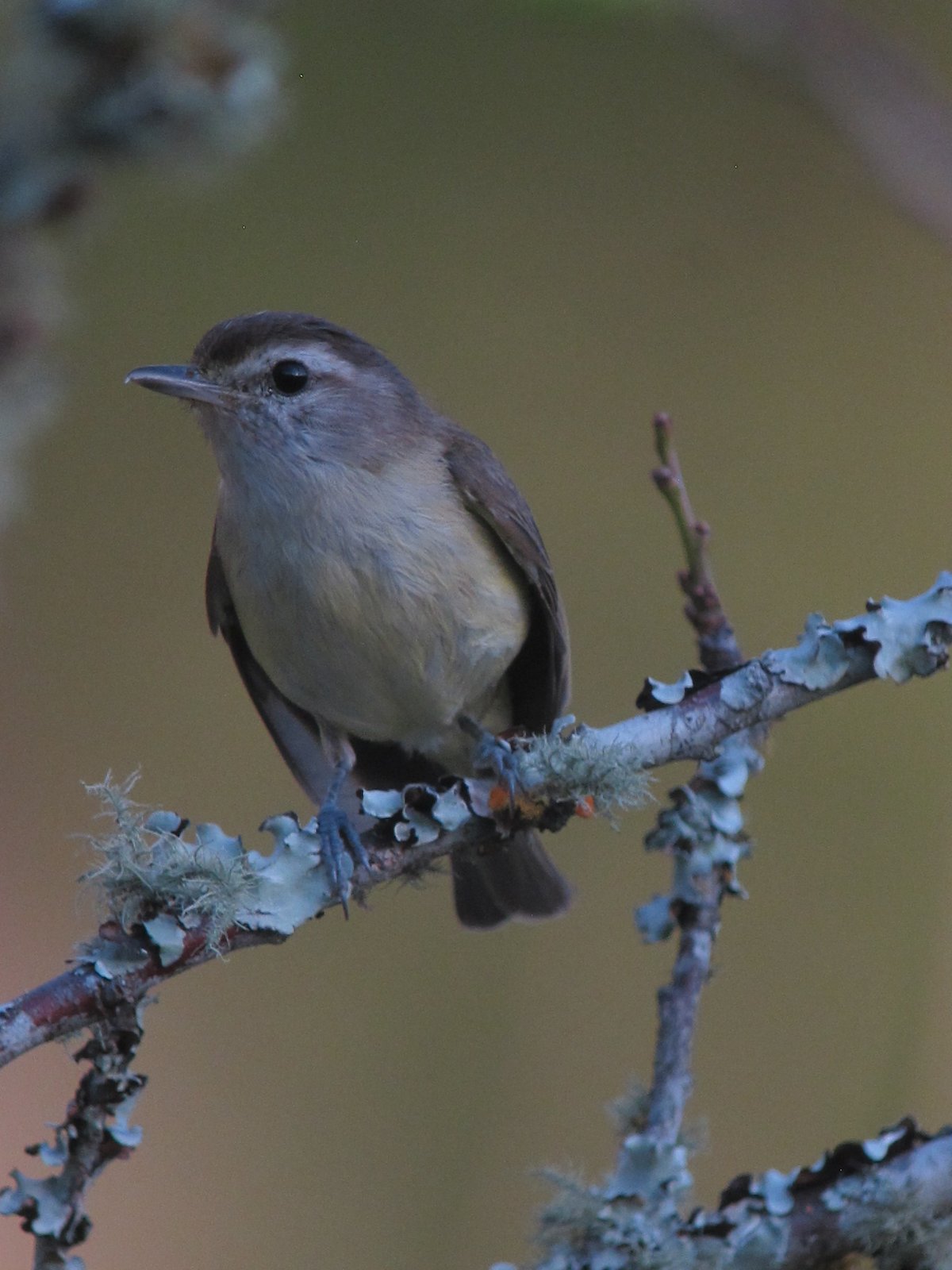
The Brown-capped Vireo is the common vireo of the montane forests of the Andes, from Colombia to Bolivia. It was formerly regarded as a subspecies of Warbling Vireo. Its warbled song is heard from the canopy throughout the year.
Voice
A short, warbled phrase of rapid notes, often repeated at length. Calls with a nasal, scolding note.
Recording: José María Loaiza B. — CC BY-NC-SA 4.0 · xeno-canto
Identification
12–13 cm, with a short, fairly stout bill and dark eyes. The crown and nape are brown, with a conspicuous white supercilium and a dark eye-line. The back, wings and tail are olive-brown to olive-green, without wing bars. The throat and breast are whitish, the belly and flanks pale yellow. The sexes are alike.
Confusion species
Warbling Vireo Vireo gilvus is a very rare winter visitor, greyer, without a brown cap. Red-eyed Vireo Vireo olivaceus is larger, with a grey crown, red eyes and a white belly, and lives lower. Rufous-naped Greenlet Pachysylvia semibrunnea has a rufous crown and nape without a white supercilium. Philadelphia Vireo Vireo philadelphicus has a grey crown and a yellow throat.
Habitat
Humid montane forest, cloud forest, forest edges and old secondary forest, roughly between 1200 and 2700 m, locally lower or higher. It searches the canopy foliage for insects and also eats small fruits; often in mixed flocks with tanagers and warblers. The nest is a small, hanging cup in the fork of a branch.
Where the bird is most at home, classified by the vegetation units of the Andes and the west coast.


Range and movements
Colombia: in all three Andean ranges, the Serranía de Perijá and the Sierra Nevada de Santa Marta. Ecuador: on both slopes of the Andes. Peru: mainly on the eastern slope along the whole length of the country, in the north also on the western slope. Bolivia: on the eastern slope of the Andes, from La Paz to Santa Cruz. Absent from the Galápagos. Outside the guide area in the mountains from Mexico to Panama and in Venezuela.
- Resident
- dark = core range, pale = thinly spread
How and when to look
Listen for the warbled song at the edges of montane forest and check mixed flocks in the canopy for a vireo with a brown cap and white supercilium.
Conservation status
Least Concern. The species is widespread and tolerates forest edges and secondary forest.
Scientific name
Vireo leucophrys | (de Lafresnaye, 1844)
De Lafresnaye described the species in 1844 as Hylophilus leucophrys; because it was later moved to another genus, the author and year stand in brackets. The genus Vireo was introduced in 1808 by Vieillot. The genus name is Latin vireo, a green migratory bird, perhaps the female golden oriole or the greenfinch; related to virere, 'to be green'. The species name comes from Greek leukos, 'white', and ophrus, 'eyebrow': 'white-browed'. The specimen the first description was based on came from Colombia.