All species › Passerines › Swallows › Brown-chested Martin
Brown-chested Martin | Progne tapera
Bruinborstzwaluw | Golondrina parda | Andorinha-do-campo
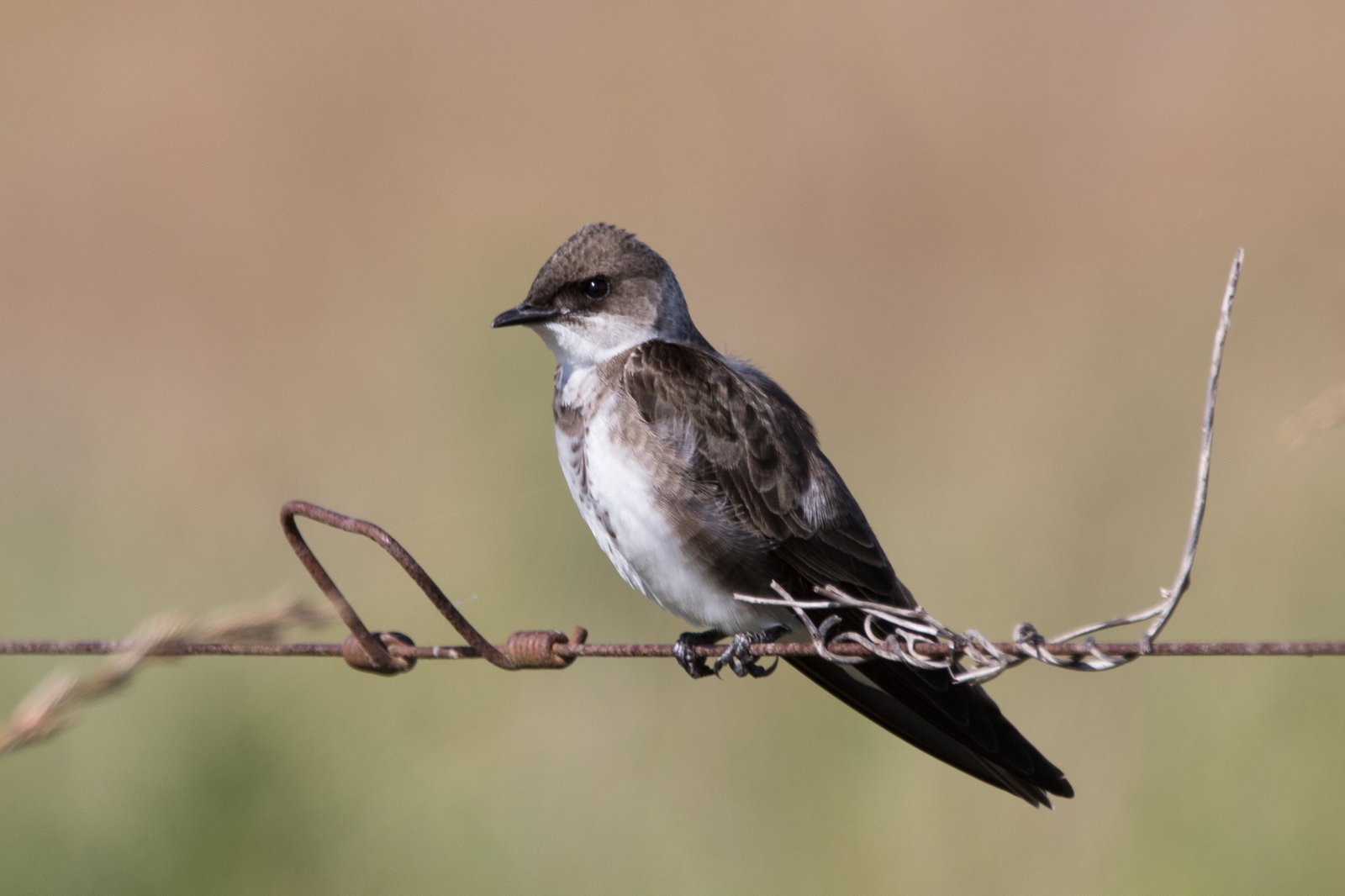
The Brown-chested Martin is a brown-and-white martin of open lowlands whose plumage is more reminiscent of a large Bank Swallow. It hunts with slow, gliding flight over rivers, savannas and pastures. In addition to the resident birds, birds of the southern subspecies fusca move into the guide area during the austral winter.
Voice
A gurgling, somewhat hoarse twitter and short, dry calls, often in flight.
Recording: JAYRSON ARAUJO DE OLIVEIRA — CC BY-NC-SA 4.0 · xeno-canto
Identification
16–18 cm, with broad wings and a slightly forked tail. The upperparts are uniform greyish brown, without gloss. The throat and belly are white, with a brown breast band; in the southern subspecies fusca a line of dark drop-shaped spots runs down the centre of the breast below the band. The undertail coverts are white and often fluffy, sometimes protruding at the sides of the tail. The sexes are alike. Juveniles have a less distinct breast band.
Confusion species
Bank Swallow Riparia riparia has the same pattern but is much smaller, with a narrower, more sharply defined breast band and faster, more fluttering flight. Grey-breasted Martin Progne chalybea is glossy blue above and has a greyish-brown throat. Southern Rough-winged Swallow Stelgidopteryx ruficollis is smaller, with a cinnamon throat and no breast band.
Habitat
Open lowlands near water: riverbanks, river islands, savannas, pastures, marshes and clearings near villages, mostly below 1000 m. It hunts flying insects in the air, often low over water and grassland. It nests in cavities, often in old ovenbird nests, and in holes in banks and trees.
Where the bird is most at home, classified by the vegetation units of the Andes and the west coast.


Range and movements
In Colombia in the lowlands east of the Andes and in the north of the country. In Ecuador and Peru in the Amazonian lowlands east of the Andes. In Bolivia in the lowlands, including the Beni savannas. Absent from the Galápagos. Outside the guide area over much of South America to Argentina; southern birds migrate north in the austral winter, as far as Central America.
- Resident
- dark = core range, pale = thinly spread
How and when to look
Over riverbanks, sandbars and wet savannas in the lowlands, look for a large brown-and-white swallow with slow, gliding flight; birds often perch on dead branches or wires near water.
Conservation status
Least Concern. The species is widespread in open lowlands and locally benefits from deforestation.
Scientific name
Progne tapera | (Linnaeus, 1766)
Linnaeus described the species in 1766 as Hirundo Tapera; because it was later moved to another genus, the author and year stand in brackets. The genus Progne was introduced in 1826 by Boie. The genus name refers to Procne (Greek Proknē), a queen in Greek mythology who was turned into a swallow. The species name comes from Taperá, a Tupi name for a kind of swallow, via the 'Tapera' of Marcgrave (1648). The specimen the first description was based on came from Pernambuco, Brazil.