All species › Passerines › Swallows › Galapagos Martin
Galapagos Martin | Progne modesta
Galápagospurperzwaluw | Martín de Galápagos | Andorinha-de-galápagos
The Galapagos Martin is the only swallow that breeds in the Galápagos and the smallest martin. It occurs thinly and in small numbers, often in pairs or small groups along cliffs and over the highlands. The species is endemic to the islands and Endangered.
Voice
A soft, gurgling twitter and short, warm calls, quieter than those of larger martins.
No recording with a suitable Creative Commons licence is available for this species yet.
Identification
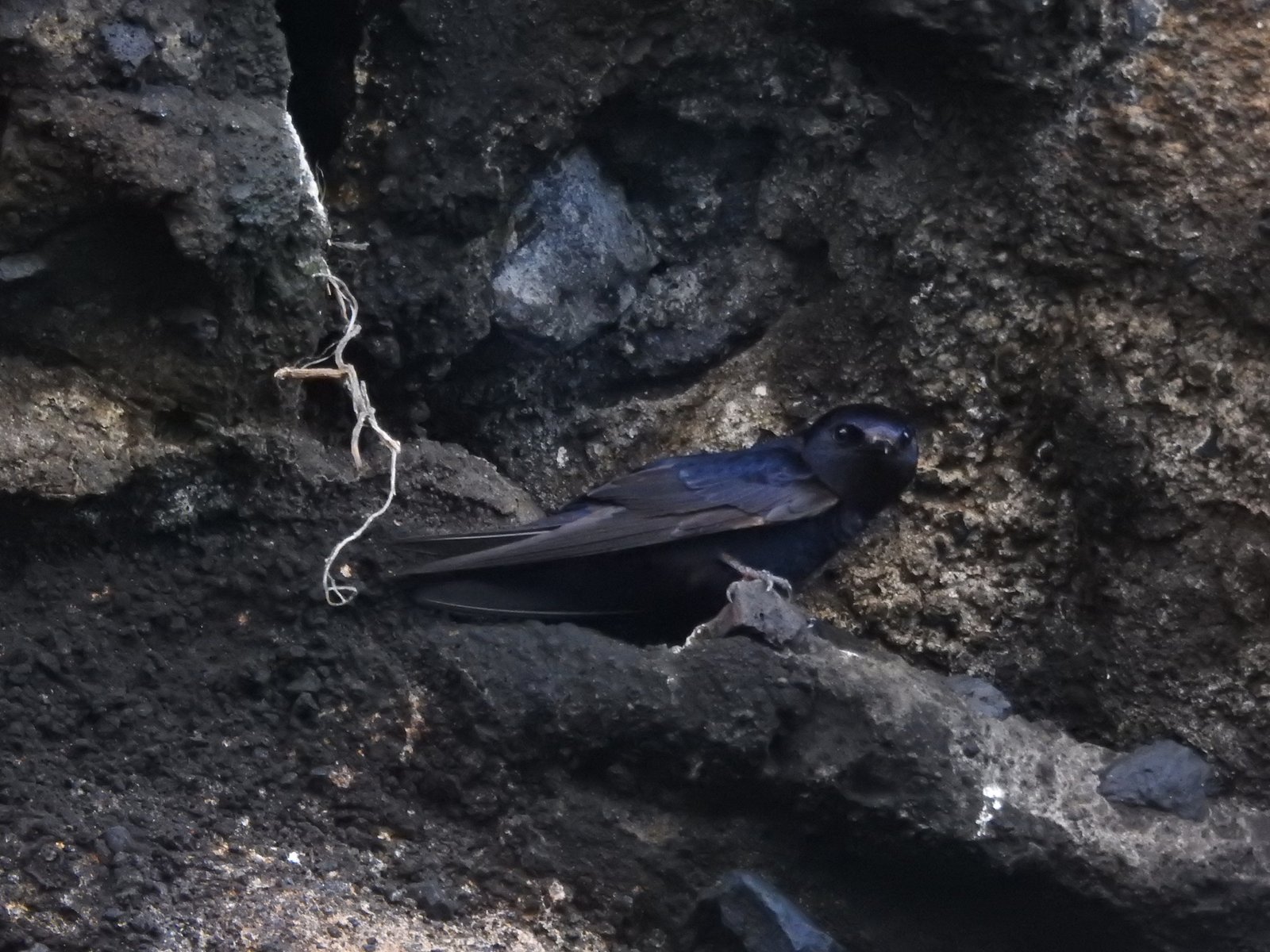
15–16 cm, compact, with broad wings and a slightly forked tail. The male is entirely dark blue-black, with little gloss. The female is dark greyish brown above and slightly paler sooty brown below, with faint pale fringes on the belly and undertail coverts. Juveniles resemble the female.
Confusion species
In the Galápagos only migrant swallows can be confused with it. Barn Swallow Hirundo rustica has a white or cream belly, a rufous throat and long tail streamers. Bank Swallow Riparia riparia is smaller, brown above and white below with a breast band. Purple Martin Progne subis is possible as a vagrant and is clearly larger. Swifts have narrower, sickle-shaped wings.
Habitat
Coastal cliffs, lava fields, crater rims and the humid highlands, from sea level to the higher parts of the islands. It hunts flying insects in the air, often over open ground, along cliffs and over highland vegetation. It nests in crevices and cavities in rock faces and cliffs.
Where the bird is most at home, classified by the vegetation units of the Andes and the west coast.


Range and movements
Endemic to the Galápagos, scattered across the central and western islands, including Isabela, Fernandina, Santa Cruz and Santiago, and also recorded on San Cristóbal and Española. Nowhere numerous. Absent from the mainland.
- Resident
How and when to look
Watch along cliffs and crater rims and over the highlands of the larger islands, such as Isabela and Santa Cruz; birds often hunt low along the rock faces.
Conservation status
Endangered. The population is small and the species occurs only thinly. Possible threats include introduced diseases and parasites, introduced predators and changes in highland vegetation; the causes of its low numbers are not well understood.
Scientific name
Progne modesta | Gould, 1838
Gould described the species in 1838 and placed it straight away in the genus where it still stands. The genus Progne was introduced in 1826 by Boie. The genus name refers to Procne (Greek Proknē), a queen in Greek mythology who was turned into a swallow. Latin modestus means 'modest, unassuming', probably after the plain dark plumage. The specimen the first description was based on came from Isla San Salvador (Santiago), Galápagos.