All species › Passerines › Swallows › Peruvian Martin
Peruvian Martin | Progne murphyi
Peruaanse purperzwaluw | Martín peruano | Andorinha-peruana
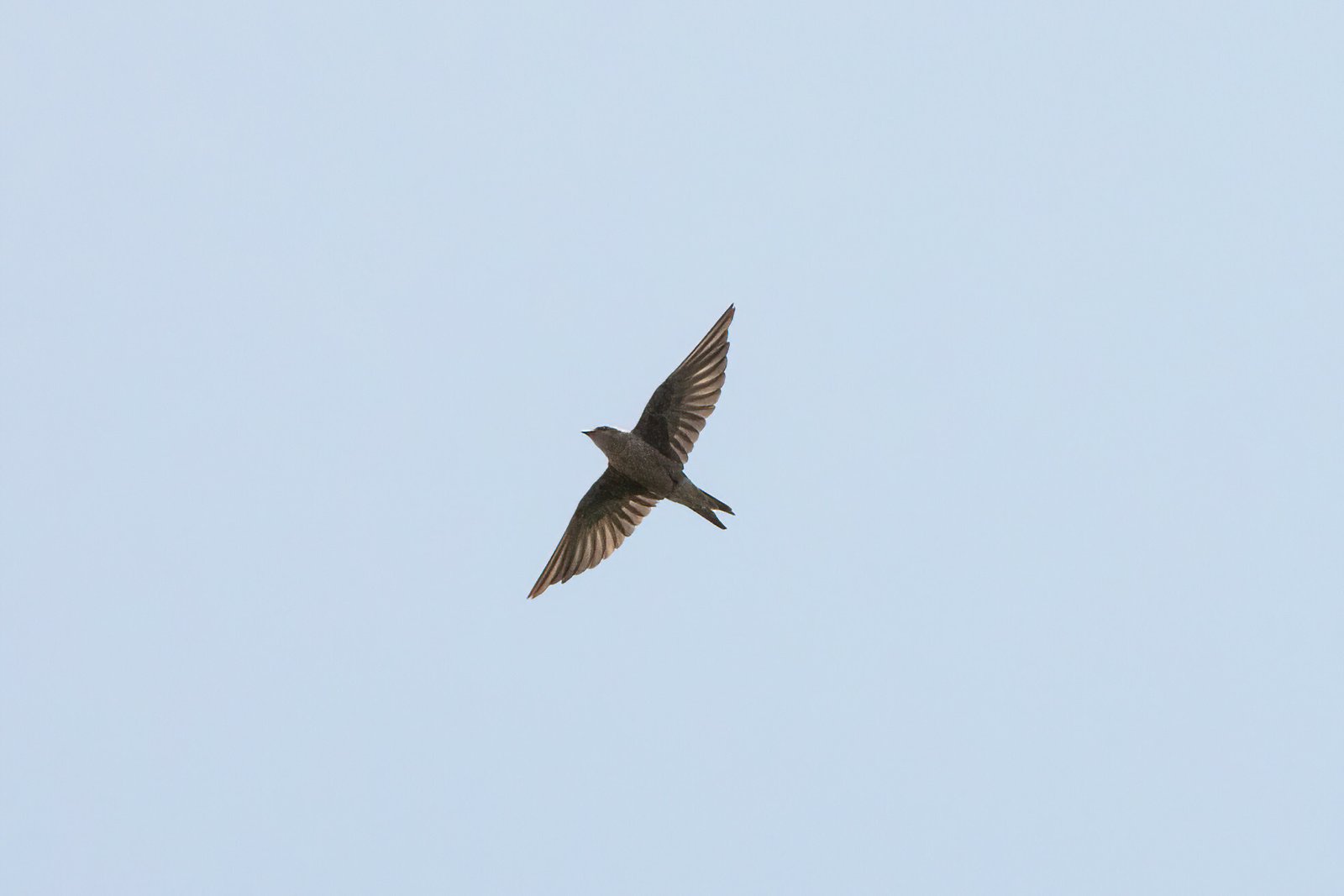
The Peruvian Martin is a small, dark martin of the desert coast of Peru and the far north of Chile. It has a small range and a small population and was long treated as a subspecies of Galapagos Martin. Small groups hunt over coastal towns, irrigated farmland and cliffs.
Voice
A gurgling twitter and short, warm calls, similar to those of other martins.
No recording with a suitable Creative Commons licence is available for this species yet.
Identification
17–18 cm, with broad wings and a moderately forked tail. The male is entirely dark blue-black, with less gloss than other martins. The female is duller above and uniformly sooty brown below, without obvious pale scaling. Juveniles resemble the female.
Confusion species
Southern Martin Progne elegans is larger, with a more deeply forked tail; the female is clearly pale-scaled below. As a migrant it occurs mainly east of the Andes and is exceptional on the coast. Purple Martin Progne subis is larger, and the female has a grey collar and a pale belly. Grey-breasted Martin Progne chalybea has a white belly. Blue-and-white Swallow Pygochelidon cyanoleuca is smaller and white below.
Habitat
The desert coast with cliffs, rocky shores, coastal towns and cities, irrigated farmland in the river valleys, and harbours, from sea level to a few hundred metres. It hunts flying insects in the air, often over fields, riverbanks and buildings. It nests in cavities in cliffs and in buildings.
Where the bird is most at home, classified by the vegetation units of the Andes and the west coast.


Range and movements
In Peru along the Pacific coast, from the north to the south of the country, locally and in small numbers. In Ecuador at most exceptional in the south-west. Absent from Colombia, Bolivia and the Galápagos. Outside the guide area in the far north of Chile.
- Resident
- dark = core range, pale = thinly spread
How and when to look
Watch over coastal towns and irrigated farmland along the Peruvian coast and along sea cliffs; birds also perch on wires and buildings.
Conservation status
Near Threatened. The range is small and the population is considered small; loss of nest sites and changes in coastal agriculture may play a role, but little is known about the causes.
Scientific name
Progne murphyi | Chapman, 1925
Chapman described the species in 1925 and placed it straight away in the genus where it still stands. The genus Progne was introduced in 1826 by Boie. The genus name refers to Procne (Greek Proknē), a queen in Greek mythology who was turned into a swallow. Named after Robert Cushman Murphy (1887–1973), American ornithologist and seabird specialist, who collected the specimens on which the description was based. The specimen the first description was based on came from Talara, Piura, Peru.