All species › Passerines › Swallows › Southern Martin
Southern Martin | Progne elegans
Patagonische purperzwaluw | Golondrina sureña | Andorinha-do-sul
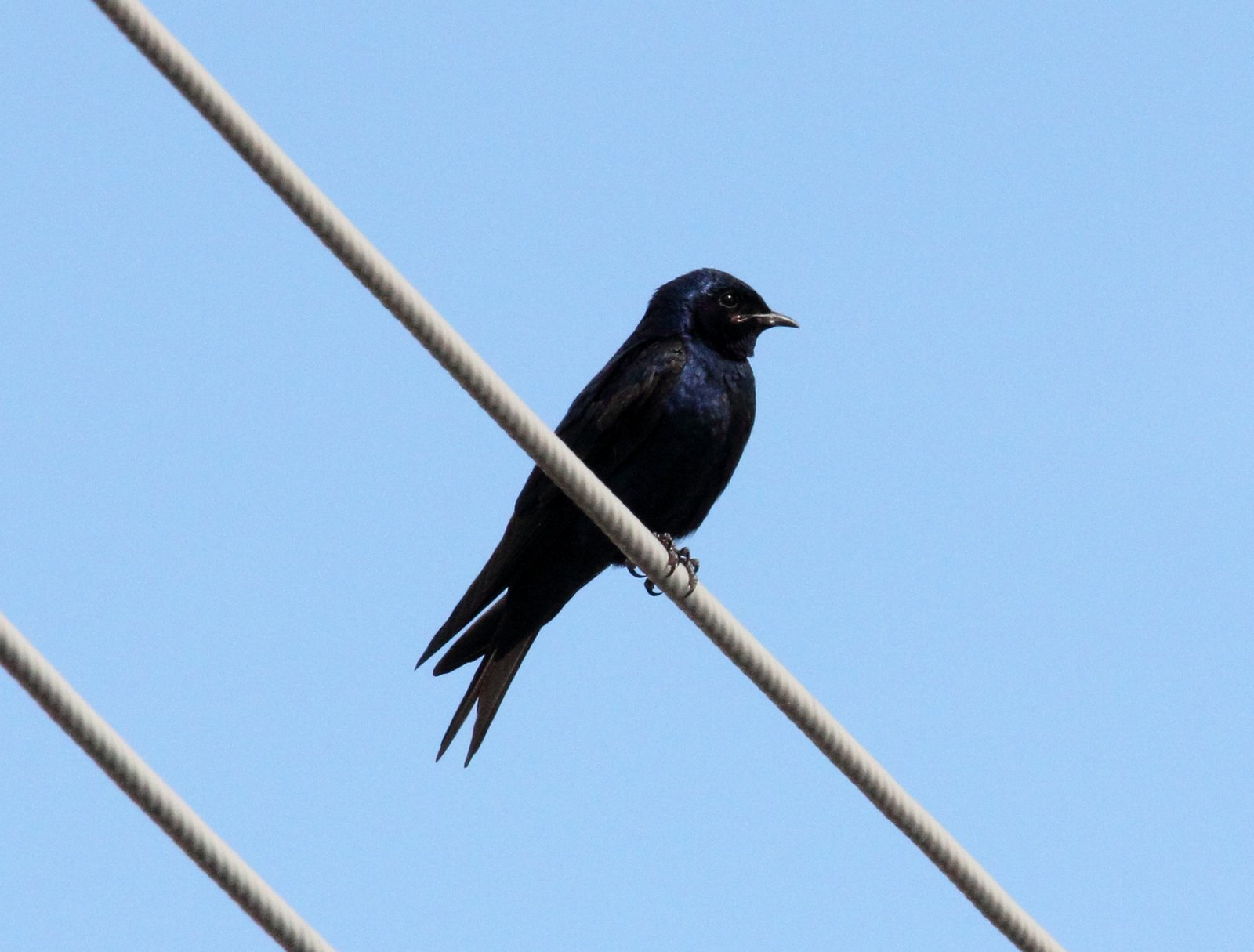
The Southern Martin breeds in southern South America and migrates to western Amazonia in the austral winter. There it sometimes forms large flocks over the major rivers. The male is entirely glossy blue-black and closely resembles that of the North American Purple Martin, which is present in the guide area in the other half of the year.
Voice
A gurgling, chattering song and a warm, short call, similar to those of Purple Martin.
Recording: JAYRSON ARAUJO DE OLIVEIRA — CC BY-NC-SA 4.0 · xeno-canto
Identification
18–20 cm, a sturdy swallow with long, broad wings and a clearly forked tail. The male is entirely glossy blue-black to purplish. The female is duller blue-black above and dark sooty brown below, with pale fringes giving a scaled pattern, especially on the belly and undertail coverts. Juveniles resemble the female.
Confusion species
Purple Martin Progne subis is almost identical in male plumage but has a less deeply forked tail; the female has a grey collar and a paler, streaked belly. The two species are largely present in the guide area in different seasons. Peruvian Martin Progne murphyi is smaller and lives only along the coast. Grey-breasted Martin Progne chalybea has a white belly.
Habitat
In the breeding season open country, dry forest, villages and towns; it nests in cavities in trees, buildings and old ovenbird nests. In the wintering range rivers, river islands, banks and open country in the Amazonian lowlands, mainly below 500 m. It hunts flying insects in the air and roosts in flocks in trees along rivers or in towns.
Where the bird is most at home, classified by the vegetation units of the Andes and the west coast.


Range and movements
In Bolivia a breeding bird in the south and south-east, including the Chaco and the lower Andean valleys, and a passage migrant in the north. In Peru, Ecuador and Colombia a winter visitor and passage migrant in the Amazonian lowlands east of the Andes, mainly from April to September. Absent from the Galápagos. Outside the guide area it breeds in Argentina, Paraguay and Uruguay.
- Summer visitor (c. Apr–Sep)
- Winter visitor (c. Oct–Mar)
- Passage (Mar–Apr, Oct–Nov)
- dark = core range, pale = thinly spread
How and when to look
In the austral winter search along the major Amazonian rivers, for example around Iquitos and in south-eastern Peru, for flocks of dark martins over the water and at roosts in the evening.
Conservation status
Least Concern. The species has a large range and also nests in buildings.
Scientific name
Progne elegans | Baird, 1865
Baird described the species in 1865 and placed it straight away in the genus where it still stands. The genus Progne was introduced in 1826 by Boie. The genus name refers to Procne (Greek Proknē), a queen in Greek mythology who was turned into a swallow. Latin elegans means 'refined, neat'. The specimen the first description was based on came from Río Bermejo, Argentina.