All species › Passerines › Swallows › Southern Rough-winged Swallow
Southern Rough-winged Swallow | Stelgidopteryx ruficollis
Zuid-Amerikaanse ruwvleugelzwaluw | Golondrina alirrasposa sureña | Andorinha-serradora
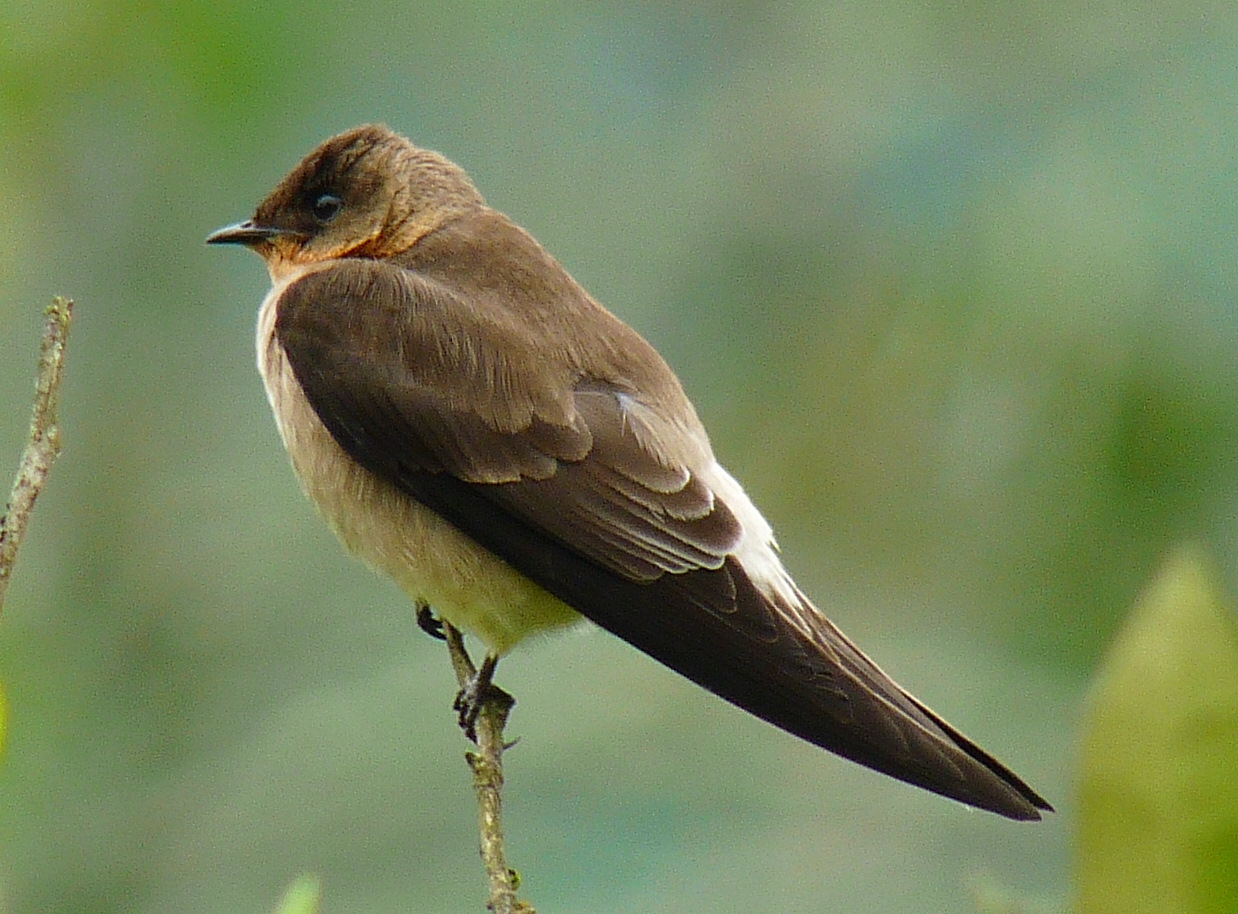
The Southern Rough-winged Swallow is a brown swallow with a cinnamon throat and the most widespread swallow of open country in the lowlands and foothills of the guide area. The name refers to the tiny hooks on the outer primary of the male, which make the leading edge of the wing rough. It nests in burrows in banks and road cuts and is often seen at rivers and along roads.
Voice
A rough, rising brreet or zrrit, often repeated in flight and when perched; faster and sharper when alarmed.
Recording: Mateus Gonçalves Santos — CC BY-NC-SA 4.0 · xeno-canto
Identification
13–14 cm, with a square or slightly notched tail. The upperparts are plain greyish brown; especially in birds of the north and west of the guide area the rump is paler, greyish white to pale buff, and contrasts with back and tail. The throat is cinnamon to rufous, the breast greyish brown, the belly pale yellow to dirty white, and the undertail coverts whitish. The sexes are nearly alike. Juveniles have cinnamon edges to the wing coverts and a less rufous throat.
Confusion species
Northern Rough-winged Swallow Stelgidopteryx serripennis lacks the cinnamon throat and the pale rump, and is only a vagrant in the guide area. Bank Swallow Riparia riparia is white below with a distinct brown breast band. Tawny-headed Swallow Alopochelidon fucata is smaller, with a cinnamon supercilium and nape and a white belly. Brown-chested Martin Progne tapera is much larger, with a white throat and a brown breast band.
Habitat
Open and semi-open country in the lowlands and foothills: riverbanks, sandbars, forest edges, clearings, pasture, roads and villages, mainly below 1500 m, locally higher. It hunts flying insects in low, fairly direct flight, often over water. It perches on wires and bare branches. The nest is in a burrow in a steep bank or road cut, sometimes in a hole in a wall or bridge; the birds dig their own or use existing holes.
Where the bird is most at home, classified by the vegetation units of the Andes and the west coast.


Range and movements
In Colombia widespread in the lowlands and lower slopes on both sides of the Andes. In Ecuador on both sides of the Andes. In Peru east of the Andes and in the north-west. In Bolivia in the lowlands and foothills. Absent from the Galápagos. Outside the guide area from Central America to northern Argentina and Uruguay.
- Resident
- dark = core range, pale = thinly spread
How and when to look
Look along rivers with steep, bare banks and along roads with sandy cuttings, where pairs fly in and out of the nest burrows. Small groups often perch on wires over pasture, sometimes with other swallows.
Conservation status
Least Concern. The species is widespread and locally benefits from road cuts and open country.
Scientific name
Stelgidopteryx ruficollis | (Vieillot, 1817)
Vieillot described the species in 1817 as Hirundo ruficollis; because it was later moved to another genus, the author and year stand in brackets. The genus Stelgidopteryx was introduced in 1858 by Baird. The genus name comes from Greek stelgis, 'scraper', and pterux, 'wing', after the rough, serrated edge of the outer primary. From Latin rufus, 'red', and collum, 'neck', after the rufous throat. The specimen the first description was based on came from Brazil.