All species › Passerines › Swallows › White-thighed Swallow
White-thighed Swallow | Atticora tibialis
Witdijzwaluw | Golondrina musliblanca | Calcinha-branca
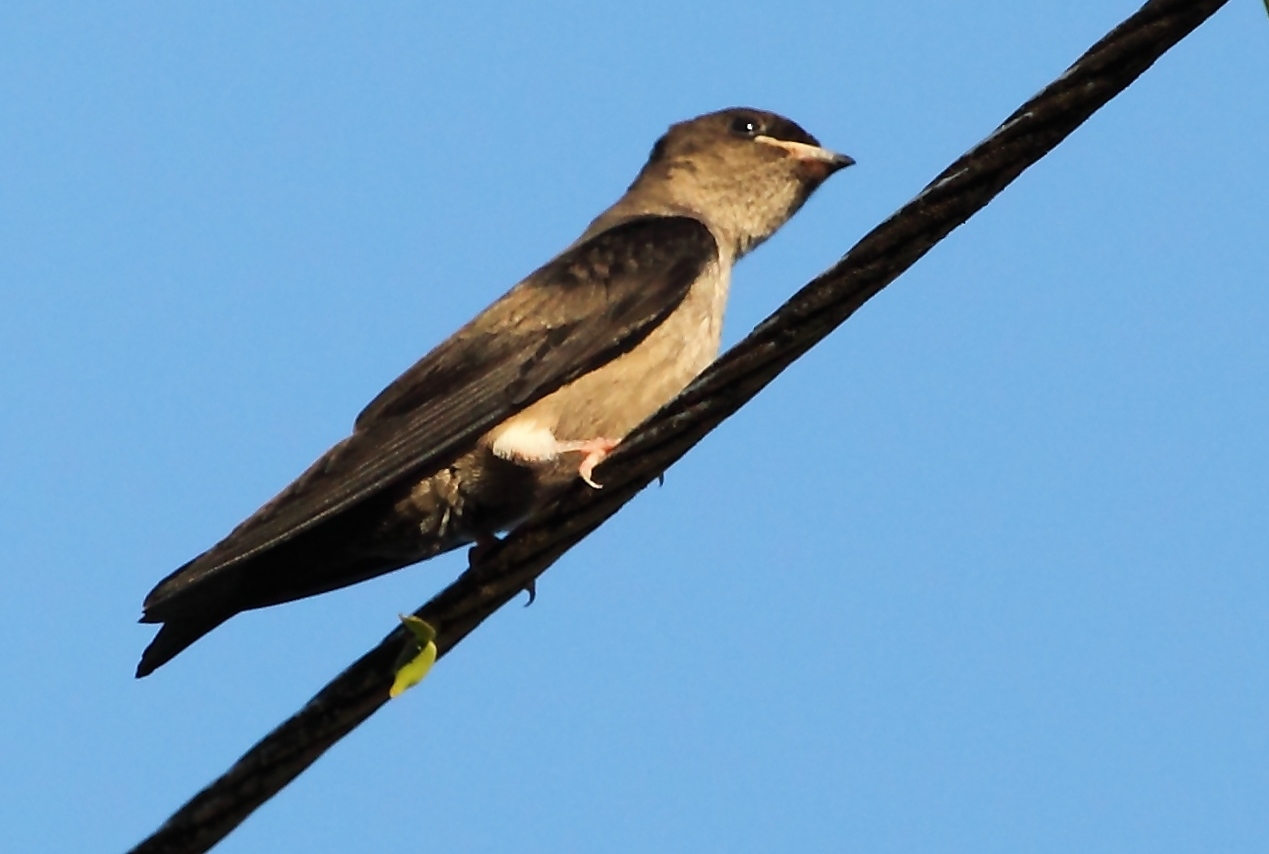
The White-thighed Swallow is the smallest swallow in the guide area: an almost entirely dark sooty-brown bird of edges and clearings in humid lowland forest. It is named for the white feathers on the thighs, which are usually hidden against the body. It flies low with a fluttering action that recalls a bat or a small swift.
Voice
Thin, soft tseep and chit calls, in flight and when perched, sometimes run together into a soft twitter.
Recording: Juan Freile — CC BY-NC-SA 4.0 · xeno-canto
Identification
11–12 cm, with a slightly forked tail. The entire plumage is dark sooty brown, the rump and underparts slightly greyer and paler. The thighs are white, but this shows only when the bird is perched or passes low. The bill and legs are dark. The sexes are alike. Juveniles are duller, with paler edges to the feathers of the upperparts.
Confusion species
Southern Rough-winged Swallow Stelgidopteryx ruficollis is larger, with a cinnamon throat and a pale belly. White-banded Swallow Atticora fasciata is larger and blue-black, with a white breast band and a deeply forked tail. Swifts such as Grey-rumped Swift Chaetura cinereiventris have narrower, stiffer wings, a short blunt tail and a different flight, and never perch on branches.
Habitat
Edges of humid forest, clearings, deforested areas with dead trees, and roads and rivers through forest, up to about 1000 m. It hunts small insects in low, fluttering flight, often over clearings and treetops. It likes to perch on bare branches of dead trees. It nests in cavities in trees, banks or road cuts.
Where the bird is most at home, classified by the vegetation units of the Andes and the west coast.


Range and movements
In Colombia in the Pacific lowlands, the middle Magdalena Valley and east of the Andes. In Ecuador in the north-west and east of the Andes. In Peru east of the Andes. In Bolivia in the north. Absent from the Galápagos. Outside the guide area from Panama to southern Venezuela, the Guianas and Amazonian Brazil, and in south-eastern Brazil.
- Resident
- dark = core range, pale = thinly spread
How and when to look
Look on bare branches of dead trees at forest edges and along roads through lowland forest; pairs or small groups make short sallies from there and keep returning.
Conservation status
Least Concern. The species is common over a large range and tolerates forest edges and small-scale clearing.
Scientific name
Atticora tibialis | (Cassin, 1853) (GBIF: Neochelidon tibialis)
Cassin described the species in 1853 as Petrochelidon(?) tibialis; because it was later moved to another genus, the author and year stand in brackets. The genus Atticora was introduced in 1844 by Boie. The genus name combines Ancient Greek Atthi, 'Athenian', with korē, 'maiden'. The species name comes from Latin tibia, 'shin', after the white thighs. The specimen the first description was based on came from Rio de Janeiro, Brazil.