All species › Passerines › Swallows › White-banded Swallow
White-banded Swallow | Atticora fasciata
Witbandzwaluw | Golondrina fajiblanca | Peitoril
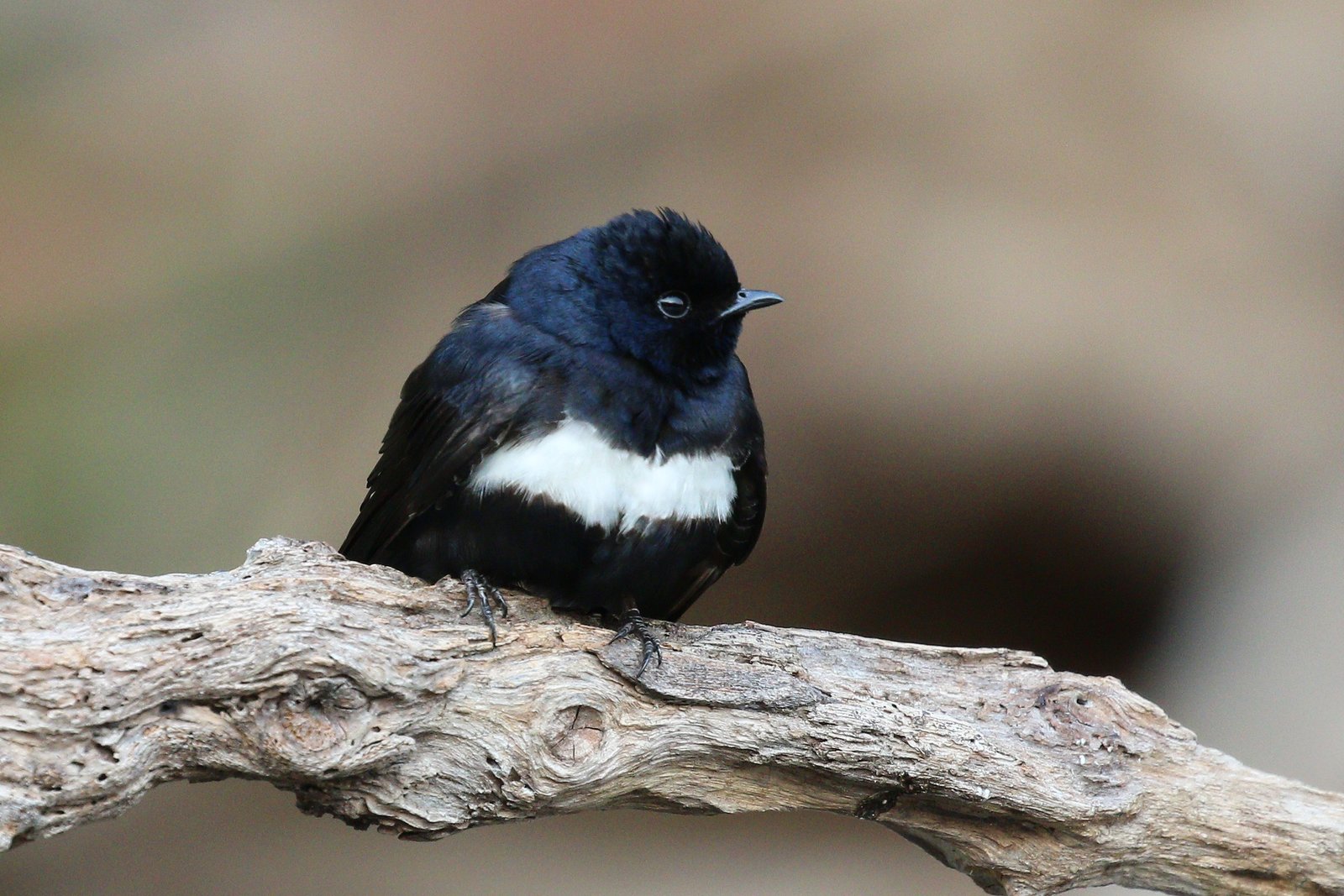
The White-banded Swallow is a glossy blue-black swallow with a narrow white band across the breast, tied to rivers in the Amazonian lowlands and foothills. It hunts low over the water and rests on rocks, branches and logs in the current. The long, deeply forked tail is often held closed and then looks like a sharp point.
Voice
Thin, buzzy dzzt calls and a soft, hoarse twitter, mainly in flight over the water.
Recording: Mauricio Cuellar Ramirez (@Birding.travel) — CC BY-NC-SA 4.0 · xeno-canto
Identification
14–15 cm, with a long, deeply forked tail. The plumage is glossy blue-black, with a narrow, sharply defined white band across the breast. The thighs are white and form small white tufts below. The underwing is dark. The sexes are alike. Juveniles are duller and browner, with a less clean breast band and a shorter tail.
Confusion species
Black-collared Swallow Pygochelidon melanoleuca is white below with a narrow black breast band, the reverse pattern. White-winged Swallow Tachycineta albiventer is white below, with white patches on the wings and a white rump. White-thighed Swallow Atticora tibialis is smaller and sooty brown, without a breast band.
Habitat
Rivers and large streams in humid lowland forest and in the foothills, favouring flowing water with rocks, sandbars and fallen trees, up to about 1000 m. It hunts flying insects in low flight over the water and rests in pairs or small groups on protruding rocks, branches and snags. It nests in burrows in riverbanks.
Where the bird is most at home, classified by the vegetation units of the Andes and the west coast.


Range and movements
In Colombia east of the Andes, in the Orinoco and Amazon basins. In Ecuador and Peru east of the Andes. In Bolivia in the north. Absent from the Galápagos. Outside the guide area in southern Venezuela, the Guianas and Amazonian Brazil.
- Resident
- dark = core range, pale = thinly spread
How and when to look
From a boat or bridge over forest rivers, scan rocks and branches that stick out just above the water; pairs often sit there, fly off low over the water when approached and settle again further on.
Conservation status
Least Concern. The species has a large range; pollution and disturbance of rivers may have local effects.
Scientific name
Atticora fasciata | (Gmelin, 1789)
Gmelin described the species in 1789 as Hirundo fasciata; because it was later moved to another genus, the author and year stand in brackets. The genus Atticora was introduced in 1844 by Boie. The genus name combines Ancient Greek Atthi, 'Athenian', with korē, 'maiden'. The species name comes from Latin fasciatus, 'banded', after the white breast band. The specimen the first description was based on came from Cayenne, French Guiana.