All species › Passerines › Swallows › Black-collared Swallow
Black-collared Swallow | Pygochelidon melanoleuca
Zwartkraagzwaluw | Golondrina collareja | Andorinha-de-coleira
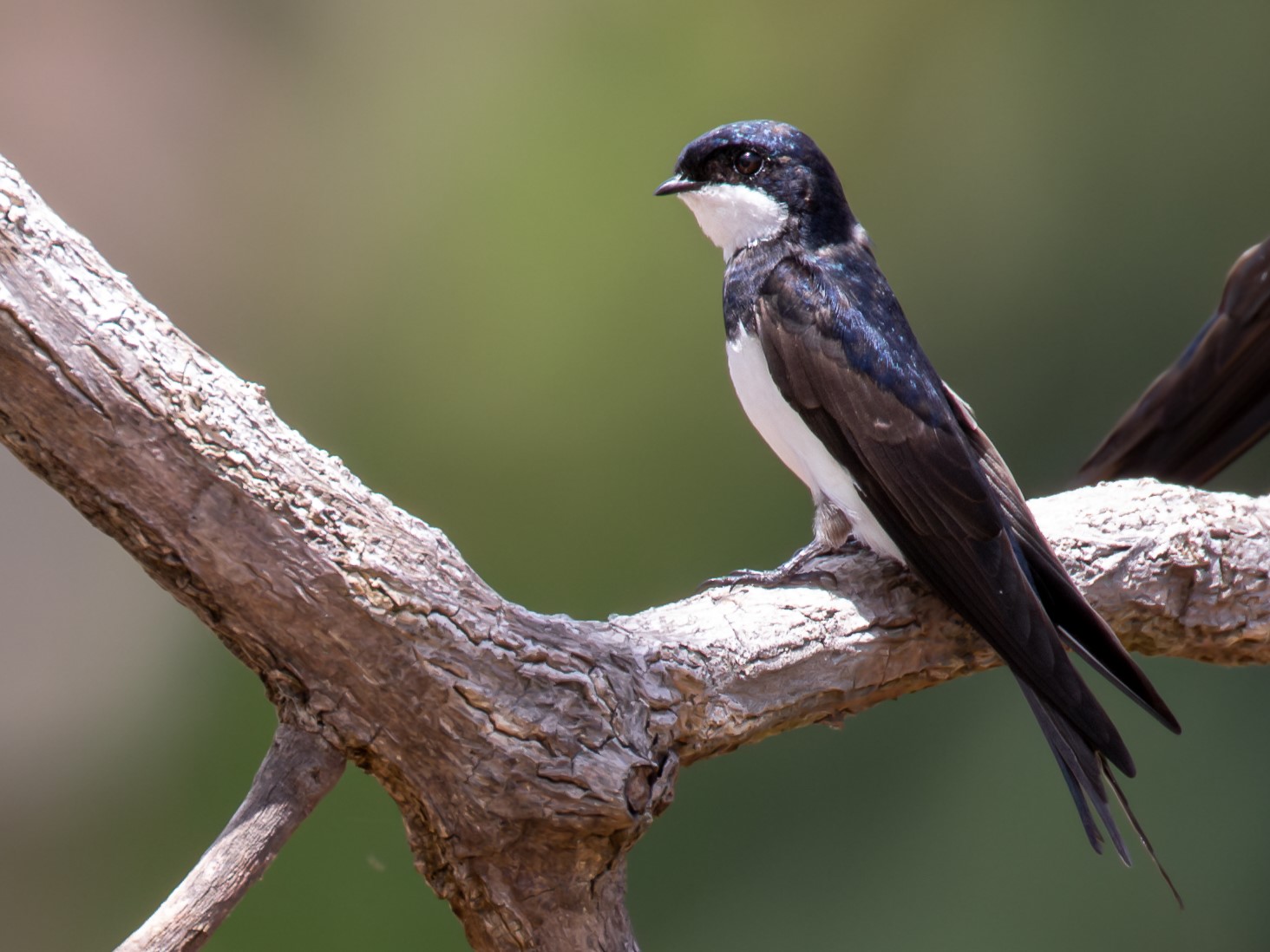
The Black-collared Swallow is a blue-black and white swallow with a narrow black breast band, tied to rocky rapids in lowland rivers. In the guide area it occurs only in the far east, along rivers of the Orinoco and Rio Negro basins and in north-eastern Bolivia. Where high water covers the rocks, it temporarily disappears.
Voice
An unstructured series of buzzy zr notes and a short, buzzy jit.
Recording: Mauricio Cuéllar Ramírez — CC BY-NC-SA 4.0 · xeno-canto
Identification
14 cm, with a long, deeply forked tail. The upperparts are glossy steel blue to blue-black. The throat, breast and belly are bright white, with a narrow black band across the breast. The undertail coverts are black. The sexes are alike. Juveniles are duller and browner above, with a brownish breast band and a shorter tail.
Confusion species
White-banded Swallow Atticora fasciata is blue-black with a white breast band, the reverse pattern. Blue-and-white Swallow Pygochelidon cyanoleuca lacks the black breast band and has a less deeply forked tail. White-winged Swallow Tachycineta albiventer has white patches on the wings and a white rump, without a breast band.
Habitat
Rocks, rapids and waterfalls in lowland rivers, especially blackwater rivers, up to about 300 m. It hunts flying insects low over the water and rests in small groups on rocks in the current. It nests in crevices and holes in rocks or in banks.
Where the bird is most at home, classified by the vegetation units of the Andes and the west coast.


Range and movements
In Colombia in the east, along rocky rivers of the Orinoco and Rio Negro basins. In Bolivia only in the far north-east. Absent from Ecuador, Peru and the Galápagos. Outside the guide area in Venezuela, the Guianas, Brazil and north-eastern Argentina.
- Resident
- dark = core range, pale = thinly spread
How and when to look
Search at rapids and rocky islands in rivers at low water, when the rocks are exposed; the birds then sit on the stones and hunt low over the water.
Conservation status
Least Concern. Locally, dams that flood rapids can affect its habitat.
Scientific name
Pygochelidon melanoleuca | (Wied-Neuwied, 1820) (GBIF: Atticora melanoleuca)
Wied-Neuwied described the species in 1820 as Hirundo melanoleuca; because it was later moved to another genus, the author and year stand in brackets. The genus Pygochelidon was introduced in 1865 by Baird. The genus name comes from Greek pugē, 'rump', and khelidōn, 'swallow'. From Greek melas, 'black', and leukos, 'white', after the black-and-white plumage. The specimen the first description was based on came from Rio Belmonte, Bahia, Brazil.