All species › Passerines › Shrike-babblers, Erpornis and vireos › Brown-headed Greenlet
Brown-headed Greenlet | Hylophilus brunneiceps
Bruinkopvireo | Verdillo cabecicastaño | Vite-vite-de-cabeça-marrom
The Brown-headed Greenlet is a small, plainly coloured greenlet of the upper Rio Negro and Orinoco drainages. In the guide area it occurs only in the far east of Colombia, in forest along blackwater rivers and on white sand. It forages in the canopy, often in mixed flocks.
Voice
A rapidly repeated series of clear, high whistles, often kept up for long periods from the canopy. Also gives nasal and shrill calls.
Recording: Jacob Socolar — CC BY-NC-SA 4.0 · xeno-canto
Identification
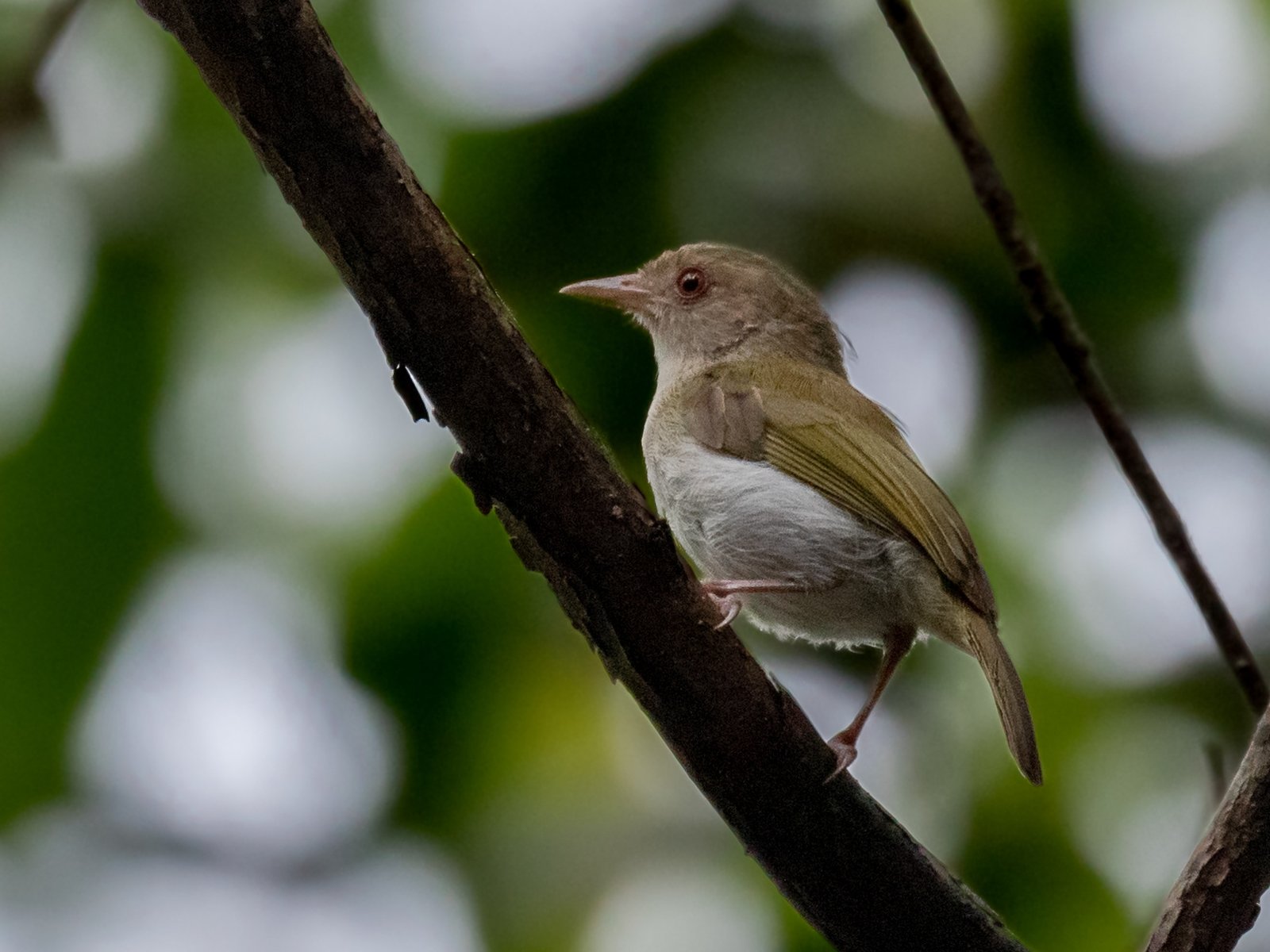
11.5 cm, with a fairly short tail and a thin, pointed bill. The crown and hindneck are dull brown, the rest of the upperparts olive-green. The throat is whitish, the breast and flanks greyish with a faint ochre wash, and the belly whitish. The eye is dark. The sexes are alike.
Confusion species
Lemon-chested Greenlet Hylophilus thoracicus has a grey crown, a pale eye and a lemon-yellow breast band. Grey-chested Greenlet Hylophilus semicinereus has an olive-green crown, a grey hindneck and breast and a pale eye. Dusky-capped Greenlet Pachysylvia hypoxantha has yellow underparts and lives mainly in terra firme forest.
Habitat
Canopy and edges of low, open forest on white sand (campina), of igapó along blackwater rivers and of adjacent taller forest, in the lowlands below 300 m. It searches leaves and twigs for insects and spiders. Little is known about its breeding.
Where the bird is most at home, classified by the vegetation units of the Andes and the west coast.


Range and movements
Colombia: only in the far east, in Guainía and Vaupés, along the upper Rio Negro and its tributaries. Absent from Ecuador, Peru, Bolivia and the Galápagos. Outside the guide area in southern Venezuela and north-western Brazil.
- Resident
- dark = core range, pale = thinly spread
How and when to look
In the white-sand forest around Inírida and along blackwater rivers in Guainía, look for mixed flocks in the canopy; the bird often gives itself away by its repeated song.
Conservation status
Least Concern. Its habitat lies mostly in remote areas and is little disturbed.
Scientific name
Hylophilus brunneiceps | Sclater, 1866
Sclater described the species in 1866 and placed it straight away in the genus where it still stands. The genus Hylophilus was introduced in 1822 by Temminck. The genus name comes from Greek hulē, 'woodland, forest', and philos, 'loving': 'forest-lover'. The species name comes from Medieval Latin brunneus, 'brown', and -ceps, '-headed': 'brown-headed'. The specimen the first description was based on came from Rio Uaupés (Vaupés), Amazonas, Brazil.