All species › Passerines › Shrike-babblers, Erpornis and vireos › Lemon-chested Greenlet
Lemon-chested Greenlet | Hylophilus thoracicus
Citroenborstvireo | Verdillo pechilimón | Vite-vite
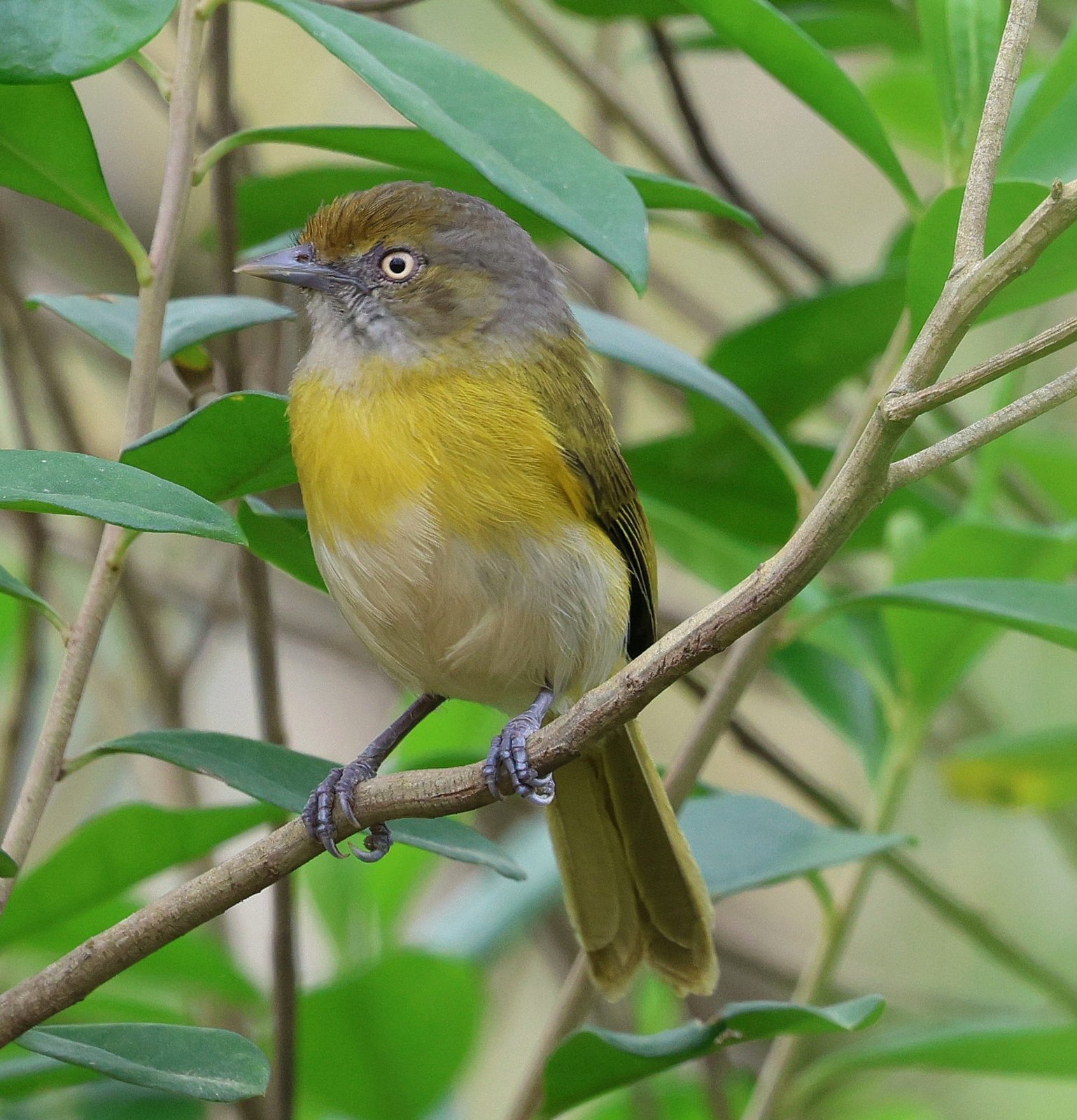
The Lemon-chested Greenlet is a small greenlet of the Amazonian lowlands, with a grey head, a pale eye and a yellow band across the breast. It lives high in the canopy and often joins mixed flocks.
Voice
A fast, clear series of even, whistled notes, often repeated at length. Also gives nasal, plaintive calls.
Recording: JAYRSON ARAUJO DE OLIVEIRA — CC BY-NC-SA 4.0 · xeno-canto
Identification
12 cm, with a thin, pointed bill and a fairly short tail. The crown and hindneck are grey, the rest of the upperparts olive-green. The eye is pale yellow to whitish. The throat is whitish, the breast lemon-yellow and the belly greyish white with a yellow wash on the flanks. The sexes are alike.
Confusion species
Grey-chested Greenlet Hylophilus semicinereus has an olive-green crown and a grey, not yellow, breast. Ashy-headed Greenlet Hylophilus pectoralis has a dark eye and an ochre-yellow breast and lives more in open woodland and scrub. Dusky-capped Greenlet Pachysylvia hypoxantha has a dark eye, a brownish crown and entirely yellow underparts.
Habitat
Canopy and edges of humid lowland forest, both terra firme and várzea, and tall secondary forest, mostly below 600 m, locally higher in the foothills. It searches leaves for insects, often in mixed flocks. The nest is a small, suspended cup in a twig fork.
Where the bird is most at home, classified by the vegetation units of the Andes and the west coast.


Range and movements
Colombia: in the Amazonian lowlands in the south-east. Ecuador: in the eastern lowlands. Peru: in the Amazonian lowlands east of the Andes. Bolivia: in the northern and eastern lowlands. Absent from the Galápagos. Outside the guide area in southern Venezuela, the Guianas and Amazonian Brazil, with a separate population in south-eastern Brazil.
- Resident
- dark = core range, pale = thinly spread
How and when to look
Follow mixed flocks in the canopy, for example from a canopy tower or along a riverbank in the eastern lowlands; the song often reveals the species before you see it.
Conservation status
Not Evaluated in its current circumscription. The species is widespread in a large area of lowland forest.
Scientific name
Hylophilus thoracicus | Temminck, 1822
Temminck described the species in 1822 and placed it straight away in the genus where it still stands. He introduced the genus Hylophilus in that same work. The genus name comes from Greek hulē, 'woodland, forest', and philos, 'loving': 'forest-lover'. The species name comes from Latin thoracicus, 'of the chest' (Greek thōrax), for the yellow breast band. The specimen the first description was based on came from Rio de Janeiro, Brazil.