All species › Passerines › Shrike-babblers, Erpornis and vireos › Yellow-browed Shrike-Vireo
Yellow-browed Shrike-Vireo | Vireolanius eximius
Geelbrauwklauwiervireo | Vireón cejiamarillo | Assobiador-de-sobrancelha-amarela
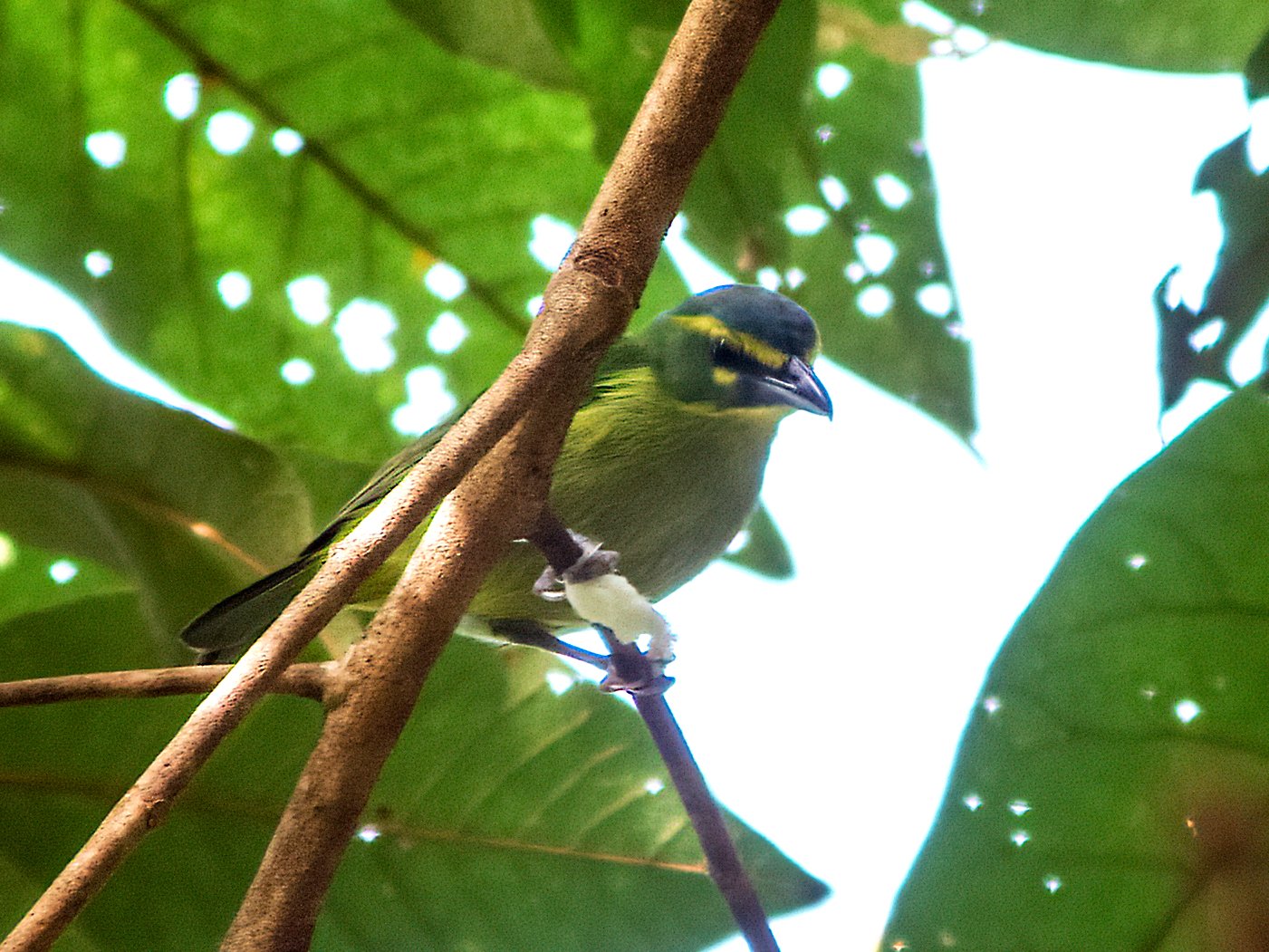
The Yellow-browed Shrike-Vireo is a stocky green vireo with a blue crown and a yellow supercilium, with a small range from eastern Panama to northern Colombia and north-western Venezuela. It lives high in the canopy and is usually detected by its monotonous song.
Voice
A monotonously repeated, clear whistle, such as tew-tew-tew, kept up for long periods from the treetops.
Recording: Ross Gallardy — CC BY-NC-SA 4.0 · xeno-canto
Identification
14 cm, with a large head, a heavy, hooked bill and a short tail. The crown and hindneck are blue, with a broad yellow supercilium and a yellow spot below the eye. The back, wings and tail are bright green. The throat and breast are yellow, the belly yellowish green. The sexes are nearly alike.
Confusion species
Green Shrike-Vireo Vireolanius pulchellus, known in the guide area only as a vagrant, lacks the yellow supercilium. Slaty-capped Shrike-Vireo Vireolanius leucotis has a grey crown, a white cheek stripe and a pale eye and lives on the Andean slopes farther south. Yellow-green Vireo Vireo flavoviridis is slimmer, with a thinner bill and no blue on the head.
Habitat
Canopy and edges of humid lowland and foothill forest and tall secondary forest, from sea level to about 1600 m. With slow movements it searches the foliage for insects and caterpillars, also in mixed flocks. Little is known about the nest.
Where the bird is most at home, classified by the vegetation units of the Andes and the west coast.


Range and movements
Colombia: in the north, in northern Chocó, Córdoba and Antioquia, the middle Magdalena valley, the foothills of the Sierra Nevada de Santa Marta and the Serranía de Perijá. Absent from Ecuador, Peru, Bolivia and the Galápagos. Outside the guide area in eastern Panama and north-western Venezuela.
- Resident
- dark = core range, pale = thinly spread
How and when to look
In humid forest in northern Colombia, for example in the middle Magdalena valley, listen for the monotonous series of whistles from the canopy and then search the foliage patiently; the green bird moves slowly and often sits still for a long time.
Conservation status
Least Concern. Forest in northern Colombia has been heavily cleared, but the species also occurs in older secondary forest.
Scientific name
Vireolanius eximius | Baird, 1866
Baird described the species in 1866 and placed it straight away in the genus where it still stands. The genus Vireolanius was introduced in 1850 by Bonaparte. The genus name combines the genus names Vireo (Latin vireo, 'green bird') and Lanius (Latin lanius, 'butcher', for shrikes): a vireo resembling a shrike. The species name is Latin eximius, 'exceptional, select'. The specimen the first description was based on came from Bogotá, Colombia.