All species › Waders, gulls and terns › Skimmers, noddies, terns and gulls › Brown Noddy
Brown Noddy | Anous stolidus
Noddy | Tiñosa común | Trinta-réis-escuro
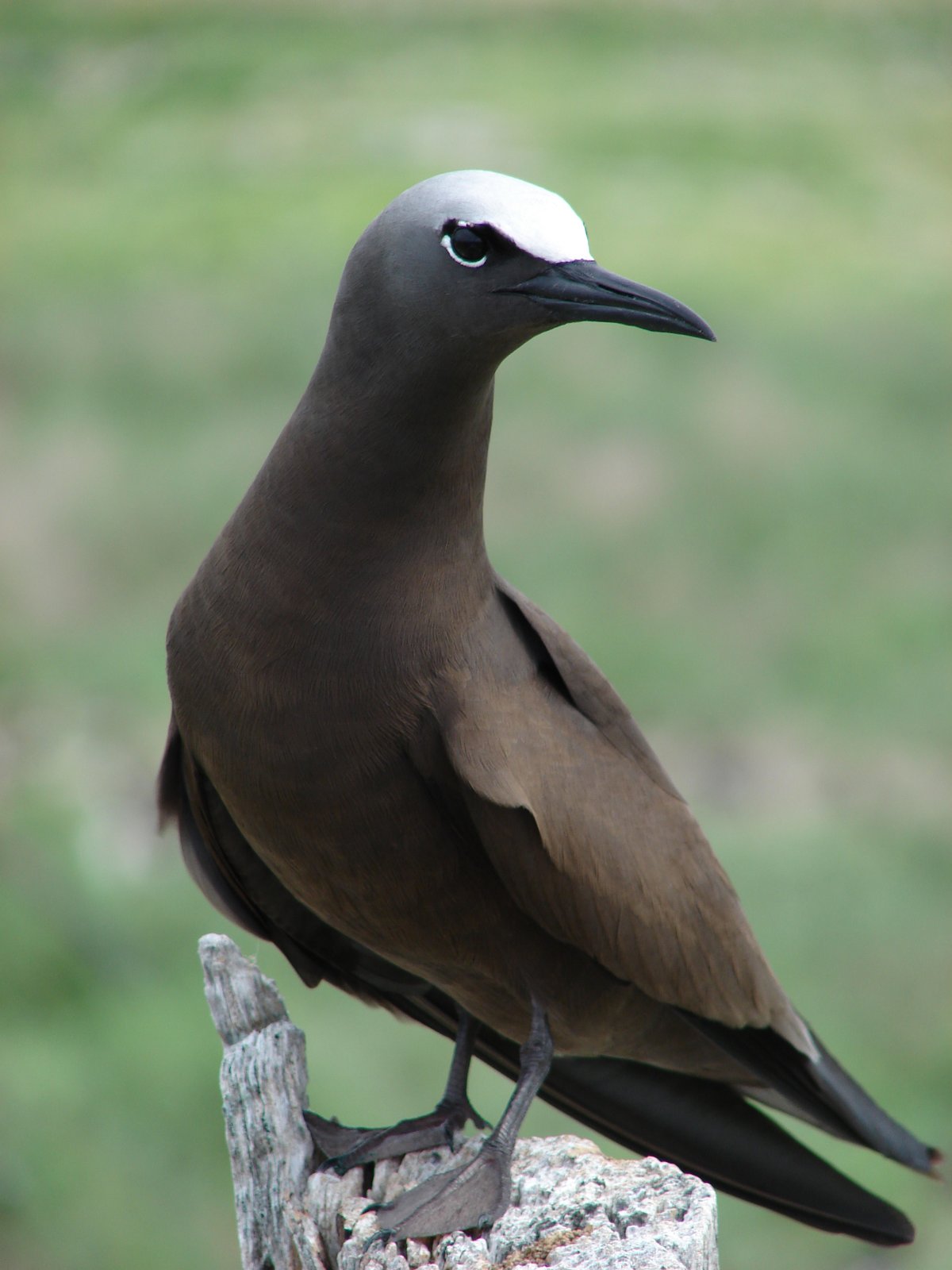
The Brown Noddy is a dark brown tern with a pale crown and a wedge-shaped tail that breeds on tropical ocean islands. In the guide area it breeds on the Galápagos and on a few islands off the coast of Colombia. Unlike most terns it rarely dives; it picks its prey from the surface in flight.
Voice
Low, harsh, croaking and growling calls, karrk or kwok, mainly at the colony; usually silent at sea.
Recording: Alexander Schlatmann — CC BY-NC-SA 4.0 · xeno-canto
Identification
38–45 cm, with long, narrow wings and a long, wedge-shaped tail without a fork. The plumage is dark chocolate brown, with a whitish forecrown shading to grey behind, and a narrow white crescent below the eye. The slender, slightly decurved bill and the legs are black. In flight the upperwing coverts are clearly paler brown than the flight feathers. The sexes are alike. Juveniles have a browner crown with little white and pale feather fringes on the back and wings. Birds of the Galápagos (galapagensis) are darker and sootier, with a greyer crown.
Confusion species
Black Noddy Anous minutus is smaller and blacker, with a longer, thinner bill, a more sharply defined, bright white cap and a shorter tail; the upperwing is uniformly dark. Juvenile Sooty Tern Onychoprion fuscatus is dark brown with white spots on the back and wings, but has a forked tail and white undertail.
Habitat
Open tropical sea and rocky islands, cliffs and lava coasts, on the Galápagos also around bays. It eats small fish and squid driven to the surface, often over shoals of tuna or with other seabirds. The nest is an untidy platform of seaweed, twigs or feathers on a ledge, in a rock cavity or in a low shrub.
Where the bird is most at home, classified by the vegetation units of the Andes and the west coast.


Range and movements
In Colombia breeding on Malpelo Island in the Pacific and on islands in the Caribbean; at sea off both coasts. In Ecuador breeding on the Galápagos, where it is widespread along the coasts; elsewhere scarce at sea off the coast. In Peru rare at sea off the north coast. Absent from Bolivia. Outside the guide area in tropical parts of all oceans.
- Resident
- dark = core range, pale = thinly spread
How and when to look
On the Galápagos at cliffs and lava coasts, where birds often rest on rocks at the waterline and forage close to boats. At sea off Colombia mainly on trips to Malpelo.
Conservation status
Least Concern. Introduced rats and cats and disturbance of breeding islands can affect the population locally.
Scientific name
Anous stolidus | (Linnaeus, 1758)
Linnaeus described the species in 1758 as Sterna stolida; because it was later moved to another genus, the author and year stand in brackets. The genus Anous was introduced in 1826 by Stephens. The genus name is Greek anous, 'stupid, foolish', after the tameness of the birds. The species name is Latin stolidus, 'stupid, dull', after the bird's tameness. The specimen the first description was based on came from West Indies.