All species › Waders, gulls and terns › Skimmers, noddies, terns and gulls › Black Noddy
Black Noddy | Anous minutus
Witkapnoddy | Tiñosa negra | Trinta-réis-preto
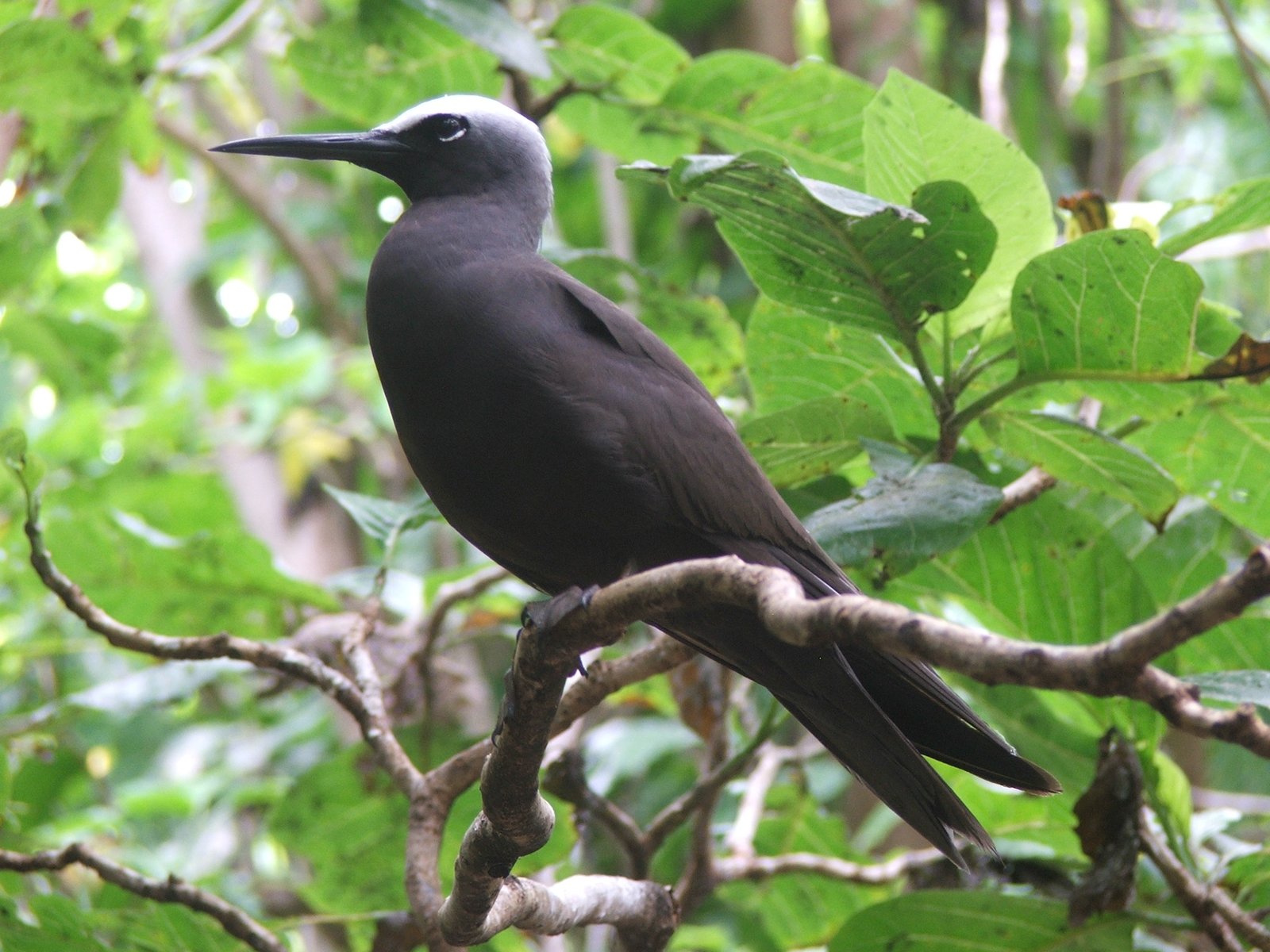
The Black Noddy is a small, blackish-brown tern with a bright white cap that breeds in colonies on tropical islands. In the guide area it is scarce and mainly to be expected at sea off the Caribbean coast of Colombia. It closely resembles the Brown Noddy, but is smaller, darker and more slender.
Voice
Dry, rattling and creaking calls, krrr or kiirr, and high squeaks at the colony.
Recording: AUDEVARD Aurélien — CC BY-NC-SA 4.0 · xeno-canto
Identification
33–36 cm, with narrow wings and a wedge-shaped tail that is shorter than in the Brown Noddy. The plumage is blackish brown, almost black on the wings, with a sharply defined, bright white cap from forehead to rear crown, shading to grey on the nape. A narrow white crescent below the eye. The bill is black, long, thin and straight, clearly longer than the head. The legs are dark. The upperwing is uniformly dark. The sexes are alike. Juveniles have an even more sharply defined white cap and pale fringes to the wing coverts.
Confusion species
Brown Noddy Anous stolidus is larger and browner, with a shorter, thicker bill, a less sharply defined pale crown, a longer tail and clearly paler upperwing coverts. Juvenile Sooty Tern Onychoprion fuscatus has a forked tail, white spots on the upperparts and a white undertail.
Habitat
Open tropical sea, mainly near the breeding islands, and rocky or wooded islands. It fishes in flocks for small fish and squid just below the surface, picked up in flight or caught in a short plunge. The nest is a platform of leaves and seaweed cemented with droppings, in a tree or on a rock ledge.
Where the bird is most at home, classified by the vegetation units of the Andes and the west coast.


Range and movements
In Colombia scarce at sea off the Caribbean coast, mainly in the north-east; the nearest colonies are on islands off the coast of Venezuela. On the Pacific side and on the Galápagos records are rare. Absent from mainland Ecuador, Peru and Bolivia. Outside the guide area in tropical parts of the Atlantic and Pacific Oceans.
- Summer visitor (c. Apr–Sep)
- dark = core range, pale = thinly spread
How and when to look
A chance at sea off the Caribbean coast of Colombia, especially among flocks of feeding terns over shoals of fish; look for the thin bill and the sharply defined white cap.
Conservation status
Least Concern. Colonies are vulnerable to introduced predators and to disturbance and egg collecting.
Scientific name
Anous minutus | Boie, 1844
Boie described the species in 1844 and placed it straight away in the genus where it still stands. The genus Anous was introduced in 1826 by Stephens. The genus name is Greek anous, 'stupid, foolish', after the tameness of the birds. The species name is Latin minutus, 'small'; it is smaller than the Brown Noddy. The specimen the first description was based on came from Raine Island, Australia.