All species › Waders, gulls and terns › Skimmers, noddies, terns and gulls › Sooty Tern
Sooty Tern | Onychoprion fuscatus
Bonte stern | Charrán sombrío | Trinta-réis-das-rocas
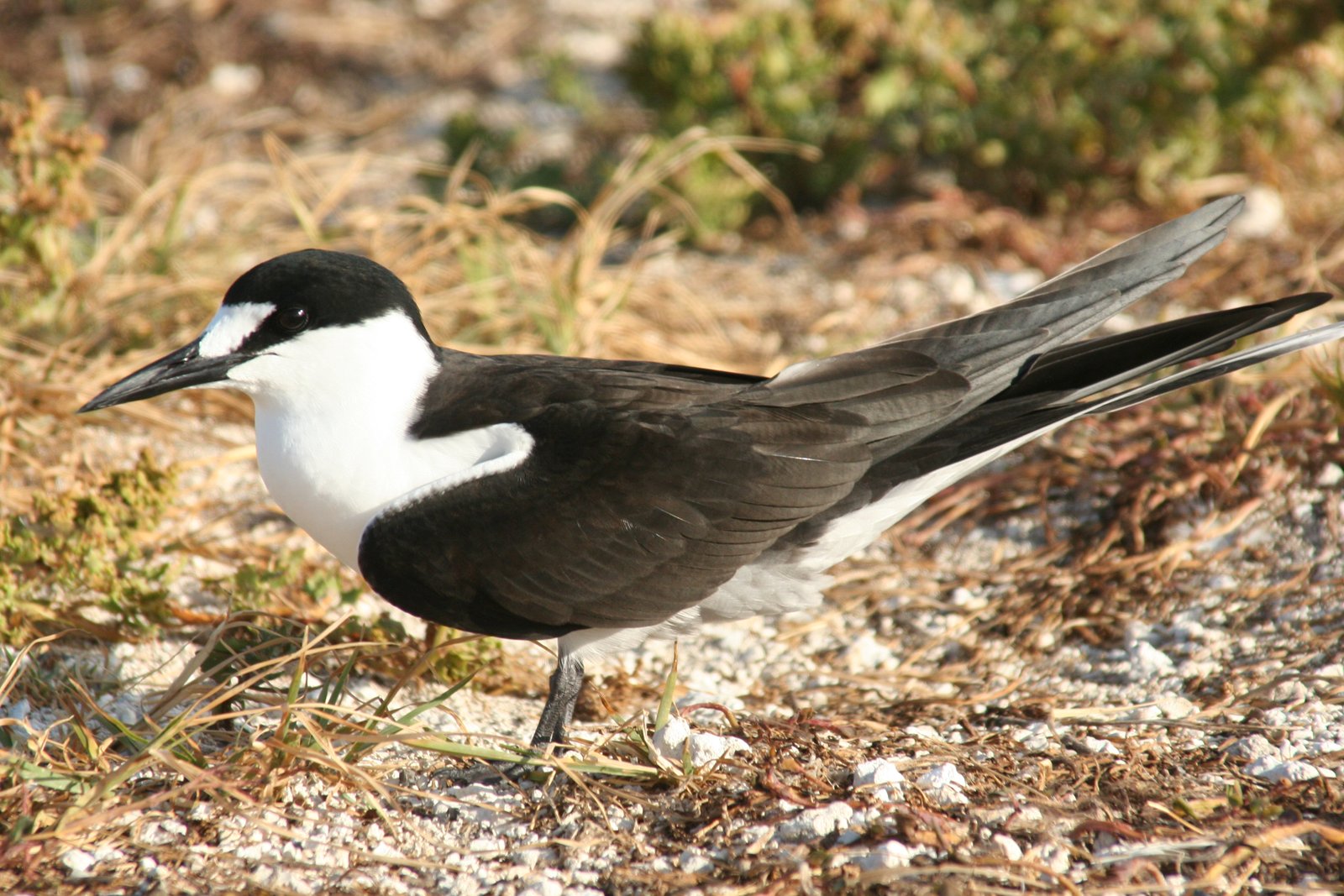
The Sooty Tern is a medium-sized, black-and-white ocean tern that spends months outside the breeding season over open ocean without landing on the water. It breeds in large, dense colonies on tropical islands. In the guide area it breeds in the Caribbean and elsewhere occurs mainly far out at sea.
Voice
A loud, nasal, three-part call, ker-wack-a-wack, often also at night over the sea and incessantly at the colony.
Recording: AUDEVARD Aurélien — CC BY-NC-SA 4.0 · xeno-canto
Identification
38–43 cm, with long, pointed wings and a deeply forked tail with long outer feathers. The upperparts are blackish, the underparts white. A black cap reaches the bill; the white forehead is broad and does not extend beyond the eye. The underwing is white with dark flight feathers. The bill and legs are black. The sexes are alike. Juveniles are entirely dark sooty brown, with white spots on the back and wings and a white lower belly and undertail.
Confusion species
Bridled Tern Onychoprion anaethetus is smaller and slimmer, with greyish-brown rather than blackish upperparts, a pale collar between cap and back and a narrower white supercilium that extends behind the eye. Juvenile Sooty Terns resemble Brown Noddy Anous stolidus, but have a forked tail, white spots and a white undertail.
Habitat
Open tropical and subtropical ocean, outside the breeding season often far from land. It picks small fish and squid from the surface in flight, often over shoals of tuna; it rarely lands on the water. It breeds in colonies on flat, sandy or rocky islets; the egg lies in a shallow scrape on the ground.
Where the bird is most at home, classified by the vegetation units of the Andes and the west coast.


Range and movements
In Colombia breeding on islets in the Caribbean, mainly in the San Andrés and Providencia archipelago, and at sea off the Caribbean coast; scarce off the Pacific coast. In Ecuador, including around the Galápagos, and in Peru mainly far out at sea, in small numbers; scattered birds are reported off southern Peru in the austral winter. Absent from Bolivia. Outside the guide area in tropical parts of all oceans.
- Summer visitor (c. Apr–Sep)
- Winter visitor (c. Oct–Mar)
- dark = core range, pale = thinly spread
How and when to look
A chance on trips at sea, especially in the Caribbean in the breeding season; look for a black-and-white tern with a deeply forked tail that flies high over the water and gives no ordinary tern calls.
Conservation status
Least Concern. The species is one of the most numerous tropical seabirds, but colonies are vulnerable to egg collecting, introduced predators and disturbance.
Scientific name
Onychoprion fuscatus | (Linnaeus, 1766)
Linnaeus described the species in 1766 as Sterna fuscata; because it was later moved to another genus, the author and year stand in brackets. The genus Onychoprion was introduced in 1832 by Wagler. The genus name comes from Greek onux, 'claw' or 'nail', and priōn, 'saw'. The species name comes from Latin fuscatus, 'darkened' or 'dusky'. The specimen the first description was based on came from Hispaniola (Santo Domingo).