All species › Waders, gulls and terns › Skimmers, noddies, terns and gulls › Bridled Tern
Bridled Tern | Onychoprion anaethetus
Brilstern | Charrán embridado | Trinta-réis-de-rédea
The Bridled Tern is a slender, greyish-brown and white ocean tern of tropical coasts and islands, which stays closer to land than the Sooty Tern. It often rests on driftwood, buoys and floating seaweed. In the guide area it breeds mainly in the Caribbean sector and elsewhere is a scarce visitor at sea.
Voice
High, yapping and whining calls, wep-wep or a drawn-out wee-ah, mainly at the colony.
Recording: David Darrell-Lambert — CC BY-NC-SA 4.0 · xeno-canto
Identification
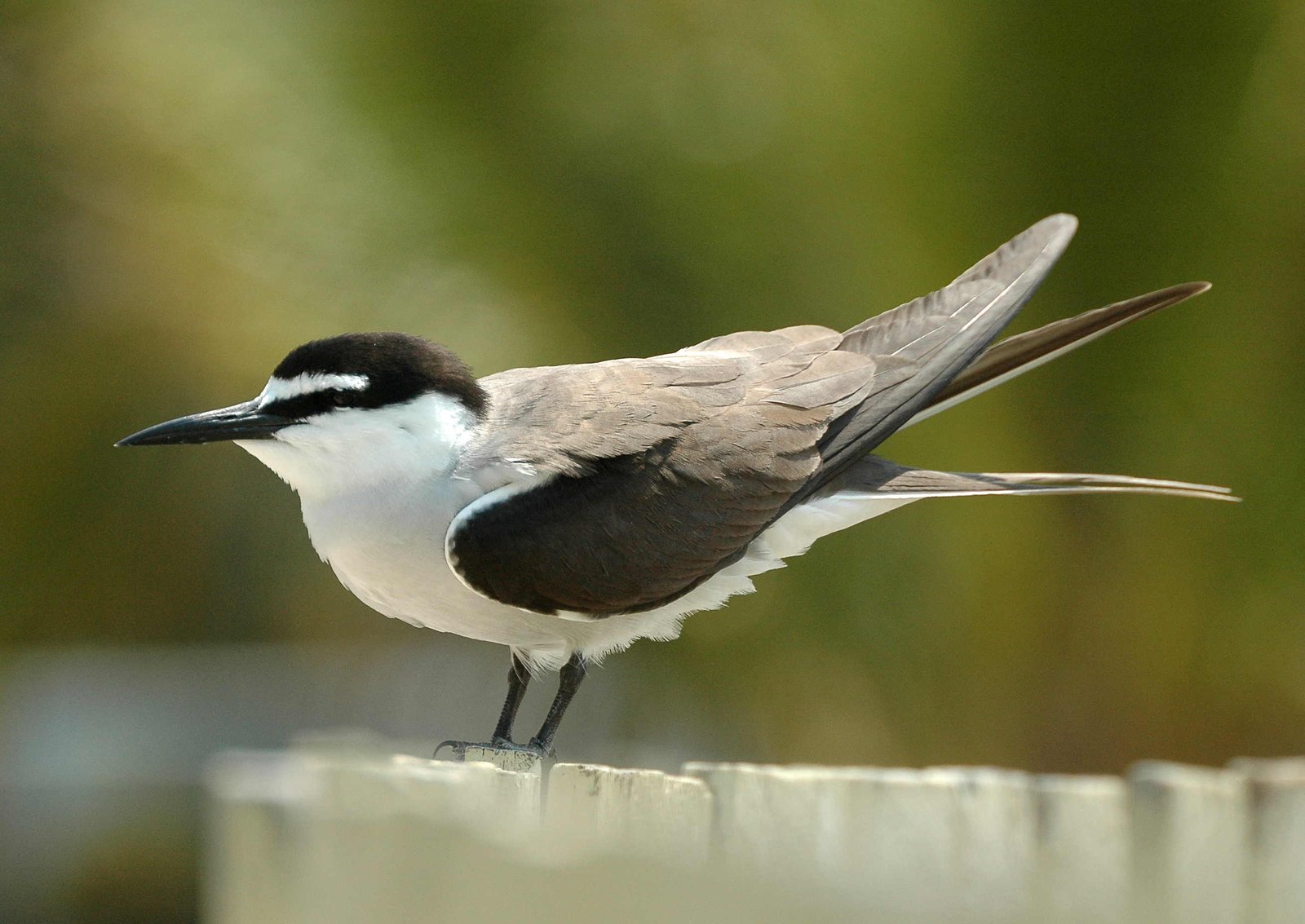
34–38 cm, with long, pointed wings and a deeply forked tail with white outer edges. The back and wings are greyish brown, the underparts white. The black cap is separated from the back by a pale grey collar. A narrow white supercilium runs from the forehead to behind the eye, with a black loral stripe below it. The bill and legs are black. The sexes are alike. Juveniles have a greyish-brown back with pale feather fringes and a whiter face.
Confusion species
Sooty Tern Onychoprion fuscatus is larger and heavier, with blackish upperparts without a pale collar, and a broad white forehead that does not extend behind the eye. Black Tern Chlidonias niger in non-breeding plumage is much smaller, with a short, barely forked tail and a grey back.
Habitat
Tropical inshore and open sea, especially over warm water with floating seaweed, and rocky islets and cliffs. It picks small fish and squid from the surface in flight or catches them in a short plunge. The egg is laid in a rock crevice, under an overhanging rock or under low vegetation.
Where the bird is most at home, classified by the vegetation units of the Andes and the west coast.


Range and movements
In Colombia breeding on islets off the Caribbean coast and in the San Andrés and Providencia archipelago, and on the Pacific side in the north, near the Gulf of Panama. In Ecuador scarce at sea off the coast. In Peru rare at sea off the north coast. Absent from Bolivia and not regular on the Galápagos. Outside the guide area in tropical parts of the Atlantic, Indian and Pacific Oceans.
- Resident
- Summer visitor (c. Apr–Sep)
- dark = core range, pale = thinly spread
How and when to look
A chance on boat trips in the Caribbean, where birds rest on buoys, driftwood and floating seaweed. Look for the greyish-brown back, the pale collar and the white supercilium extending behind the eye.
Conservation status
Least Concern. Locally vulnerable to egg collecting, introduced predators and disturbance of breeding islands.
Scientific name
Onychoprion anaethetus | (Scopoli, 1786)
Scopoli described the species in 1786 as Sterna Anaethetus; because it was later moved to another genus, the author and year stand in brackets. The genus Onychoprion was introduced in 1832 by Wagler. The genus name comes from Greek onux, 'claw' or 'nail', and priōn, 'saw'. The species name comes from Greek anaisthētos, 'senseless' or 'stupid', for the bird's tameness. The specimen the first description was based on came from Panay, Philippines.