All species › Waders, gulls and terns › Skimmers, noddies, terns and gulls › Yellow-billed Tern
Yellow-billed Tern | Sternula superciliaris
Amazonestern | Charrancito amazónico | Trinta-réis-pequeno
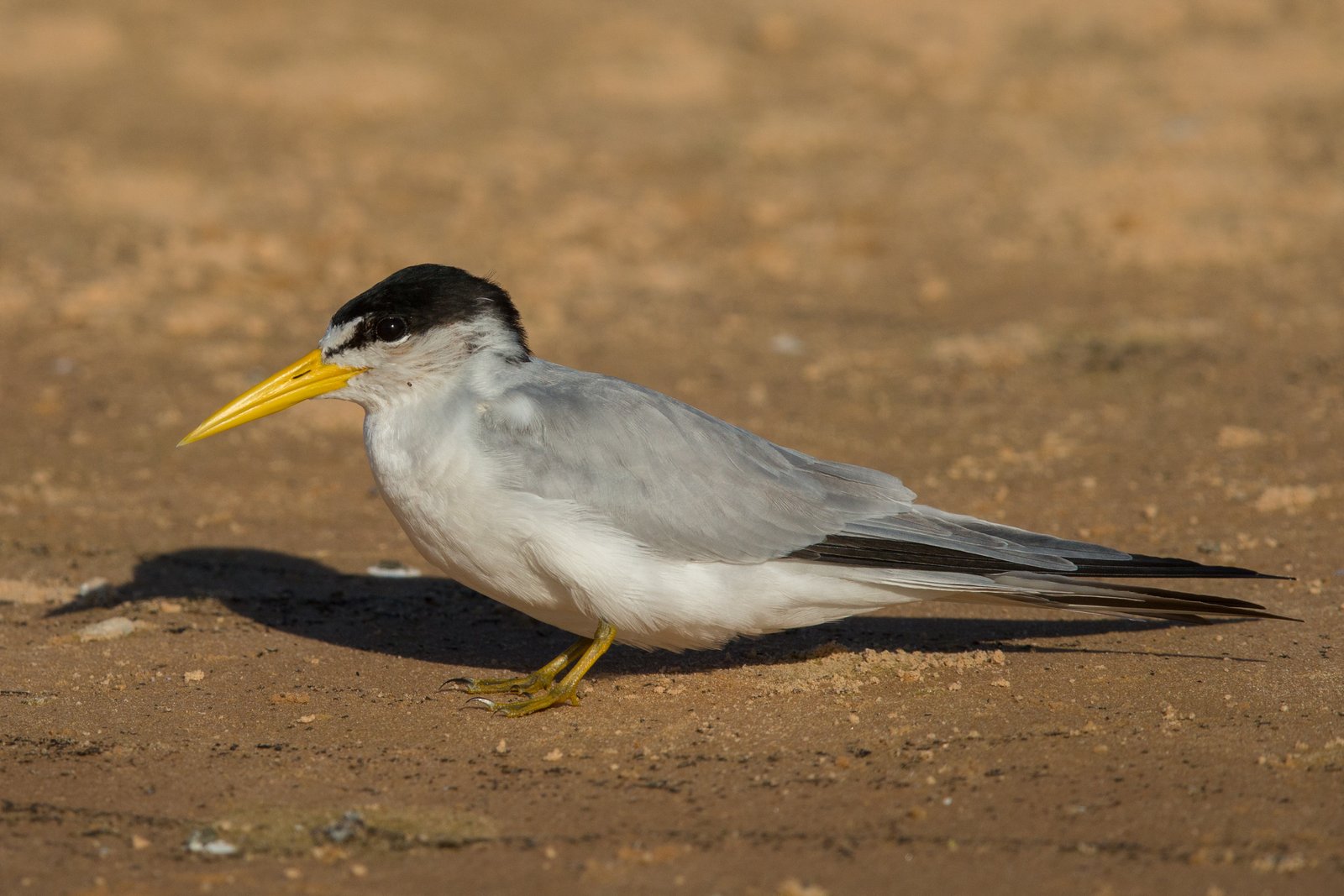
The Yellow-billed Tern is a small, pale grey tern with a stout, all-yellow bill that lives along the large rivers of the South American lowlands. It breeds on sandbars that emerge in the dry season and fishes with short plunge dives. It is the common small tern of Amazonia.
Voice
High, sharp calls, kip or kee-ik, often repeated, and a rapid chattering at the colony.
Recording: Jacob Wijpkema — CC BY-NC-SA 4.0 · xeno-canto
Identification
23–25 cm, with narrow, pointed wings and a short, forked tail. The bill is fairly long and stout, bright yellow without a black tip; the legs are yellow. In breeding plumage a black cap with a white forehead reaching above the eye. The back and wings are pale grey, the underparts white. The outer two or three primaries are dark and form a dark wingtip. Outside the breeding season the crown is whiter and the bill duller. The sexes are alike. Juveniles have brown scaling on the back and wings and a dull, darker bill.
Confusion species
Least Tern Sternula antillarum is slightly smaller, with a thinner yellow bill with a black tip and less dark in the wingtip; it occurs mainly on the coast as a winter visitor from the north. Peruvian Tern Sternula lorata is greyer, also on the underparts, and lives on the coast of Peru. Large-billed Tern Phaetusa simplex is much larger, with a heavy yellow bill and a black-and-white wing.
Habitat
Large lowland rivers with sandbars, lakes and oxbows, flooded areas and outside the breeding season also estuaries and lagoons on the coast. It fishes for small fish with short plunge dives after hovering briefly over the water. It breeds singly or in loose groups on bare sandbars, often next to skimmers and Large-billed Terns; the nest is a scrape in the sand.
Where the bird is most at home, classified by the vegetation units of the Andes and the west coast.


Range and movements
In Colombia along the Magdalena, the rivers of the llanos and Amazonia, and outside the breeding season on the Caribbean coast. In Ecuador along the large rivers in the east; rare on the west coast. In Peru along the rivers of Amazonia, rare on the Pacific coast. In Bolivia along the lowland rivers of the north and east. Absent from the Galápagos. Outside the guide area from Venezuela and the Guianas to Brazil, Paraguay and northern Argentina.
- Resident
- dark = core range, pale = thinly spread
How and when to look
Along large rivers with sandbars in Amazonia, especially on boat trips in the dry season, when the birds breed on the sandbars and fish over the river.
Conservation status
Least Concern. Breeding birds on sandbars are vulnerable to disturbance, egg collecting and changes in water level caused by dams.
Scientific name
Sternula superciliaris | (Vieillot, 1819)
Vieillot described the species in 1819 as Sterna superciliaris; because it was later moved to another genus, the author and year stand in brackets. The genus Sternula was introduced in 1822 by Boie. The genus name is a diminutive of Sterna, 'tern', so 'little tern'. The specific name comes from Latin superciliaris, 'eyebrowed', from supercilium, 'eyebrow'. The specimen the first description was based on came from Paraguay.