All species › Waders, gulls and terns › Skimmers, noddies, terns and gulls › Peruvian Tern
Peruvian Tern | Sternula lorata
Peruaanse dwergstern | Gaviotín peruano | Trinta-réis-peruano
The Peruvian Tern is a small, grey tern of the desert coast of Peru and northern Chile. It breeds scattered on bare desert plains, sometimes kilometres from the sea, and fishes in the surf and in estuaries. The species is threatened by loss and disturbance of its breeding grounds.
Voice
High, sharp calls, tseek or kee-reek, and a rapid chattering when the breeding site is disturbed.
Recording: Juan Freile — CC BY-NC-SA 4.0 · xeno-canto
Identification
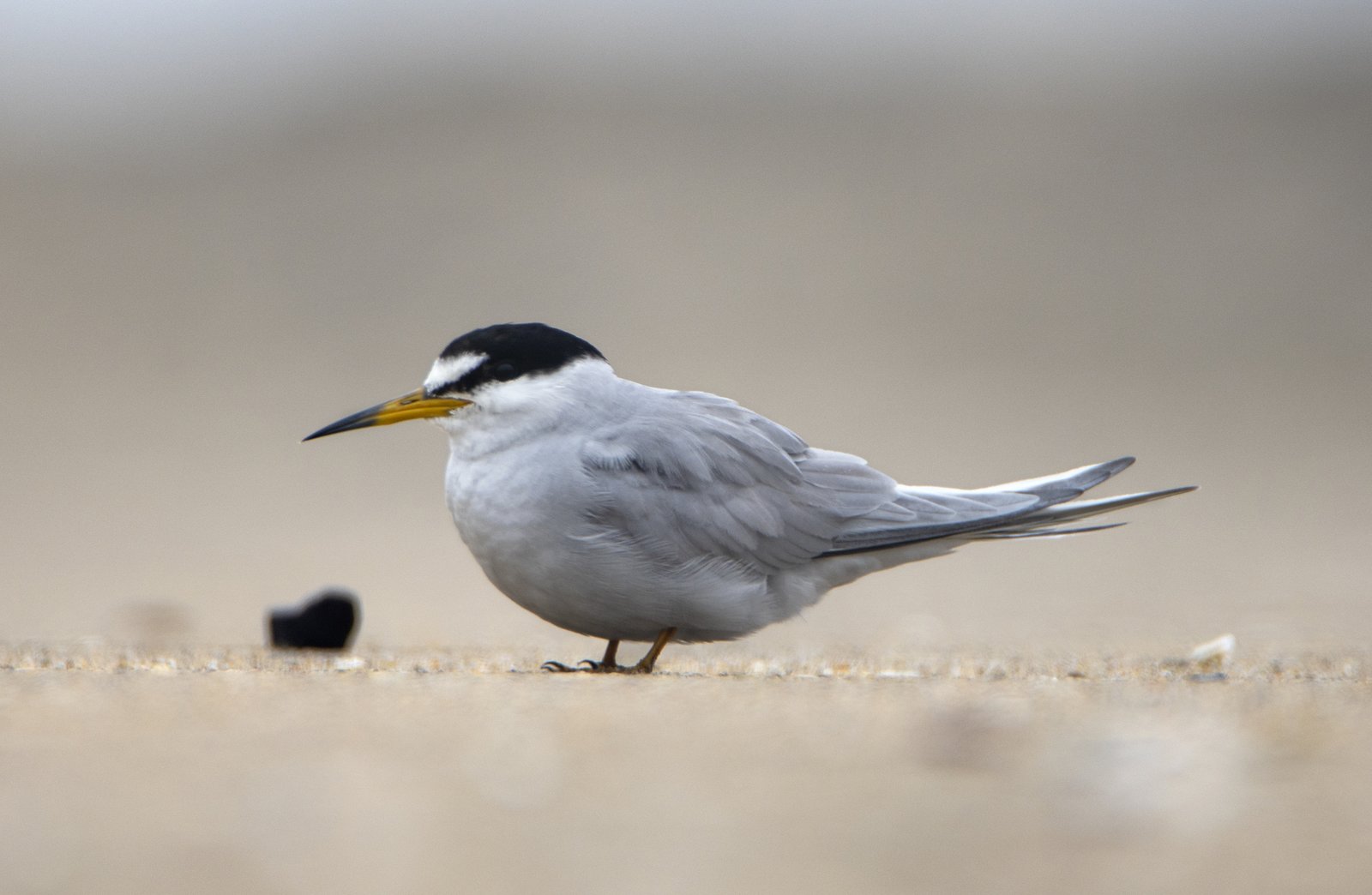
22–24 cm, with narrow, pointed wings and a short, forked tail. In breeding plumage a black cap with a narrow white forehead. The back and wings are grey, and the underparts are also pale grey, not white; only the throat and cheeks are whitish. The outer primaries are dark. The bill is yellow with a black tip, the legs yellow to orange-brown. Outside the breeding season the forehead is whiter and the bill darker. The sexes are alike. Juveniles have brown scaling on the upperparts and a dark bill.
Confusion species
Least Tern Sternula antillarum is whiter below and paler on the back; it occurs as a winter visitor from the north along the coasts of Ecuador and Peru. Yellow-billed Tern Sternula superciliaris has a stouter, all-yellow bill and white underparts and lives along lowland rivers. Larger coastal terns, such as Common Tern Sterna hirundo, are much larger, with a red or black bill.
Habitat
Sandy beaches, surf, estuaries, lagoons and salt pans along the desert coast; it breeds on flat, bare desert plains with gravel or sand, often several kilometres inland. It fishes with short plunge dives in the surf and shallow inshore water for small fish such as anchovy. It breeds singly or in loose groups; the egg lies in a shallow scrape among stones or shells.
Where the bird is most at home, classified by the vegetation units of the Andes and the west coast.


Range and movements
In Peru along almost the entire coast, from Piura to Tacna, with scattered breeding sites. In Ecuador scarce along the south-western coast, mainly around the Gulf of Guayaquil and the Santa Elena peninsula. Absent from Colombia, Bolivia and the Galápagos. Outside the guide area in northern Chile.
- Resident
- dark = core range, pale = thinly spread
How and when to look
Along sandy beaches and at river mouths and lagoons on the Peruvian coast, where birds fish in the surf. Keep your distance from breeding birds on the desert plains and do not enter the breeding areas.
Conservation status
Endangered. The small population is declining through loss and disturbance of breeding areas by coastal development, mining, off-road vehicles and stray dogs; in El Niño years food supply also decreases.
Scientific name
Sternula lorata | (Philippi & Landbeck, 1861)
Philippi & Landbeck described the species in 1861 as Sterna lorata; because it was later moved to another genus, the author and year stand in brackets. The genus Sternula was introduced in 1822 by Boie. The genus name is a diminutive of Sterna, 'tern', so 'little tern'. The specific name comes from Modern Latin loratus, 'of the lores', from Latin lorum, 'strap, bridle'; probably after the black loral stripe. The specimen the first description was based on came from Arica Bay, Chile.