All species › Waders, gulls and terns › Skimmers, noddies, terns and gulls › Least Tern
Least Tern | Sternula antillarum
Amerikaanse dwergstern | Charrancito americano | Trinta-réis-miúdo
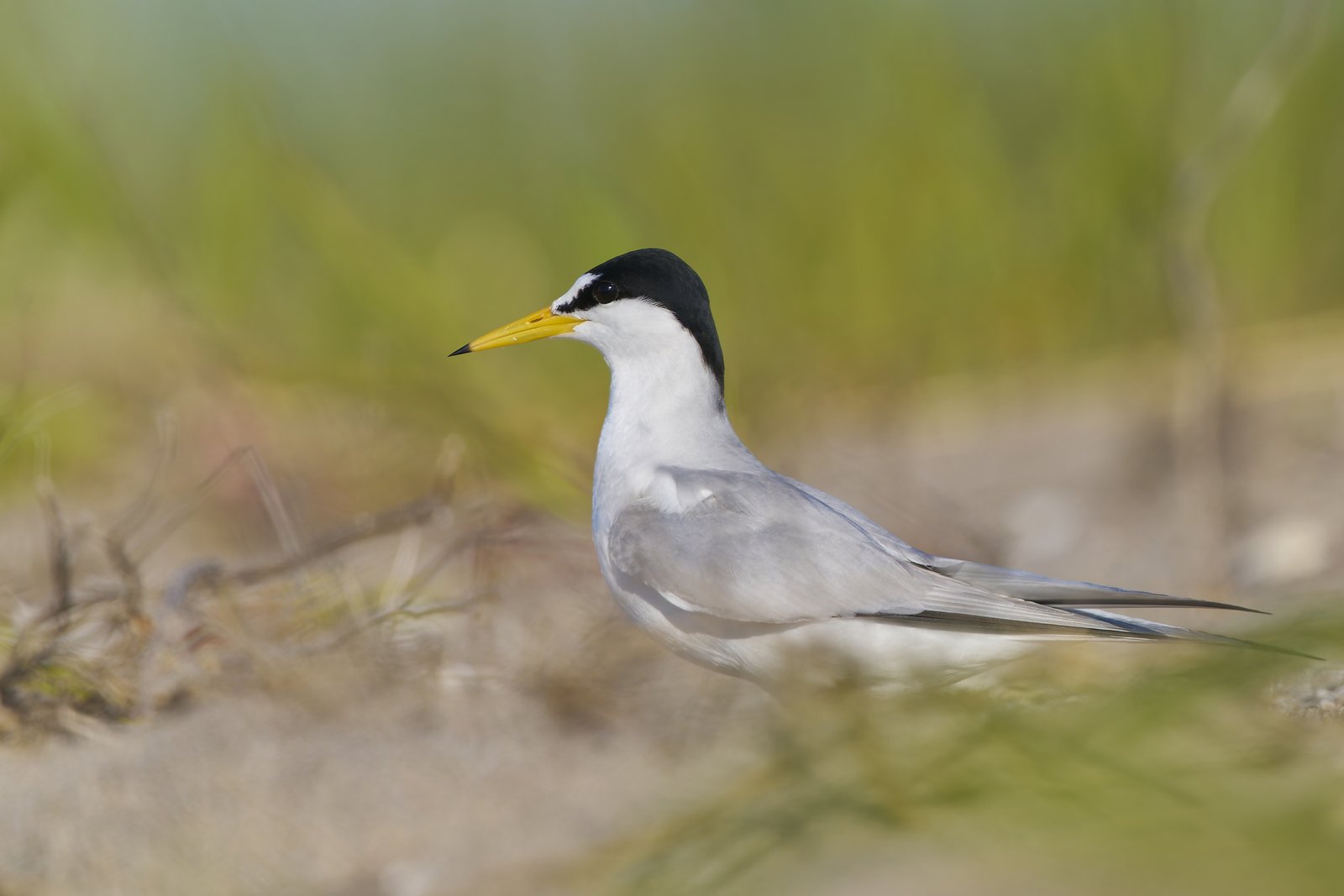
The Least Tern is the smallest tern of North America, a fast, fluttering fisher that often hovers over shallow water and then plunges straight down. It breeds on the coasts and large rivers of North America and the Caribbean and moves to northern South America in winter. In the guide area it belongs mainly to the Caribbean coast of Colombia.
Voice
A high, shrill kit or zree-ik, and a rapid, chattering kidick-kidick, mainly at the colony and in flight.
Recording: Paul Lynch — CC BY-NC-SA 4.0 · xeno-canto
Identification
21–23 cm, a small, slender tern with narrow wings and a short, forked tail. In breeding plumage a black cap with a white triangle on the forehead, a yellow bill with a dark tip and yellow to orange-yellow legs. The upperparts are pale grey, the outer two or three primaries form a dark wedge on the leading edge of the wing, and the underparts are white. In non-breeding plumage a white crown, a black band from eye to nape, a dark bill and a dark carpal bar. The sexes are alike. Juveniles have brown scaling on the upperparts and a dark carpal bar.
Confusion species
Peruvian Tern Sternula lorata of the Pacific coast is equally small, but greyer below, with a longer, thinner bill; their ranges barely overlap. Yellow-billed Tern Sternula superciliaris of lowland rivers has a stouter, all-yellow bill and greenish-yellow legs. Black Tern Chlidonias niger in non-breeding plumage is dark grey above, with a dark patch on the side of the breast and a less deeply forked tail. Common Tern Sterna hirundo is much larger.
Habitat
Sandy beaches, lagoons, estuaries, salt pans and shallow coastal waters, also fish ponds and river mouths. It catches small fish and shrimps by diving into the water after a short hover. It breeds in colonies on bare sand or shell, the nest being a scrape in the ground.
Where the bird is most at home, classified by the vegetation units of the Andes and the west coast.


Range and movements
In Colombia a passage migrant and winter visitor along the Caribbean coast, with small breeding colonies, for example in La Guajira; rare along the Pacific coast. In Ecuador and Peru a rare visitor to the coast. In Bolivia and on the Galápagos absent or at most a vagrant. Breeds from the United States and Mexico to the Caribbean and winters along the coasts of Central America and northern South America.
- Resident
- Summer visitor (c. Apr–Sep)
- Passage (Mar–Apr, Oct–Nov)
- dark = core range, pale = thinly spread
How and when to look
Search the Caribbean coast of Colombia, such as the salt pans of Manaure in La Guajira and the lagoons of the Ciénaga Grande de Santa Marta. Look for small terns hovering over shallow water and flying back and forth with high-pitched calls.
Conservation status
Least Concern. The species is sensitive to disturbance of beach nesting sites and to the loss of bare sand flats; in North America it therefore also nests on flat roofs and dredge-spoil sites.
Scientific name
Sternula antillarum | Lesson, 1847
Lesson described the species in 1847 and placed it straight away in the genus where it still stands. The genus Sternula was introduced in 1822 by Boie. The genus name is a diminutive of Sterna, 'tern', so 'little tern'. The specific name antillarum refers to the Antilles ('of the Antilles'); this is not necessarily the type locality. The specimen the first description was based on came from Guadeloupe.