All species › Waders, gulls and terns › Skimmers, noddies, terns and gulls › Black Skimmer
Black Skimmer | Rynchops niger
Amerikaanse schaarbek | Rayador americano | Talha-mar
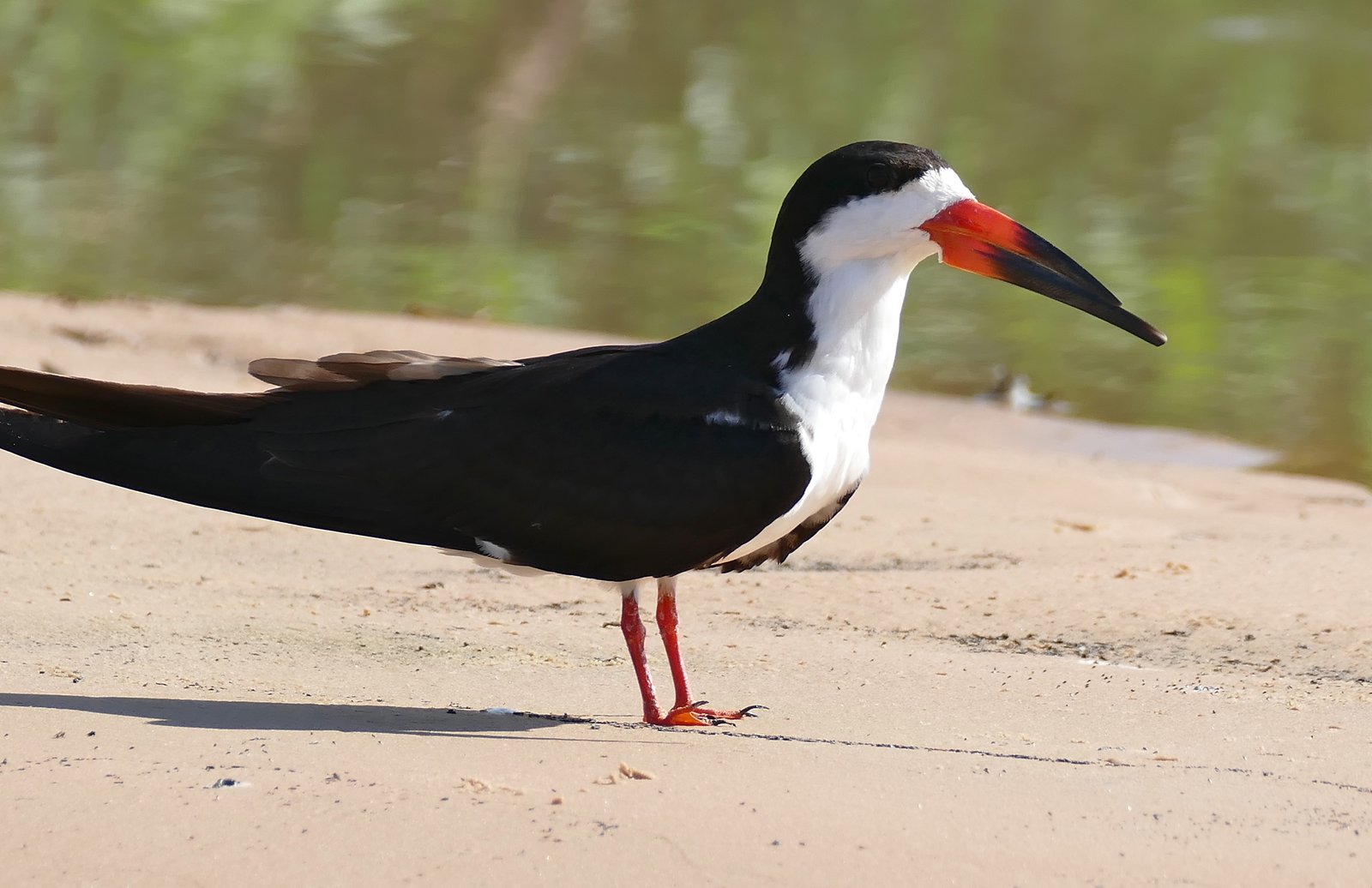
The Black Skimmer is a large black-and-white tern-like bird with a unique bill: the lower mandible is clearly longer than the upper. It fishes by flying low over the water with the lower mandible slicing the surface, snapping the bill shut as soon as it touches a fish. In the guide area it lives both along the large lowland rivers and on the coast.
Voice
Short, nasal, barking calls, kak or kaup, often in series; groups on a sandbar give a continuous yapping, also at night.
Recording: Mauricio Cuellar Ramirez (@Birding.travel) — CC BY-NC-SA 4.0 · xeno-canto
Identification
40–50 cm, with long, narrow wings and a short, slightly forked tail. The bill is red with a black tip and strongly compressed laterally; the lower mandible projects well beyond the upper. The crown, hindneck, back and upperwing are black, the forehead, face and underparts white. The legs are short and red. Males are clearly larger than females, with a longer bill. Outside the breeding season the hindneck is whitish. Juveniles are mottled brown above and have a duller bill. Birds of Amazonia (cinerascens) have a darker tail and less white in the wing than North American birds.
Confusion species
The bill with its long lower mandible rules out any other species. Large-billed Tern Phaetusa simplex also lives along the rivers and also has a black-and-white wing, but has a thick yellow bill, a grey back and large white patches in the upperwing. Large terns such as Royal Tern Thalasseus maximus have a grey back and an ordinary orange bill.
Habitat
Sandbars and banks of large lowland rivers, lakes and oxbows, and on the coast estuaries, lagoons, tidal flats and sandy beaches. It fishes mainly at dusk and at night over calm, shallow water, taking small fish and shrimps. It breeds in colonies, often with terns, on bare sandbars that emerge in the dry season; the nest is a scrape in the sand.
Where the bird is most at home, classified by the vegetation units of the Andes and the west coast.


Range and movements
In Colombia along the Caribbean coast, the Magdalena, the rivers of the llanos and Amazonia, and locally on the Pacific coast. In Ecuador along the coast, especially around the Gulf of Guayaquil, and along the large rivers in the east. In Peru along the coast, mainly in the north, and along the rivers of Amazonia. In Bolivia along the lowland rivers of the north and east. On the Galápagos only as a vagrant. Outside the guide area from the United States to Argentina.
- Resident
- dark = core range, pale = thinly spread
How and when to look
On sandbars of large rivers in the dry season, and on the coast at estuaries and lagoons, where flocks rest on the beach. Fishing birds are best seen in the early morning and at dusk over calm water.
Conservation status
Least Concern. The species is vulnerable to disturbance of breeding colonies on sandbars and beaches, and to altered river levels caused by dams.
Scientific name
Rynchops niger | Linnaeus, 1758
Linnaeus described the species in 1758 and placed it straight away in the genus where it still stands. He introduced the genus Rynchops in that same work. The genus name comes from Greek rhunkhos, 'beak', and ōps, 'face'. The species name comes from Latin niger, 'black'. The specimen the first description was based on came from Coast of South Carolina, United States.