All species › Waders, gulls and terns › Jaegers and skuas › Chilean Skua
Chilean Skua | Stercorarius chilensis
Chileense grote jager | Salteador chileno | Mandrião-chileno
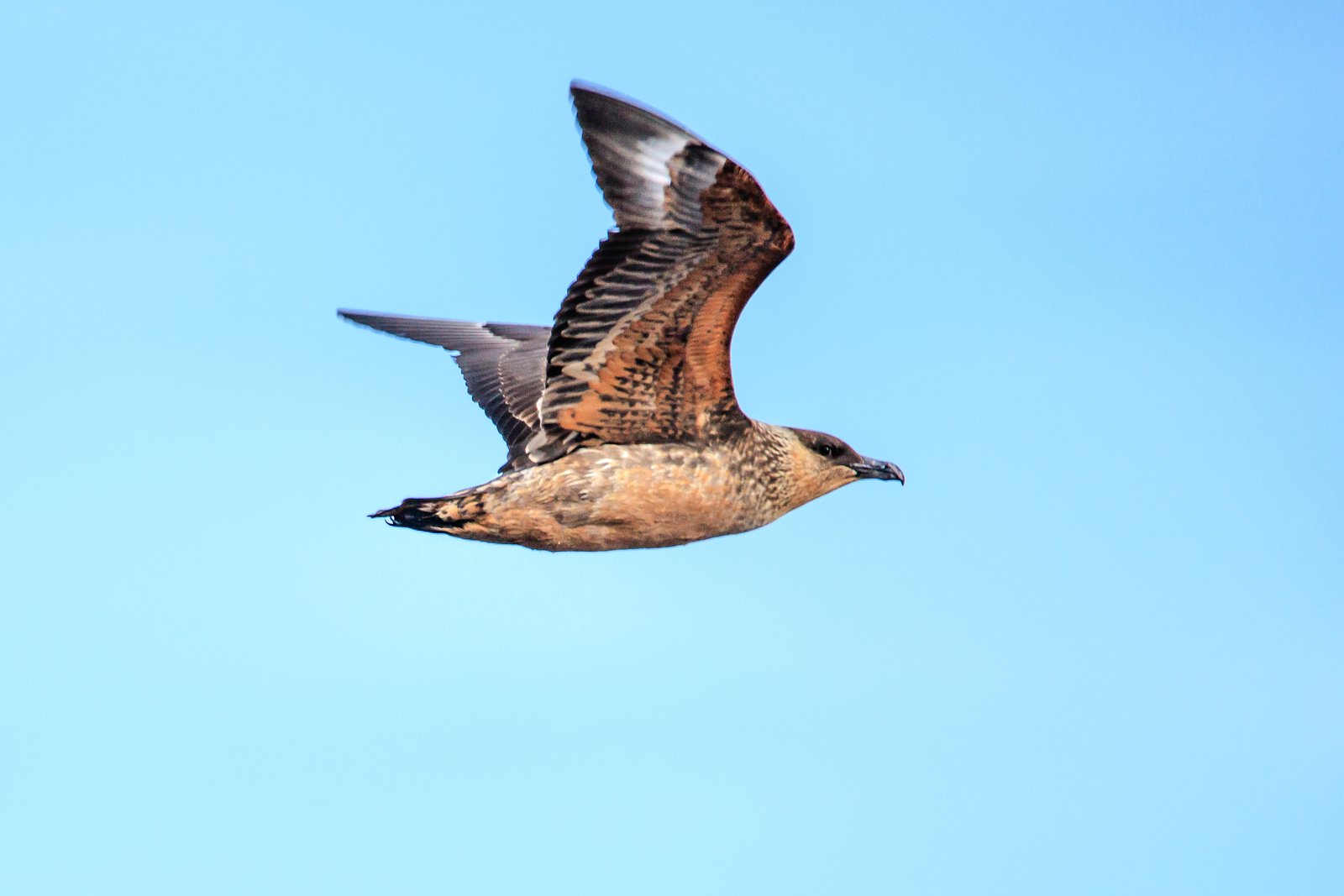
The Chilean Skua is the skua of the west coast of South America. It breeds in colonies along the coasts and on islands of southern Chile and Argentina and after the breeding season moves north along the Humboldt Current as far as Peru. It is the only skua with cinnamon underparts and underwing.
Voice
Usually silent away from the breeding grounds, except in fights over food, when it gives hoarse, grating calls. At colonies loud, laughing series of calls.
Recording: Sebastián Saiter V. — CC BY-NC-SA 4.0 · xeno-canto
Identification
53–58 cm, a heavy, broad-winged skua with a short tail and a strong, hooked bill. The adult has a dark cap contrasting with a paler, cinnamon-brown face and neck, cinnamon to rufous-brown underparts and underwing coverts, and dark brown upperparts with fine pale streaks. The bill is two-toned, with a pale, blue-grey base and a black tip. A large white patch at the base of the primaries, above and below. Juveniles are warmer and plainer cinnamon-brown, with a less distinct cap. The sexes are alike; the female is larger on average.
Confusion species
South Polar Skua Stercorarius maccormicki is smaller and colder greyish brown or buff, without cinnamon, with plain dark underwing coverts and a smaller, dark bill. Brown Skua Stercorarius antarcticus is darker brown with pale spots and lacks the cinnamon underwing; in the guide area at most exceptional. Dark birds and juveniles of Pomarine Jaeger Stercorarius pomarinus are smaller and slimmer, with narrower wings, a longer tail and a smaller white wing patch.
Habitat
Inshore waters and the sea just off the coast, also harbours, fishing villages and beaches; often at fishing boats and at guano islands and seabird colonies, where it steals fish from cormorants, gulls and terns and takes eggs and chicks. It also eats offal and carrion. It does not breed in the guide area; outside it nests on the ground among grass and rocks, often near colonies of penguins and cormorants.
Where the bird is most at home, classified by the vegetation units of the Andes and the west coast.


Range and movements
In Peru a fairly common winter visitor along the whole coast, more numerous in the south; mainly in the austral winter, but some birds stay all year. In Ecuador scarce off the southern coast; only exceptionally reported from the Galápagos. Not in Colombia or Bolivia. Breeds along the coasts of southern Chile and Argentina and moves north along the Pacific to Peru and along the Atlantic to southern Brazil.
- Resident
- Summer visitor (c. Apr–Sep)
- Winter visitor (c. Oct–Mar)
- Passage (Mar–Apr, Oct–Nov)
- dark = core range, pale = thinly spread
How and when to look
Search fishing harbours and guano islands along the coast of Peru, for instance at Pucusana, Paracas or Callao, or join a pelagic trip; especially from May to October birds sit on the water near fishing boats or chase cormorants and gulls.
Conservation status
Least Concern. There is no evidence of a strong decline; the species locally benefits from fishery discards, but is sensitive to changes in fish stocks during El Niño.
Scientific name
Stercorarius chilensis | Bonaparte, 1856
Bonaparte described the species in 1856 and placed it straight away in the genus where it still stands. The genus Stercorarius was introduced in 1760 by Brisson. The genus name is Latin stercorarius, 'of dung' (from stercus, 'dung'); food disgorged by birds chased by skuas was once thought to be excrement. The species name refers to Chile. The specimen the first description was based on came from Chile.